
Germany · taz · · 2h
State of the EU speech: Ursula von der Leyen's plans
Deutsch (original) · Auto-translated to English
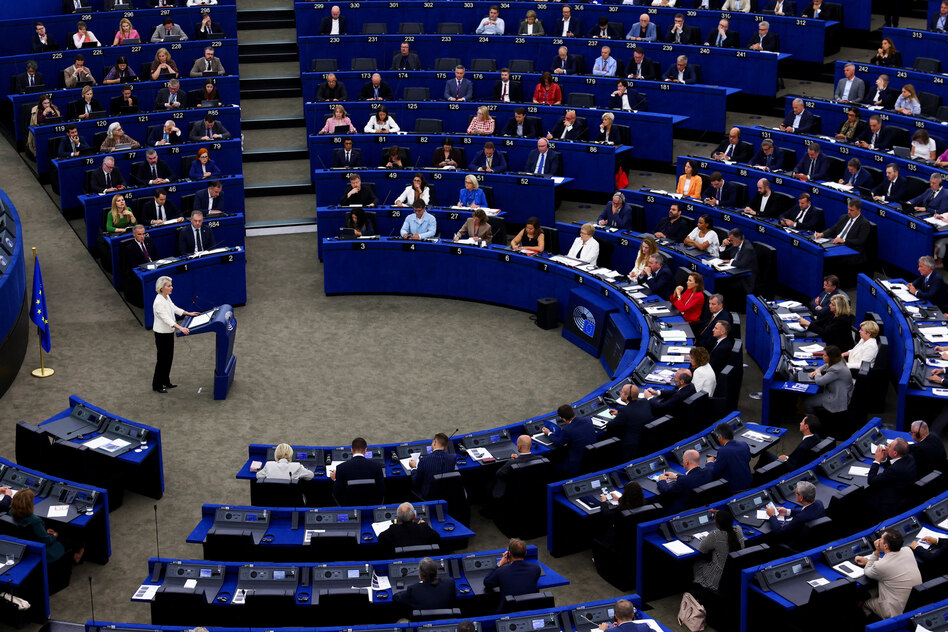
This Wednesday morning, EU Commission President Ursula von der Leyen (CDU) gave her annual “State of the European Union” speech, or SOTEU for short, to the EU Parliament in Strasbourg. For half an hour she presented her plans for Brussels politics for the coming year and beyond - and campaigned for majorities.
For the first time, a head of government was also in the audience: Canadian Prime Minister Mark Carney.
What exactly von der Leyen is planning: an overview.
The EU Commission wants to restrict access to social networks for children under 13 in EU member states. “No social networks under the age of 13. No own user account under the age of 15,” said EU Commission President Ursula von der Leyen.
The major platforms already stipulate a minimum age of 13 in their terms and conditions. However, internet watchdogs in Brussels have repeatedly criticized the fact that this age limit is not being properly enforced. The new requirements are intended to change this - the platforms should be held accountable.
The burden of proof should be reversed, said von der Leyen: "The platforms have to prove that they are safe. It's not about our minors accessing social media. It's about when and to what extent we allow social media access to minors."
According to von der Leyen's idea, young people from the age of 13 will be allowed to do a little more in the future: they should then be able to use “mini accounts” that are set up and supervised by their parents, with limited functions and time restrictions. (dpa)
Von der Leyen wants to pave the way for Canada to associate membership in the European Union. The country could become the first associated member of the EU, she said.
Trump's tariffs and his repeated statements that Canada could become the 51st U.S. state have led Ottawa to seek closer economic and security ties with Europe. Von der Leyen announced that he would build on the existing Ceta free trade agreement and create a more comprehensive “Alliance for the Future”. This should form a common space for prosperity and economic security. (ap)
The EU Commission President wants to create an alarm mechanism that is independent of NATO for security crises below the threshold of an armed attack. “We need a mechanism analogous to Article 4 of the NATO Treaty,” said the top German politician. Von der Leyen also announced a concept for a European Security Council. (dpa)
Von der Leyen has promised Ukraine the most far-reaching support from the European Union for the coming winter since the beginning of the Russian war of aggression. The coming winter will be the hardest for Ukraine since the beginning of the war, said the Commission President. Together with partners, the EU wants to provide humanitarian aid and strengthen Ukraine's electricity and heat supplies.
In addition, Ukrainian air defense should be expanded. US Patriot defense missiles urgently need to be delivered. However, the EU, together with Ukraine, must reduce its dependence on a single supplier. To this end, a cost-effective, modular missile defense system should be developed, with the Ukrainian project “Freyja” at the center. (rtr)
Since the start of the Iran war, the EU has spent an additional 90 billion euros on importing fossil fuels. And this “without getting a single more energy molecule,” said von der Leyen in front of the European Parliament.
The closure of the Strait of Hormuz once again made it painfully clear how expensive Europe's general dependence on imported fossil fuels is. “That’s why we have to do a lot more with our own, affordable and clean energies,” said the head of the EU Commission. “This means we have to become independent.”
For this independence, Europe must be more electrified, said von der Leyen. The Commission's goal is to double the share of electricity by 2040. It is estimated that up to 260 billion euros in fossil import costs will be saved by then. In order for the energy generated to be available, grid connections would have to be accelerated, storage expanded and investments accelerated. (dpa)
After the record heat and forest fires this summer, von der Leyen described climate change as one of the “turning points of our time”. “Europe can, must and will stay on track with its climate goals,” she promised in her speech. In addition, the Commission will present a “European plan for heat waves”.
Von der Leyen called for “better early warning systems and better crisis prevention in the healthcare system”. Europe must curb climate change and adapt at the same time. “This summer must not be repeated.” A total of 660,000 hectares of land burned in the EU and 35,000 people died as a result of the heat. Rivers like the Danube and the Rhine are “disappearing before our eyes”.
Von der Leyen announced that the Commission will identify the most vulnerable areas in Europe in the next few weeks. The authority also wants to create an “Alliance for Climate Insurance”. She pointed out that only around a quarter of catastrophe losses in Europe are covered by private insurance. Too often the state has to help out.
According to scientists, Europe is the continent warming fastest as a result of global climate change. This summer, large parts of Europe, including Germany, were repeatedly hit by extreme heat waves, some of which lasted for a long time. The consequences of this were, among other things, temperature records, violent forest fires, extremely low river levels and numerous heat deaths. (afp)
The Commission wants to consult with leading AI developers on how to limit the risks of this technology. In addition, the EU wants to advance the regulation of the industry in cooperation with like-minded partners such as Canada or Great Britain, announced von der Leyen.
Recently, the debate about the risks of artificial intelligence (AI) has gained momentum. The trigger was warnings from several experts and industry representatives that humanity could lose control of technology and thereby herald its own end. They therefore advocated slowing down the pace of development.
In the past few months, highly developed AI programs – so-called AI agents that carry out tasks largely independently – had repeatedly bypassed security measures and penetrated third-party IT systems. US President Donald Trump still doesn't want to know anything about stricter regulation of the AI industry. Warnings about the dangers of the technology are a “hoax” and play into China’s hands. The USA and the People's Republic are in a race for technological supremacy. To limit AI risks, the government in Beijing relies primarily on government controls and strict requirements for developers. (rtr)
The EU wants to reduce its trade deficit with China using all available means. The imbalance has reached a critical point, said Commission President von der Leyen. Last year, the deficit in goods trade was one billion euros per day. Europe is suffering from deindustrialization as a result of a second “China shock”.
“One thing must be clear: we will use all available instruments to bring our relations back into balance,” said von der Leyen. Words are good, but actions are better. It is in the interest of both sides to find a solution together.
EU leaders called on the Commission in June to make progress in dialogue with China and to ensure the bloc has the necessary tools to defend its interests. EU Trade Commissioner Maros Sefcovic, who is responsible for the negotiations, said he wanted to present concrete results by October.
Von der Leyen also pointed out the EU's dependence on China for many critical raw materials such as rare earths. It is urgently necessary to build up reserves. The EU will set up a new European Agency for Critical Raw Materials to coordinate procurement and storage for the 27 member states. (rtr)
The Commission President declared war on “ultranationalists” and “anti-Europeans”. “They despise our values and they want to destroy our European unity,” she said in her speech. “So let us not just fight against this, but let us fight together for our European idea,” she added.
Von der Leyen also called for action against Russian influence and disinformation. “The names may be different, but the goal is the same,” she clarified. A “battle of narratives” should “weaken trust in Europe”. Real concerns, such as the cost of living, are being used “as weapons to drive a wedge between us,” said the Commission President. (afp)
Read the full story at the source
Source: taz