
Germany taz
Shift to the right in the classroom: When right is the order of the day
At a high school in Saxony it becomes clear how the social shift to the right is increasingly shaping everyday school life. What does that mean for the school? more...
Deutsch (original) ·Auto-translated to English
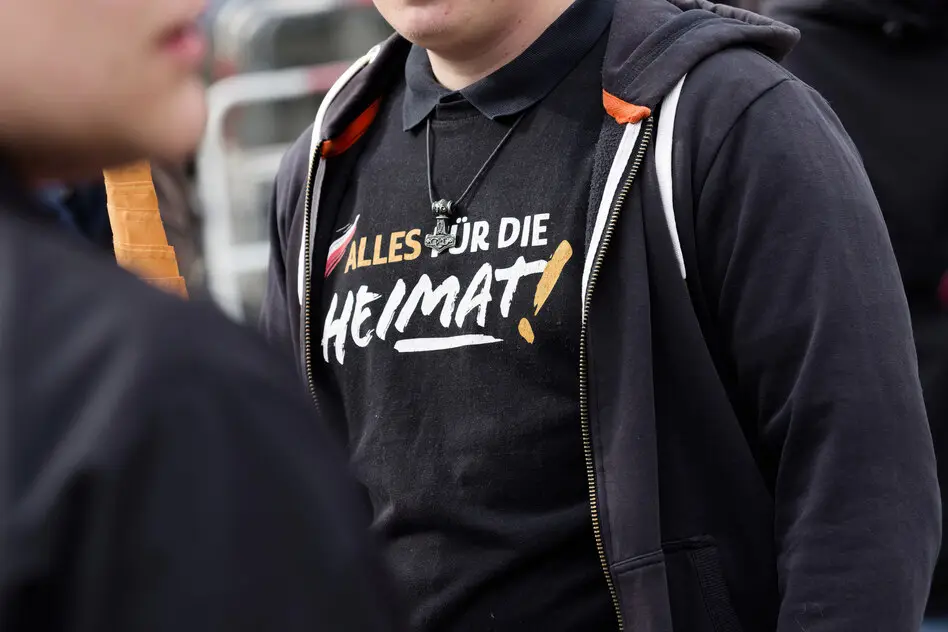
Sharply drawn heads and clothing from brands that are popular in the right-wing extremist scene: “Trendrechts” – this is how the headmaster of a high school in Saxony describes some of his students. In a survey by the magazine Katapult Sachsen, 44 percent of the students surveyed said that the AfD best represents their interests. “Being on the right” is popular among the students, says the headmaster. At least in part. Others no longer dared to stand up against right-wing positions.
The high school is located in a small town in eastern Saxony. As part of a research project with the taz panter foundation, Katapult Sachsen took a closer look at this school with the consent of the school management. The magazine focuses primarily on data research on the subject of right-wing extremism. In this case, the original aim was to find out what concerns young people in rural areas are concerned about. Another question then emerged on site: How does the shift to the right in society as a whole manifest itself in schools?
The right-wing extremist AfD is particularly popular among young people. In Saxony-Anhalt, the AfD got 44 percent of 18 to 24 year olds. In Mecklenburg-Western Pomerania, the party achieved 38 percent among 16 to 24 year olds.
The number of right-wing extremist incidents in Saxon schools is also increasing: according to the Saxon Ministry of Culture, 245 were reported in 2025. Since 2021, the number has almost quadrupled. The ministry lists incidents: swastikas scratched into a school locker, anti-constitutional graffiti on a homework book, a henna tattoo with an 88.
So what does this mean for schools? Katapult wanted to explore this question as an example and KATAPULT developed an online survey that the class teachers conducted with their students in the computer room. 208 children and young people from grades 6 to 10 took part. They answered questions like: Do you like living here? What worries do you have? And: Which party best represents your interests?
When asked about the party, almost half of those surveyed said the AfD. Based on this, the magazine researched further and held discussions with school management, teachers and young people. But as the publication got closer and the school administration was supposed to release the quotes, they withdrew their consent.
She feared that her school could be placed in a “right-wing corner”. Even when a first version of the article was presented to the headmaster, he stuck to his decision. The text assumes that the student body has a “right-wing ideology” and is not open to values. Although the survey results showed political proximity to the AfD, you should not automatically assume that this represents a solid right-wing extremist stance: many are just followers.
We have nevertheless decided to report on the research because the questions raised go beyond the specific case. To protect the school and the people involved, we have anonymized all information that allows us to draw conclusions about them.
An incident at school shows how great the tension is: a student gave the Hitler salute in class. The school newspaper wanted to report critically about it. It wasn't easy. The authors first considered publishing the article anonymously - for fear of rejection and hatred if they openly positioned themselves against the right. This fear was well-founded: After publication, the authors had to justify their political stance. Classmates called them liars.
And the teachers? One student says it bothers him when teachers openly position themselves on the left. In doing so, the student is using a narrative that is popular with the AfD: teachers have to subordinate themselves to a supposed requirement of neutrality. For many teachers, this intimidation means that trust in them and their competence decreases. Teachers are particularly unsettled in the East, as the German School Barometer 2026 shows: 21 percent of the teachers surveyed in the East feel unsettled by a supposed neutrality requirement, while in the West the figure is 15 percent.
Cases like that of the teacher Max Heckel from Saxony-Anhalt contribute to the uncertainty. When students asked, he explained why he did not vote for the AfD. Because this was not neutral, he was warned by the state education authority. Heckel sued the labor court. But before the hearing, the school district withdrew. For now, no court will decide whether Heckel was in the right.
Perhaps the rather reserved answer from a teacher at the Saxon high school can be understood against this background. She suspects that the desire for order could be one reason why her students are leaning towards the AfD. Constantly changing teachers and timetables caused uncertainty, says the teacher. But does a lack of structure lead to Hitler salutes?
Karim Fereidooni, Professor of Didactics of Social Science Education at the Ruhr University Bochum, says that the most important thing is not to ignore problematic behavior among students: “Because that means, conversely, for the students: Either the teacher is not interested in me or he agrees.” The scientist has been concerned with racism and discrimination in the German education system for many years.
In order to change something in the long term, the main focus must be on the training of teachers. “You can study to become a teacher for five years, complete your traineeship for one and a half or two years and have never taken a seminar on the subject of anti-Semitism or racism,” says Fereidooni. He calls for democratic competence as an interdisciplinary concept.
Fereidooni sees school management and teachers in particular as having a responsibility to take a stand. “For many young people, school is the only place in their lives where they are confronted with opposing opinions and where they learn about the democratic rules of our society,” he says. “If schools and school representatives duck away, where are young people supposed to learn these rules?” The didactics professor observes that schools are more afraid of a negative image than of the actual problem.
There is often a lack of resources to respond appropriately to problems, says the headmaster of the Saxon high school. If there is a swastika on a table, there is simply no money to replace it immediately. At the same time, attempts are made to address political conflicts in class with the help of the school social worker. Nevertheless: When resisting the right, you reach your limits because you now have to defend yourself against 40 percent.
The Saxon Ministry of Culture’s “Action Plan Against Extremism” is now trying to counteract this. It is intended to help schools respond to extremist incidents in an educationally appropriate and legally secure manner. The concept lists 15 concrete measures: Among other things, teachers should be better trained in dealing with extremism, parents should be informed more specifically and schools should be supported with clear house rules and protection concepts.
The plan sounds good, says the school principal. But in most cases it remains unclear who is responsible for right-wing extremist graffiti, for example. If you file a complaint against an unknown person, nothing will happen - from an educational perspective, this lack of consequences is a big problem.
In the survey, many of the students expressed the feeling that politics did not represent their interests - for example when it came to the issue of compulsory military service. But describing the shift to the right in the classroom as just a trend and as a protest against the feeling of not being heard with problems and concerns - teacher Max Heckel from Saxony-Anhalt warns against this. This trivializes the problem: “After all, fascism doesn’t need a majority that votes for it, but rather one that remains silent about it.”
The text was created as part of the taz panter foundation’s “local and constructive” young talent project. Five groups nationwide have developed dialogue formats in the local area and have received micro-funding for this. Further information can be found here.