
Germany taz
Farmer Mental Health: When Farmers Consider Suicide
Björn Scherhorn wanted to take his own life - like many other farmers. There is often economic pressure behind this. What can help those affected? more...
Deutsch (original) ·Auto-translated to English
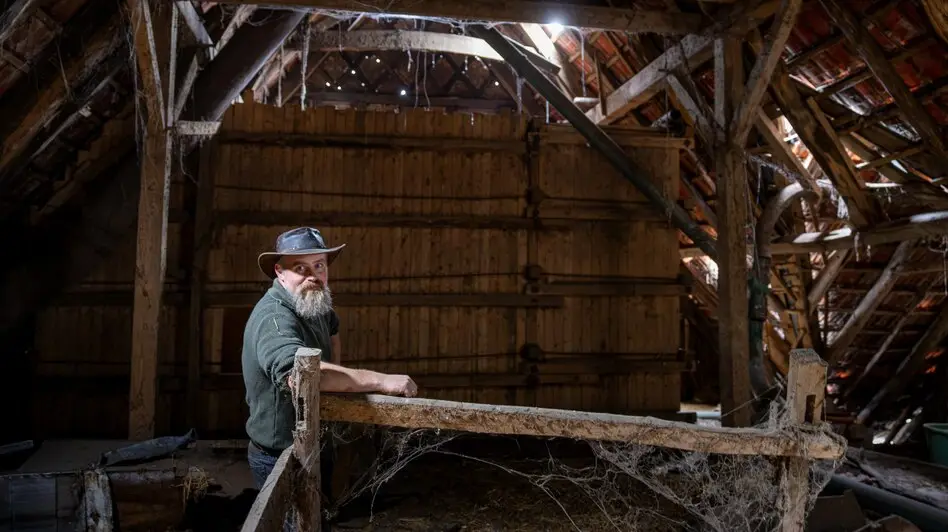
When everything became too much, Björn Scherhorn no longer wanted to live. He climbed into the attic of his old farmhouse in the Lower Saxony village of Berge to prepare for his suicide. Nine years later, the farmer is back in this place. It is dark and smells musty, and there are remains of straw under his rubber boots. Scherhorn talks about his desperation at the time. “I wanted to execute myself,” he says.
It has been suspected for years that farmers take their own lives more often than people from other professional groups. Now, for the first time, there are numbers that could confirm this. For a study recently published in the Federal Health Gazette, the team led by prevention scientist Christian Hetzel evaluated Bavaria's police crime statistics. The result: Even under conservative assumptions, from 2017 to 2024 there were at least 50 percent more suicides per 100,000 people in agriculture, forestry or fishing than in the rest of the population. According to the publication, the suicide rate among 18- to 59-year-old men in these professional groups is more than three times higher. In total, 463 people from “green professions” committed suicide within eight years – an average of around one per week.
It must be said that Bavaria is currently the only federal state that breaks down suicides according to the main activity of those affected. However, it can be assumed that the suicide rate among farmers is also above average in the other federal states. This has already been proven for other countries. In France, for example, in 2008 scientists found that male farmers had a 28 percent higher risk of suicide than the general public.
So the question is urgent: What drives people to go so far in agriculture? In the industry that feeds us all and has a significant impact on the environment. And how can such suicides be prevented?
Scherhorn is a 1.83 meter tall, robustly built man. He has a bushy beard, a large tattoo in a Gothic script on his neck and a dark brown, wide-brimmed leather Western-style hat. His voice is strong. Farmers wanted to show themselves as “a whole guy,” to be “really tough guys,” says Scherhorn. But back in 2017, in his crisis, he was “on his knees”.
“I leased the business from my dad in 2004,” says Scherhorn. His herd produced an average of 11,700 liters of milk per cow each year - a high figure. He fattened pigs and bulls. He also raised female young cattle for sale and grew crops. “Overall, in terms of price, it was never really enough.” His economic situation was “precarious”. He was constantly afraid of bankruptcy: “I always took out a personal loan from my parents or from the bank.” Several times he received so little for the milk that the proceeds didn't even cover his costs. “And then if a machine breaks or something like that, then of course it becomes funny.”
There was also a generational conflict. His father prevented him from investing more and getting into debt, says Scherhorn. "And every time I saw him, I made sure I got away. We really had beef." His father was “sometimes very hard” on him. Even though he worked 11 to 14 hours every day, with no weekends off and no vacation.
Scherhorn was under pressure that is typical for farmers: Conventional entrepreneurs would analyze the market before setting up a company, calculate their costs and then calculate the price, he explains. "But you don't have that as a farmer. You start on the farm because you see the whole thing as a family." His ancestors have had the farm in the Osnabrück district for more than 700 years. The mighty half-timbered house was built in 1789, the year of the French Revolution. The names of Scherhorn's ancestors are written on the door arch to the hall and on the facade there are sayings such as "Thus says the Lord God: Bless the pious their goods". You don't give up something like that lightly. Like many farmers with a similar heritage, Scherhorn was clear: “I never wanted to be the last generation here on the farm.”
This inner commitment can lead to a dead end that you may not be able to get out of: “If you have a shitty job and it just doesn't stop, oh my goodness, then you change companies or move to another city,” says Scherhorn. "I live where I work. This is my home." Many farmers see themselves tied to their farm and therefore to their economic problems.
During his time of crisis, Scherhorn remembers, he lost a lot of weight and repeatedly suffered from pain. “I was just a line in the landscape.” At one point his arm was paralyzed, then he developed an “evil eye twitch.” And there was always this thought: "Shit, I don't know how this is going to continue. You can't influence the price. You can try even more overexploitation." Even more medication for the cows, even more artificial fertilizer, even more pesticides. But at some point it was no longer possible to get more out of its soil.
His economic situation was critical - and then so was his personal one: "My relationship back then went south," says Scherhorn. “Koppheister go”, which means something like “to break” in Northern German. His ex-partner moved to Schleswig-Holstein with their three-year-old son. "Back then I had two milking times a day. I would never have been able to go between them," says Scherhorn. The fact that his own child could no longer be with him was difficult to bear. Especially for a father who says, “My children are my everything.” But the separation from his son “actually just came as a straw that broke the camel’s back.”
“Suicidal behavior is associated with various issues, primarily with threats to the company’s existence,” write Hetzel and other scientists in another study. To do this, they surveyed around 440 psychosocial professionals who provide advice in the “green industry”. A study by the federally owned Thünen Institute for Agricultural Research also found a significant connection between burnout among female farmers and concern for the business and the industry in general. This analysis focused exclusively on women.
Anyone who wants to eliminate the causes of the increased suicide rate must therefore clarify: Why do so many farmers have such great economic worries that they are reaching their psychological limits?
Do you suspect you are suffering from depression? Or do you even have suicidal thoughts? Other people can help you. You can contact family members, friends and acquaintances. You can also get professional or volunteer help – even anonymously. Please seek help, you are not alone. Below you will find some contact points.
Acute suicidal thoughts: Call 911 if you have acute suicidal thoughts. If you would like to be treated immediately, you can find help at the psychiatric clinic or the crisis service.
Depression and depressed mood: Get help through psychotherapy. The German Depression Aid Foundation can also offer you help and information on dealing with depression.
Sorrow: Are you sad and want someone to talk to? Do you want to get rid of worries and want someone to listen to you? The telephone counseling service is anonymous, free of charge and staffed around the clock. The telephone numbers are 116 123 or 0800 111 0 111 or 0800 111 0 222. You can also take advantage of the written offer via chat or email.
Online advice for suicidal thoughts: MANO Suicide Prevention offers anonymous online advice. If you are over 26 years old, you can register on the website. If you are younger, you can write a help email here.
Offer of help for children, young people and parents: The number against grief has set itself the goal of helping children, young people and parents. Children can get support there on 116 111, parents on 0800 111 0 550, and you can also find help in Russian and Ukrainian at the Helpline Ukraine on 0800 500 225 0.
Offer of help for Muslims: You can reach the volunteers of the Muslim pastoral care hotline anonymously and confidentially on 030 443 509 821.
You can search for other pages and numbers that meet your needs at the German Society for Suicide Prevention.
In Scherhorn's eyes, prices for farmers' products that are too low are to blame. For him it's like this: The farmers don't get enough money for their milk, meat and grain. That's why they have to work more and more and have no time to rest or get help. If private strokes of fate come into play, some people can no longer do it. “It’s just always the issue of prices,” says Scherhorn. He would like to see retailers and processors such as dairies and slaughterhouses pay farmers more.
Alfons Balmann is director of the Leibniz Institute for Agricultural Development in Halle an der Saale and one of the best-known experts on structural change in agriculture. This is what experts call the development that the number of agricultural companies has been falling since around 1950. According to the Federal Statistical Office, the number of businesses fell by around 15 percent to 255,000 between 2010 and 2024. Recently, the death of farms in Germany has slowed down significantly. But small to medium-sized agricultural companies in particular are still closing. Their land is usually taken over by larger ones.
Balmann's institute is located in a former officers' mess from the 1930s. The foyer is lined with gray natural stone slabs, the doors are framed with black and white marble. Scherhorn's farm doesn't just seem far away geographically. Balmann himself grew up on a farm in Emsland, but the now 63-year-old does not shy away from clearly criticizing the industry.
“When companies are unprofitable, they come under pressure,” says Balmann. “But better prices or subsidies will not solve this problem.” Nor would it be enough to weaken the rules for environmental and animal protection in order to reduce production costs. Even then, many farms would not be able to operate successfully in the long term, according to the agricultural economist.
Balmann gets his iPad, puts it on the conference table in his office and opens a table: “Success differences in management” is in the title line. He explains that there are data from full-time dairy farmers, differentiated into the upper, middle and lower thirds. “The most successful third earned 90,000 euros per worker in the 2024/25 financial year, while the bottom third only earned 30,000 euros.”
This was “a paradise year” because milk prices were extremely high. But even then, the profit for the bottom third only corresponded to a theoretical hourly wage of an average of 15 euros gross, assuming 50 working weeks with 40 hours each. This is only a little more than the legal minimum wage and very little compared to the assets invested and the responsibility that farmers have as food business operators for the health of consumers and their animals.
Balmann swipes a finger across the screen and calls up the same table for the 2023/24 financial year. At that time, the lower third of dairy farmers only earned an hourly wage of 5 euros. “This is more of a normal year,” he says.
The same pattern can always be seen among pig farmers and arable farmers: “The differences in success are simply huge between the top and bottom third.” Even in a year with normal to low milk prices, the good dairy farms earned an average wage of at least 35 euros per hour. This is above the average gross hourly earnings of all employees in Germany, which, according to current figures from the Federal Statistical Office, is a little less than 27 euros.
"We have very successful companies on the one hand and less successful companies on the other. This is usually due to how they are managed," concludes Balmann. There are farms “that are not really able to operate successfully in the long term, even with changed policies and good prices.” That means: Many of these companies are in trouble because their managers don't manage them well.
What size, how many hectares of land, how many animals - that doesn't play such an important role, he says. Larger farms are on average somewhat more profitable. “You can only make really good money once you reach a certain size.” With a milking robot, for example, production costs can often only be reduced from 60 cows onwards; Otherwise the high purchase price would not be amortized by the working time saved. Nevertheless, he considers the differences in profitability between large and small companies to be small. In fact, his table for 2023/24 shows that the third with the highest profit only has 2 more cows than the third with the lowest: 69 instead of 67 animals.
What is more relevant than the size of the farm is that some farmers are more skilled at selling their products, says Balmann. In most years, an average organic farm has performed better in terms of income than a conventional one. However, this is less due to the fact that organic food is more expensive. Rather, they are often people who deal intensively with marketing and network with buyers in their region who reliably pay them good prices.
According to Balmann, another success factor for dairy farms is knowing how to keep the herd healthy so that it produces as much milk as possible. The health status of the herds varies considerably from farm to farm. What is crucial, however, is that operations managers are “entrepreneurial types”. In other words, “managers” who constantly analyze the market and react to it. This also includes questioning yourself and your production methods, asking around and measuring yourself against others.
“Every farmer is the master of his own fortune,” says Balmann. It is similar to other sectors of the economy, “where some are up to the challenges and others are not”. Only, unlike other industries, in agriculture those who don't make it don't quit so easily.
It's easy to say from a distance. At the same time, and this is also true, everyone is born into their circumstances and can do nothing about their initial situation.
"We have this topic: tradition. The argument is often made: You don't want to be the one who turns off the light," says Balmann. There are often “social constraints” to persevere. "What should the neighbors think? What does the family say?" These are the questions that obscure the purely economic view.
In addition, it is often more difficult to close a business in a village than in a more anonymous city. "Appearances often have a high value. And if some people are overwhelmed with their business, then appearances may be maintained for much longer than is wise."
Balmann points out that many farmers cannot simply sell their farm because they would then suddenly have to pay off their co-heirs. According to special rules for the industry, the farm heir usually takes over the business at a comparatively low value, “the heirs who leave only get peanuts”. But if the farmer does sell, additional payments often have to be made to the relatives. This is particularly difficult in the case of financial difficulties, because after taxes have been deducted and paid out to the co-heirs, only a fraction of the proceeds may remain to pay off the debts. “This may also contribute to the fact that people react too late.”
According to Balmann, the tradition sometimes leads to people who are not suitable for this becoming managers. Scientists or journalists would choose their professions. But: "Many farmers slip into this. They don't become farmers because they feel called to it, but you become a farmer when you inherit a farm." Even within the family, sometimes the person with the greatest management skills doesn't take over: the son is usually supposed to take over, even if the daughter is more competent.
You can imagine it well: the eldest son has to maintain the centuries-old family tradition, invests hundreds of thousands, perhaps millions, on credit, realizes that he cannot pay them back, but knows no way out.
Balmann says he also feels sorry for the farmers who are in trouble. But the extensive subsidies for the industry would only make things worse. EU payments for agricultural land or for discounts on energy tax for agricultural diesel and inheritance tax cost society more than 10 billion euros per year. The agricultural economist calls these privileges “sweet poison.” Because they would help actually unprofitable companies to continue before they eventually give up. “Anyone who subsidizes need in agriculture will have even more need tomorrow,” he warns. That is why he is in favor of the European Union gradually reducing area payments and other benefits.
Instead of demanding more and more aid money, farmers' associations and politicians should rather address the actual problem that not all farm managers are up to their task - and then give these people a way out that makes them happier, Balmann demands: "We need a different framing that makes it easier for farmers to give up loss-making businesses."
A good new approach could be to make socio-economic advice free of charge in the future. The Lower Saxony Chamber of Agriculture, for example, not only helps with generational conflicts, but also with economic crises. Another approach could be to sell more products directly to consumers to save on retail margin. Or just run the farm as a sideline. If necessary, the chamber also advises on the “orderly withdrawal from agriculture”.
But the German Farmers' Association and its member organizations are ignoring the management problem, complains Balmann. “The farmers’ association is keeping this quiet,” he says. It is easier to blame the poor situation of some companies on politics or the markets in order to negotiate new subsidies.
The lobby organization rejects such allegations. “Our companies are run by well-trained entrepreneurs,” writes an association spokeswoman for the taz. The official blames “increasing political requirements and costs combined with a lack of revenue” for the misery of some companies. In the “current situation” sustainable and cost-covering production of “many” agricultural products is simply impossible.
Stefan Adelsberger also fights against the constraints that drive farmers to despair. Together with a colleague, he runs the “With us in balance” telecenter of the Social Insurance for Agriculture, Forestry and Horticulture (SVLFG), where most farmers are legally insured. Adelsberger's colleagues advise insured people on offers of help for mental stress. He is also responsible for the crisis hotline, which SVLFG members can call around the clock and speak to trained psychologists at short notice. “We regularly have women and men on the phone who are crying and completely desperate,” he reports.
Church sponsors, chambers of agriculture and state farmers' associations also offer regional advice on mental health problems. “There are enough offers of help,” says the trained forester. Some counselors would like more training on suicide, which is now in the works. "However, our biggest task is reaching people. Mental health is more of a taboo topic in agriculture than in other industries." Many farmers - most of them men - are told that they have to deal with their problems alone. It is often said: “The business comes first.” Concerned wives often called, rather than the victims themselves.
The SVLFG therefore advertises its offers of help with headlines such as “Even the strongest need help sometimes”. She addresses psychological problems and counseling options in her lectures at farmers' meetings or in press work. One message is: “Getting help is a strength.”
According to SVLFG data, an average of more than 220 people called the crisis hotline per month from March to August. “As early as August 2026, the number of calls exceeded the total calls from 2025,” writes the insurance company. These are the highest number of calls since the crisis hotline was introduced in June 2018.
The insurance also offers telephone coaching for individual cases to maintain and strengthen mental health. The inhibition threshold is lower than if you have to drive to a practice. Nobody in the village sees this. And the access route, which can be long, especially in the countryside, is eliminated.
At some point during his time of crisis, Björn Scherhorn spoke to his family doctor about his psychological problems. That's better than no conversation at all. Today he tells how he found a way out of his despair: When he was about to end his life, he saw a beam in the attic. His ancestors would have laboriously sawed and carved it by hand. "You know how you feel ashamed for giving in? It's such a stark feeling of shame towards all your ancestors," he says. In the end he thought about his possible suicide: "That's just bad shit, you can't do that."
Then a small swallow flew through the attic. “I’ve always been crazy about swallows,” says Scherhorn. "Yes, an animal like that brought me back down there. It was nice of her."
He later met his wife Johanna. He calls her the “best half you could possibly have” and seems very happy. They now have six children. Johanna also works with us. In addition, the father-in-law helps in a half-time position. Scherhorn is no longer on his own as he was during his crisis.
He had recently started converting the farm from conventional to organic farming. Now he no longer sprays chemical-synthetic pesticides, which can produce larger harvests but which contribute to the extinction of more and more plant and animal species. He also avoids using artificial fertilizers and focuses on more diversity in the field. The cows are now allowed to go out to pasture and not just live in the stable, even if they then produce less milk.
The change was difficult because, according to regulations, Scherhorn had to produce under organic conditions for years, but was not yet receiving the higher organic prices. But he went through with it. “The change was a fundamentally rebellious idea of mine,” says the farmer. He wanted to do business in a more environmentally and animal-friendly way. "We have said goodbye to the idea that more production automatically means more success. Today we ask ourselves how we can manage our resources in such a way that the farm, nature and people alike have a future."
Scherhorn developed the type of management skills and marketing sense that agricultural economist Balmann believes is necessary in agriculture. And the farmer is doing better economically today because organic prices and organic subsidies are higher than conventional ones - even if he still thinks they are low. But Scherhorn is also selling more and more meat and cheese directly to consumers. He is increasingly marketing his products himself. He is even planning to set up his own cheese factory. For example, he advertises on Instagram, where he now has more than 70,000 followers. This means he can keep the part of the price that dealers would otherwise collect. Scherhorn now enjoys wearing T-shirts that he commissioned himself. At the front it says “Organic rocks”, at the back it says “Live by example instead of giving in”.
Two of his sons are there as he mucks out the pigsty with a farm loader. They listen as he talks about farming, the fear of being the last family member on the farm. Then eight-year-old Haldor asks: “Dad, was this the largest farm in the area?” And: “What should go in the empty attic?” These farm children also seem to perceive the farm as something that has grown historically - and they think about how it should continue.
But Scherhorn doesn't want to put any pressure on them to continue farming. He doesn't want to pass on this burden that he himself has felt for a long time to his children. "If our daughter thinks she has to do an art studio here, then she'll do an art studio. I don't care," he says. “The main thing is that the children are happy.”