
Germany taz
Manslaughter trial: flags still in the basement
A 51-year-old kills his neighbor and is convicted. Is the motive racism? His imperial flag plays no role in the process. more...
Deutsch (original) ·Auto-translated to English
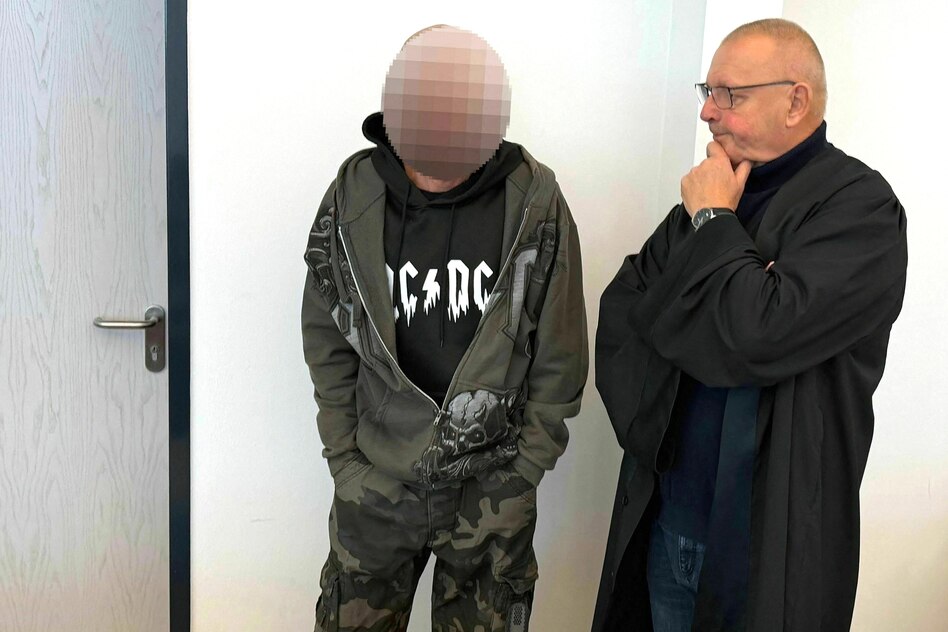
On Tuesday, the Neubrandenburg regional court sentenced a 51-year-old defendant to six and a half years in prison for manslaughter. In April 2026, the unemployed craftsman killed his Serbian neighbor, twenty years his junior, with a crossbow shot in the neck. With the verdict, the jury chamber of the regional court remained below the sentence of eight and a half years demanded by the public prosecutor.
Why did 32-year-old Milos P. have to bleed to death on the meadow in front of the defendant's property? For the court, in a remote district of Neustrelitz (Mecklenburg-Western Pomerania), between idyllic sheep pastures and a popular swimming lake, a dispute between neighbors ended fatally after mutual provocations and threats of violence.
Since August, the chamber had spent several days of negotiations reconstructing the course of the crime and its history using voice messages, witness statements and reports. However, neither the public prosecutor nor the presiding judge were interested in one striking detail: a German flag with the AfD logo and a black, white and red Reich flag that the investigators had photographed in the defendant's workshop.
Instead, the court largely followed the version of the defendant, who repeatedly emphasized in court that he had actually arranged to have dinner with Milos P. and other acquaintances on the evening of the crime on April 18th and was friends with him.
The two craftsmen got to know each other through work, said Christian P. He also got the younger man from Serbia an apartment in the house next door in the small town of Prälank near Neustrelitz. Even though there were frequent arguments in which Milos P. threatened him with violence and once attacked him with a hammer: "We were friends, somehow," said Christian P. and assured: "I didn't want to kill him."
Both Milos P. and he himself drank a lot of alcohol on the day of the crime, and Milos P. then threatened him via WhatsApp for no reason. Christian P. responded to his message, “Don’t mess with me. I’ll kill you immediately so you know,” with an unmistakable voice message: “I’m coming down now and killing you.”
It is undisputed that Christian P. took his crossbow with a 40 centimeter long metal bolt out of the workshop and inserted the bolt. Milos P. met him in a meadow after crossing a low fence between the properties. Why did the defendant aim the crossbow at the neck of the man who was at least 2 meters away and pull the trigger?
Christian P.'s assurances that he feared an attack and only fired in defense did not completely convince the court. It was based on a conditional intent to kill. Milos P. was unarmed, said the presiding judge. Christian P. could have defended himself against a feared attack differently. In addition, the defendant did not warn about the shot. He also did not act while intoxicated: an expert found that Christian P., who was used to alcohol, was guilty at the time of the crime with a blood alcohol level of 2.0 per mille measured after the crime.
While Milos P. bled to death on the meadow, Christian P. covered him with a white sheet. He then called his lawyer and only then called the police via the emergency number. When the recording of the emergency call was played in the courtroom, sheep bleating and birdsong could be heard in the background, while Christian P. told a young officer in a calm, composed voice: "I shot someone with my crossbow. I'm sorry. I didn't mean to, I hit him right in the neck. Carotid artery. He was dead then."
The murdered man's mother and sister, who live in Serbia, were not represented as co-plaintiffs in the trial. This allowed the defendant to portray the 32-year-old as violent and threatening without being contradicted. Without co-plaintiff representation, contradictions remained open. Why did the defendant, who so persistently asserted his peacefulness, take violent action against a woman in May 2022 and be sentenced to a fine of 1,200 euros for bodily harm? And why had the district weapons authority banned him from owning weapons and ammunition in 2014?
Nobody in the regional court wanted to find out details from Christian P. about his entries in the Federal Central Register. Nobody there wanted to know whether he shared the racism and xenophobic agenda of the AfD, whose flag hung in his workshop. “What’s the problem with the AfD?” a lay judge asks back as he waits in the hallway outside the courtroom. He didn't even notice the AfD flag.
In a study on the application of Section 46 Paragraph 2 of the Criminal Code, according to which, among other things, racist motives must be taken into account when sentencing, the Criminological Research Institute of Lower Saxony found: "The interviews with experts from the police, public prosecutor's office and courts revealed that there are some uncertainties in proving prejudice motives." But if you don't ask any questions at all, you don't have to deal with evidence of prejudice. The verdict against Christian P. is not yet final.