
Germany taz
Trial against former director Schlesinger: A small revolution
Patricia Schlesinger has exploited the RBB's gaps like no one else before her. And thus inadvertently brought about reforms. more...
Deutsch (original) ·Auto-translated to English
In the beginning there was the bycatch: More than four years ago, Springer's online service Business Insider had actually been researching personnel changes at Messe Berlin and had stumbled across a lavish consulting contract between former Spiegel journalist Gerhard Spörl and the state's own trade fair company.
This came about with the blessing of Wolf-Dieter Wolf, head of the trade fair supervisory board. And because Wolf was also chairman of the board of directors at RBB and Spörl was the husband of a certain Patricia Schlesinger, the ARD broadcaster in the capital region suddenly came under scrutiny.
As if a valve had opened, things happened in quick succession: expensive company cars, office renovations with fine woods, designer furniture and living wallpaper were mixed up with meals with guests in the director's private apartment that were allegedly wrongly billed through the station or trips with her husband and Wolf to a charity event in London paid for by the RBB.
In addition to these peanuts, which serve the general envy complex, allegations soon emerged about bonus systems that had been introduced freely for the station's - already - top earners, as well as a friendly four-digit bonus for lower hierarchies in connection with the oh-so-arduous ARD chairmanship, which was taken over from RBB at the beginning of 2022.
Everything was decided correctly and approved by the board of directors, is the somewhat abbreviated position of Schlesinger's defense attorneys in the current criminal trial today. They want to show that even individual members of the board of directors demanded and received this bonus for the chairmanship, which is completely unusual in the ARD. The defense also wants to prove in the trial that the dinners took place to maintain contacts and maintain the RBB's image and therefore obviously had a business purpose. It can indeed happen that individual guests like Berlin's police chief Barbara Slowik thought the whole thing was a private invitation from the Schlesingers.
In general, Schlesinger is just the culprit for doing what a woman in the ARD men's club had never dared to do before: namely, showing the crusty shop how it's done and turning the RBB from the bottom of the institutional chain into the digital powerhouse of the public broadcaster in the shortest possible time.
And there is actually something here. Schlesinger relied on Berlin and the capital's appeal - which earned her the eternal enmity of Brandenburg's Prime Minister Dietmar Woidke (SPD), which today's RBB director Ulrike Demmer still nibbles on today. With great enthusiasm, by the way, but that's another story.
A new digital media house was to be built for RBB and the station itself would finally become one. Schlesinger wanted to turn her station, which was definitely lagging behind in terms of technology, into a public service engine in the digital media world. But the project never went beyond the planning stage. There were lofty designs, many expensive consultants (who definitely had nothing to do with the real estate developer Wolf-Dieter Wolf, who as chairman of the board was responsible for controlling the project) - and costs that soon got blatantly out of control.
The RBB today puts the planning and consulting costs at around 16 million euros for the project, which was stopped by emergency braking after Schlesinger's expulsion. After write-offs, the already cash-strapped station was left with actual damage amounting to 13.6 million euros, according to current RBB board chairman Wolfgang Krüger.
The costs for the prestigious property had meanwhile risen to 310.6 million euros. But under Schlesinger, significantly lower sums were always mentioned publicly and internally to the RBB committees such as the Broadcasting Council.
The digital media company is not part of the criminal proceedings. Nothing is known about public prosecutor's investigations either. The RBB is attempting to take civil action against Schlesinger for negligent breach of duty. If this is confirmed in court, managers' insurance will come into effect to compensate for damages resulting from their misconduct. The lawsuit is still pending at the Berlin Regional Court II for civil matters.
But no matter how the trials turn out: the scandal had already caused massive changes at RBB immediately after the summer of 2022, which also had an impact on public broadcasting as a whole. As a result, internal control mechanisms were significantly tightened, and not just at RBB. The compliance department, which previously only existed in a minimal version on Masurenallee, was expanded and the in-house auditing department was strengthened. The committee office for the broadcasting and administrative boards was also expanded and, above all, organizationally separated from the directorate in order to strengthen the control bodies at the RBB.
In response to the specific financial holes at the RBB, but above all because of the massive public debate about the “self-service shop of public broadcasting”, non-tariff salaries at the RBB were also transparently stated, reduced or completely eliminated for the first time. Other institutions followed suit.
And politicians also presented their receipt: The new RBB state treaty restructured the station's management and preserved the omnipotent position of the director, who today has to coordinate closely with her board of directors. The external supervision was tightened again as a “direct response to the massive loss of trust that the station’s previous management caused,” as Brandenburg’s Prime Minister Dietmar Woidke explained in justifying the regulations that came into force at the beginning of 2024.
Seen in this way, the Schlesinger era brought about a small revolution and made the public media system - albeit rather involuntarily - more transparent and predictable. Today, top earners such as artistic directors and directors have to admit their salaries by name; additional salaries are meticulously recorded and published.
Internal guidelines and control systems were standardized and the proliferation of institutions, which often operated according to very different criteria, was abolished. And anyone who wants to report abuses within the institution no longer has to contact Business Insider immediately, but can instead contact compliance and ombudsman offices confidentially.
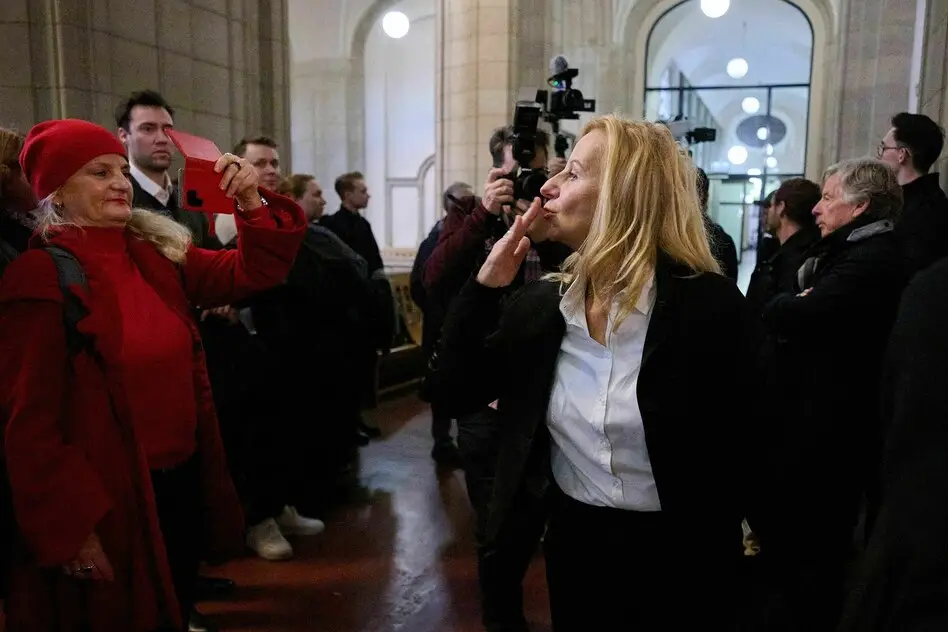
Schlesinger accused her RBB colleagues, who ensured transparency in the summer of 2022, of disloyalty and threatened legal action. Now she is standing trial herself and is as confident of victory as ever. With her kisses at the start of the trial, she demonstrates diva-like self-confidence, but she also damages the reputation of the public broadcaster. However, she will not be put on trial for this.
And at least for the man at the very beginning of the RBB saga, things ended lightly: Schlesinger's husband Gerhard Spörl was initially co-accused, then the proceedings were discontinued on payment of a fine. An RBB insider says that he would at most “bet nothing” that Patricia Schlesinger would be acquitted.