
World taz
Protests in France: Who owns the anger?
Anyone who sees the rioters in France only as criminals is overlooking the social causes of the violence, says French writer Édouard Louis. We have to take a closer look. more.
Deutsch (original) ·Auto-translated to English
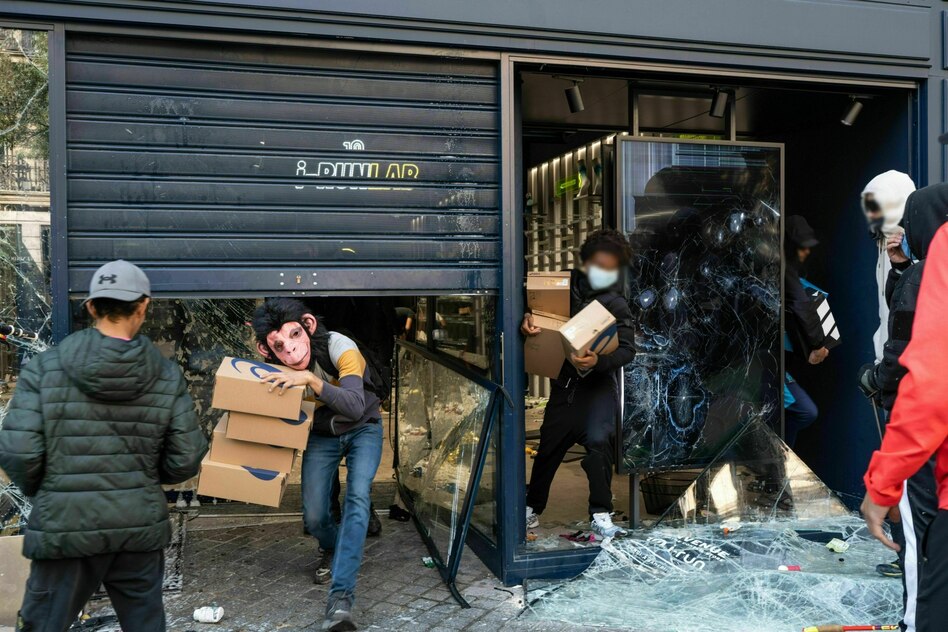
Hundreds of thousands gathered across France in the nationwide demonstrations on October 17th. They did it to express their opinions, to protest, to sing together and to demand radical political change - for social justice, equality and the redistribution of wealth.
At the same time, several thousand people turned the day into a wave of violent riots in Paris and Lyon, in Marseille and Limoges: shops were vandalized and looted, shop windows were smashed, kiosks and cars were set on fire. The Place de la République in Paris was devastated and the Boulevard de Magenta was defaced. In Limoges the town hall was set on fire, and in Lyon the tourist information office also went up in flames.
This text first appeared in wochentaz, our weekly newspaper from the left!
Every week, wochentaz is about the world as it is – and as it could be. A left-wing weekly newspaper with a voice, attitude and the special taz view of the world. New every Saturday at the kiosk and of course by subscription.
The very next day, voices from right to left rose to denounce the destruction and looting. Hundreds of videos are circulating on social networks showing desperate, sometimes crying shopkeepers in front of their destroyed shops.
Against the background of these images, two different perspectives emerged. The first, predominant reaction strongly condemns the “chaotics” and calls for the harshest punishment possible: they have plunged France “into chaos” and targeted the republic as a whole. This is the discourse of the right and right-wing extremists - and also of the socialists, who always adopt the government's language regulations for fear of not appearing respectable enough.
33, became known in 2014 with his autofictional debut novel “The End of Eddy” (S. Fischer). He studied sociology and philosophy in Paris, including with Didier Eribon. In his books, Louis primarily deals with social inequality, class relations, violence and homosexuality.
The second reaction, on the other hand, emphasizes that the “chaoters” had “nothing to do” with the demonstrations, that they damaged the current social movement and put it in a bad light. The extreme right will use the events to call for order and repression - as it is already doing.
Like vultures, the right-wing extremists pounce on the carcasses of burned shops and the remains of charred bus stops to feed their vile language. A part of the left is aware of this and therefore insists that the riots, the destroyers and the looters have nothing to do with the social movement.
What these discourses have in common is that they act as if the group of “chaoters” were real. As if the population could be divided into two groups. As if on the one hand there are the authentic demonstrators who are outraged by the political and social situation and have decided to protest peacefully - and on the other hand there are those who, completely detached from the context, have decided to become violent; isolated, ragtag individuals who are supposedly motivated only by the desire to destroy and cause trouble.
But how can one miss the fact that those who rioted and looted over the weekend look alike? That they all seem, at least for the most part, to come from the lower social classes, wear the usual clothing, hats and sneakers and that, as you can hear in the videos, they speak with accents and expressions from this milieu?
How can one overlook the fact that these were largely racialized men. About blacks and Arabs. About people who French society has been cramming into run-down housing estates and keeping in poverty for decades, assigning them to squalid secondary schools infested with rats or cockroaches, and who cannot move through the cities without being controlled and humiliated by the police?
The fact that most of the rioters seem to come from the same social environment should make the following clear to us: It is always a certain environment with certain living conditions that produces certain behaviors. And it's not about individual decisions to hit something or destroy something, but about a social conditioning that leads you to act in one way or another.
I'll say it quite openly: it makes me sad too and I feel for the merchants crying when I see them in front of their shops. But empathy must not distract from deeper questioning of what this violence means.
Understanding why certain people riot does not mean denying the suffering of those affected by the destruction. It means refusing to use this suffering as an excuse to stop thinking. As if the pain of one must necessarily blind us to that of the other.
To what extent does suffering and social violence drive some people to use violence as their only language? To what extent have the impoverishment of the French population, the decline in social welfare, the destruction of public services and the neglect of the lower social classes by the governments of Macron and his predecessors contributed to the fact that destruction and looting are the only possible option for some?
Of course there are other factors. Such as masculinity - while the looting came from men and women, the destructive acts came almost exclusively from men - the culture or the glorification of violence on social media, the fascination with money and consumption.
But the questions remain the same: Why do these representations, these behaviors resonate more in certain social milieus than in others? Why does violence take this exact form, with these exact people, at this exact moment?
One person never decides on an act alone. A violent act is never an individual, even a group of people, waking up in the morning and deciding, "Hey, I'm going to do something violent today." And even if they thought like that, the reason for their actions would lie beyond themselves. One would still have to explain why they have an urge to destroy, why this particular type of action seems accessible to them.
The day we see children from posh neighborhoods and students from elite universities in white shirts and polished shoes, smashing shop windows and looting supermarkets - perhaps that day we can begin to believe in the theories of responsibility and individual action. But as long as the same behaviors almost always occur among the same populations, in the same areas, and among the same groups of men, it is fair to admit that something in the organization of our society makes these behaviors more likely than others.
Who has a right to sociology and politics? When students demonstrate and block their high schools, we readily say that the context and the situation prompted them to do so. But when those who protest by burning buildings, breaking windows and looting stores are young men or women from working-class neighborhoods, that argument suddenly breaks down. They are then no longer the product of a history, a social class, an area, an upbringing, a relationship to the police, to money and to consumption. They become people without motives, without a past, without social influences. They are credited with a pure will, an almost natural viciousness.
The problem with this desociologizing view of the rioters is that it prevents us from perceiving the social, expressive and political dimensions of their actions. The question is not a moral one. It's not about whether what they do is good or bad. It is political: why are they doing this and what do their actions tell us about the state of France and current social violence? What do those who riot, sometimes without meaning to, tell us about the neglect of certain sections of the population, about lives reduced to exclusion and violence?
The events that have occurred in France over the past few days are of immense complexity. I do not claim to understand or solve them. But I believe that we must not close our eyes to certain questions of crucial importance in order to understand the very justified anger that has been shaking the country for several weeks.