
World taz
Protests in France: Marseille fears and hopes
Saturday's protests left a trail of destruction in France's second largest city. There will be more demonstrations this weekend. more...
Deutsch (original) ·Auto-translated to English
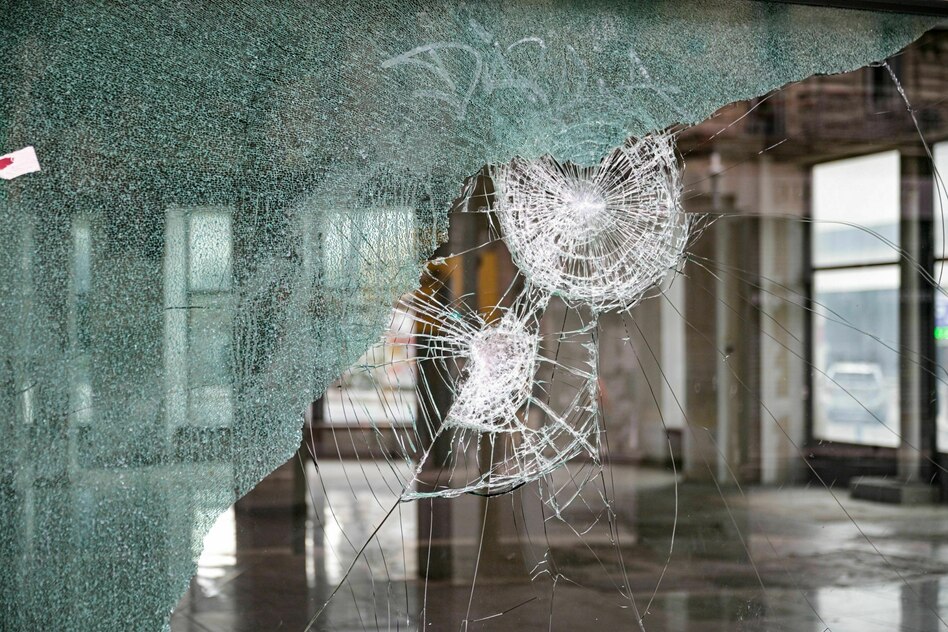
The stenciled red hammer and sickle emblem on a window of the Marseille Stock Exchange is small but visible. The splinters of the broken window panes have been swept up and the facades have been nailed up with chipboard. “You should finally stop this crap,” shouts a woman as she passes a pharmacy. Like many shops, it is open, but there is not a single intact window left. The traces of devastation in the city center as a result of last Saturday's demonstration have not yet been completely removed.
It not only affected luxury boutiques, but also many everyday shops. Tension has been palpable in the city since violent clashes, burning cars and looting broke out last Saturday around the “Day of Mobilization Against Expensive Life”.
The door of the old town hall on the harbor mile was brutally broken open and the “Marianne”, the French symbolic figure, was knocked off the pedestal in the foyer. On Tuesday at noon, a police car was parked in front of the barricaded entrance. Two police officers stand guard. Minors have a curfew at night.
It is the first time in her life, says 55-year-old Julie, who works as an alternative city guide, that she has experienced a curfew. “As if we were at war.” She already felt this way on Saturday when the various groups that had called for mobilization set off from their meeting points - “peacefully at the beginning and much more colorful and lively than usual”.
What Julie then experienced was a disaster, a “non-simultaneity” and a completely “failed coordination of state power to regain control of the situation”. In Marseille, the municipal police station on the Canebière shopping street burned down and remains closed for the time being.
Next door is the Monoprix department store – also closed until further notice. In front of it there is a large container in which many white garbage bags are stacked. A woman stands waist high in the middle. She opens one garbage bag after the other and throws the intact and now unsaleable cosmetic products that came from the emptied Monoprix into the opened bags of the children waiting at the container.
“The sociology of the city is easy to read,” says Julie later over coffee. “They simply seize the opportunity to loot.” In Marseille, poverty is also visible in the city center, where rich and poor coexist close together. Around 30,000 lootings are said to have taken place in France's second largest city, the prefecture of the Bouches de Rhône metropolitan region announced on Monday.
A number that Mayor Benoît Payan later calls absurd and that public prosecutor Nicolas Bessone massively corrects downwards. Bessone estimates the number of looters at around 1,800 to 3,000, and there were around 8,000 rioters, he confirms.
It is difficult to say how many people actually took part in the actions last Saturday. There were 101 arrests and the first people were brought to court on Tuesday. They are exclusively young adults, not of the black bloc and rioter type, but rather followers and opportunist thieves, reports the Marseille online magazine Marsactu. The reporter notes that hardly any of the real perpetrators of violence seem to have been caught. Only 800 police forces are said to have faced 8,000 rioters.
How could this come about? Mayor Benoît Payan, who governs with a center-left alliance, complained on Monday in a joint statement with the mayors of the cities of Limoges and Paris that they felt abandoned by the government. The prefecture had been warned, Payan writes, but the people were able to act unmolested.
There are many theories floating around as to why everything turned out this way. The right-wing and conservatives are trying to blame the excesses of violence on the left-wing populist “Insoumis” of Jean-Luc Mélenchon. Social media may have rapidly accelerated the mobilization of young people from the suburbs.
Right-wing extremists are also said to have been involved. In Lyon, neo-Nazis paraded openly through the city on Monday evening - unthinkable in the more left-leaning Marseille. “Probably a mixture of everything,” suspects Simon, a bookseller who also demonstrated last Saturday. It's his day off. “It started off peacefully and happily, but at some point it got really complicated.” For him it is clear: “That was strategy: they let the violent perpetrators have their way.”
Many shops in the city center will be closed next Saturday. “Not again” and “We are tired of riots like the Macron government” is the prevailing mood. The curfew for minors will be maintained for the time being. In addition to schools, universities are also on vacation next week.
Time to recharge and gather strength. The two police officers in front of the town hall will need reinforcements. They fear new riots, they say. The sun that day dried the streets, but did not soothe the spirits. The city's museums will remain closed this week as a precautionary measure.
Another nationwide day of action has been announced for Saturday, October 24th. President Emmanuel Macron announced that only demonstrations organized by unions would be allowed. “We hope for a peaceful outcome,” say the police. Julie and Simon will hit the road again with the same hope and mixed emotions.