
Migration taz
Protests against deportations: demonstrations at the scene
People across the country have protested against deportations. New deportation centers are to be built at the airports in Frankfurt and Düsseldorf. more...
Deutsch (original) ·Auto-translated to English
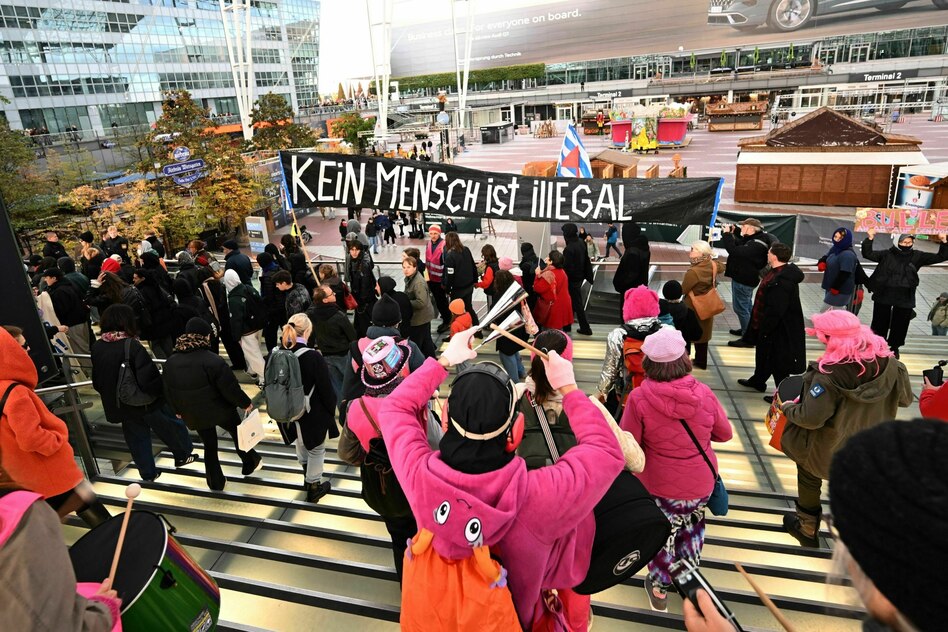
Hundreds of people demonstrated against deportations at several airports across Germany over the weekend. The protests were directed against the expansion of detention, against the brutalization of deportation practices and an increase in deportation cases overall. “It’s not just about what happens when you cross a border,” said Salah Kurdi from the Welcome United initiative from Darmstadt, which took part in the protests at Frankfurt Airport. “The border also accompanies you in everyday life.”
Around 500 people joined the protests in Frankfurt at Terminal 1. A new deportation center will soon be built in the western area of the airport. From 2027 onwards, twice as many people will be deported to their countries of origin than before.
In Frankfurt, in addition to people who themselves are threatened with deportation, initiatives such as the Hessian Refugee Council also took part in the demonstration. Kurdi said that the fight against deportations is a daily struggle for many people. These fights not only take place at airports and borders, but are also part of the everyday life of refugees. These included restrictions on family reunification and hurdles in accessing jobs.
In the first six months of 2026, 921 people were deported in Hesse alone. This means that almost as many people were deported there in the first half of the year as in the whole of 2021. Most recently, the Wiesbaden Administrative Court stopped the deportation of a three-month-old baby to Turkey in an urgent procedure. The Federal Office for Migration and Refugees (BAMF) had threatened the infant with deportation without his parents in an accelerated procedure.
An asylum border center is also to be built at the airport in Düsseldorf, where families will also be interned - around 80 people protested against this in the terminal on Saturday. On banners and in their speeches they complained about the increasing brutalization of deportations. They criticize the planned construction of a deportation prison in Mönchengladbach and the cooperation of the German authorities with the Afghan Taliban regime.
Several speakers emphasized that detention pending deportation has nothing to do with crimes that have been committed. Its sole purpose is to make deportations easier for the authorities. At the same time, they criticized the increasing brutality towards detainees in the deportation facilities. One speaker reported that the response to psychological crises there is with solitary confinement.
"Imagine you're lying in a cell in the deportation prison at night. And then the light comes on and you have to give a sign of life," reports Frank Gockel from the association "Help for People in Detention Detention in Büren". In the Büren deportation prison, people are to be woken up regularly via so-called “vital signs checks”, at intervals of 15 minutes. In one documented case there were six weeks with 5,000 life checks. “Anyone who is already afraid of deportation doesn’t even have time for sleep and rest,” said Gockel, who has been visiting prisoners in the deportation prison in Büren every week for 30 years.
Lizzy Schubert, a Left Party member of the Bundestag in Düsseldorf, also criticizes the deportation of children and babies in particular. “We have reached a new level of inhumanity,” she complains. Gockel is even clearer in his criticism of isolation stations with sleep deprivation in deportation prisons: “Others may say it is necessary, I call it torture.”