
Germany taz
Waste problem: Other people’s garbage
Illegal garbage on the streets is increasing, but so is the willingness to take action against it. A search for clues in Bremen Neustadt. more...
Deutsch (original) ·Auto-translated to English
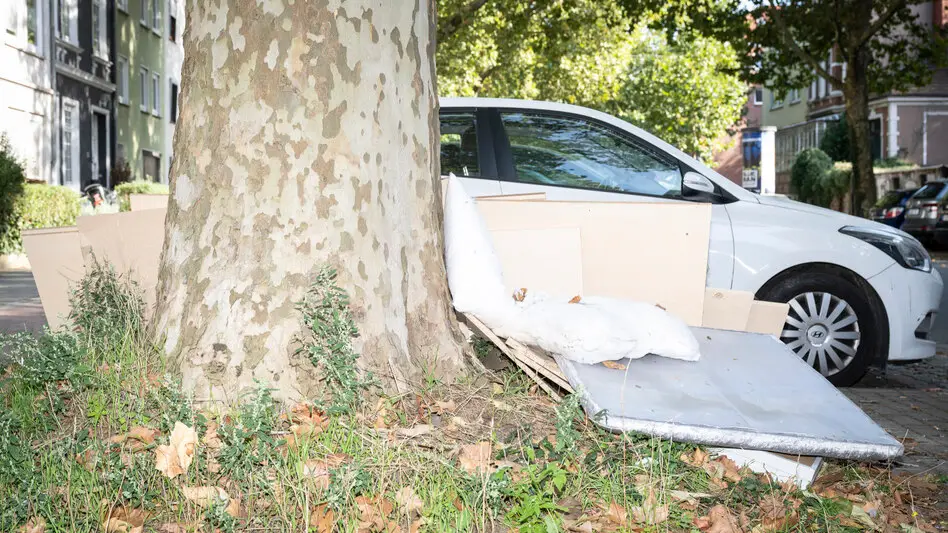
Until recently, I thought the garbage problem wasn't mine. I was familiar with the reports about illegally dumped garbage from other parts of the city and cities, especially from Berlin. But that seemed far away from the everyday life of my almost small-town neighborhood in Bremer Neustadt.
Sometime over the last two years, that certainty disappeared. Sacks and bags of trash lie on sidewalks or in front of recycling containers in my neighborhood. Paper, packaging, leftover food, even the occasional refrigerator, chair or vacuum cleaner. Whatever you want to get rid of. Sometimes real mountains of rubbish grow within a short period of time.
But why do people dispose of their waste like this? To answer this question using Bremer Neustadt as an example, I spoke to a consultant from the municipal waste management company. I have accompanied people who clean up other people's messes in their free time. And I looked for theories that could explain the phenomenon.
There are no statistics that can be used to determine with certainty how long there has been “more and more” household and bulky waste on the streets, neither for Bremen nor nationwide. However, there are figures that suggest an increase over the last ten years - although not a continuous one everywhere.
In 2017, Bremen, like many other municipalities, introduced a reporting portal where citizens can report illegal waste dumping. In 2018 there were 6,899 illegal garbage heaps, twice as many as two years before, and in 2019 there were even 2,000 more. According to the Senate, it now levels off at around 6,000 annual reports.
What is certain is that attention to the problem has increased, as the reports in newspapers, television stations and online portals show. It can also be seen that not only Germany is affected and not only large cities, but also smaller towns. Local newspapers also report on illegal garbage dumps between places: in the forest, on the edge of the field, in the nature reserve.
In Bremen, illegal waste disposal has been a topic in the state parliament more frequently for the past three years. MPs last debated it in June, for the fifth time this year. The reason was an article in the local newspaperWeser courier,in which a resident complained that littering at the Buntentor had “increased at an almost epidemic rate for several months.”
The Buntentor is one of eight districts of Bremer Neustadt, which is located on the other bank of the Weser from the city center. In the last state election, the ruling coalition of the Left, SPD and Greens in the state of Bremen received 70 percent of the vote in Neustadt.
In the parliamentary debate in June, the CDU and right-wing populist citizens angrily accused the Bremen state government of inaction. Citizens are “abandoned” with the garbage. A CDU MP claimed: “To date, the Senate has nothing to offer apart from appeasement and announcements.”
Coalition representatives rejected this. Rightly so, because like many German cities, Bremen has started the fight against garbage: more education, more controls, more cleaning up after it. From 2027, “garbage sheriffs” from the municipal cleaning department will also be able to punish violations themselves; previously, such cases had to be handed over to the public order office.
But the Green Bremen Environment Senator Henrike Müller, who is responsible for waste disposal, also thinks that all of this is not enough to bring about a “change in mentality”. That's why, she said in the citizens' debate, she would like to see video surveillance at so-called garbage hotspots. Municipalities in Bavaria and North Rhine-Westphalia do this in isolated cases, and Baden-Württemberg changed its state data protection law in February.
Increasing fines is also under discussion in Bremen. The senator referred to Berlin, which drastically increased its fines a year ago. The illegal disposal of household waste can be punished with up to 6,000 euros, while bulky waste that exceeds a single item can be punished with 1,500 to 15,000 euros. In Bremen, the maximum amount for household waste is currently 1,000 euros and for bulky waste it is 2,500 euros.
But is it true that there is more rubbish on the street in Buntentor than before? Since when and is there objective data on this? The spokeswoman for the Environment Senator wrote in an email that the garbage problem was not new in Bremen and that she could not say anything about the situation in the individual parts of the city. In principle, conflicts are more common in areas with a higher population density and more apartment buildings.
At least one of these two criteria applies to the Buntentor: Like two other districts of Neustadt, it is one of the five most densely populated areas in the city. The district is located on Werdersee, a branch of the Weser, with an adjacent allotment garden and local recreation area. There are two theaters, a left-wing cultural center, a few cafes and shops. Apartment buildings are mainly located on the three or four slightly larger streets. There is more trash there than in the many narrow streets that are lined with two-story, often brightly painted old row houses with tiny front gardens.
On one of these larger streets, Kornstrasse, Melissa Ahrens runs a tailor shop, the Schneiderwerk. She opened it ten years ago; The first garbage bags appeared a year and a half ago, she estimates. They were lying in front of her door, on a small paved area between the sidewalk and the road, where she also leaves her garbage can ready for collection. In the beginning, she always disposed of the garbage herself, says the woman in her mid-thirties, “but I no longer saw that, I pay for it.”
Once she found an address label. “Usually people make sure to remove those.” She went to the address a few blocks away. The doorbell had the same name three times and no one answered.
“I threw the garbage bag into the appropriate bin in front of the house and the next day it was back in front of my door.” After that, she informed the city cleaning department several times a week; it was driving to despair.
Now the trash has disappeared as suddenly as it appeared. She heard that a neighbor had caught the perpetrator in the act. However, the topic continues to concern her. "Why?" she asks, "why do people do that? I don't understand it."
Rainer Schnepf, one of eight waste consultants at Bremen city cleaning, has answers to this question. On one of the first days of autumn at the beginning of October, we walk through the Garden City South, a block settlement from the 1950s that borders the Buntentor. We are amazed at how little rubbish there is around here today, we both know it differently.
The 63-year-old is wearing a black hoodie with the city cleaning logo, an orange cap and a bright orange jacket. He and his colleagues have been working for six years, providing information about waste separation spontaneously or at information stands. They also receive complaints about littered neighboring properties. And they ask the alleged polluters why they simply put their garbage on the street.
Sometimes it's simply ignorance, says Schnepf. He remembers a student who didn't know where his trash can was. Or in the people's country of origin it was common for the garbage collector to drive through the streets and pick up whatever was left on the side of the road. You also have to understand the principle of waste separation. The seamstress Melissa Ahrens also had this experience, explaining to the shared apartment next door what belongs in the yellow bag so that their residual waste bin doesn't constantly overflow.
Sure, some people are just lazy, says Rainer Schnepf. He tells of a man who didn't feel like lifting the bin up from the cellar. For others this is impossible because they lack the strength. As we walk through the apartment blocks, we discover a “garbage cage” on one property. You can access the garbage cans behind bars with a key. An alternative to going into the basement, which can also be scary.
Sometimes, says Schnepf, there is not enough space in the house and owners do not fulfill their obligation to find a solution. Or they neglect to inform the tenants well. However, their gaps in knowledge are often so large that it is too easy to blame the landlords alone. “If one more person moves in or a child is born, the tenants have to report this to the landlord so that he can request a larger garbage can,” says Schnepf. “But many people don’t do that and then the bin is quickly full of diapers.”
Nevertheless, there are big differences between the housing companies. On the one hand there are those like the urban Gewoba. “They do a lot,” says Schnepf, even organizing days where bulky waste can be dropped off in the neighborhood.
On the other side are those who are only interested in high dividends. You can often tell this from the appearance of the residential complexes, he says, pointing to the green spaces between the apartment blocks. “The more airborne waste, the …” He doesn’t say the company’s name.
According to Schnepf, landlords who rent apartments to more people than permitted are also causing problems. Then the city cleaning department provides a garbage can for four people, but one for ten would be needed. It was only in the morning that he and a colleague were at such a problem property; neighbors had complained about rats and rubbish in the garden. “When we ring the doorbell at houses like this, rarely does anyone answer the door and then we usually can’t communicate.” Migrant workers often live there, being driven from one place of work to the next, across Europe, with no connection to the place where they are staying overnight. “I’m not surprised if proper waste disposal isn’t at the top of your to-do list.”
This text first appeared in wochentaz, our weekly newspaper from the left!
Every week, wochentaz is about the world as it is – and as it could be. A left-wing weekly newspaper with a voice, attitude and the special taz view of the world. New every Saturday at the kiosk and of course by subscription.
Avoiding, separating and disposing of waste takes time, nerves and energy. The more precarious the living conditions, the less there are of them. Even the waste disposal companies see it that way. “Many people are under pressure in uncertain times,” writes a spokeswoman for the Waste Management Region Hannover Association, aha for short. This often explains a “creeping indifference or excessive demands”. But with all understanding: “Wild garbage is unacceptable misconduct at the expense of the general public.”
The experiences from Hanover speak against the assumption that people would dispose of their garbage legally if the state went far enough to accommodate them - just as the Berlin Left promised during the election campaign in its “5-point plan against garbage chaos”. In it she speaks out against “repressive measures” such as garbage sheriffs and instead wants to create more opportunities for Berliners to “get rid of their garbage.” There will be more recycling centers in the capital in the future, more trash cans and two free bulky waste days.
In Hanover it is possible to register bulky waste almost every day, but the amount is limited to five cubic meters. And yet there is also wild bulky waste here, writes the spokeswoman for the special purpose association.
Another theory that both the Berlin Left and the Bremen CDU adhere to is that of the “Broken Window”. After that, neglect invites more neglect. According to this reading, the state is responsible for other people's garbage because it doesn't clean it up quickly enough.
However, from an educational perspective, this is a double-edged sword, as the Bremen Environment Senator explained in the parliamentary debate: “People experience that their district is clean, even though they dirty it every day.”
In addition, no one is forced to put the kebab paper in the bike basket because there is already a used tissue in there. Or putting the smelly household garbage on the street, the dog poop bag next to the full trash can.
The sociologist Hartmut Rosa, known for his resonance theory, provides an explanation for this behavior. In an episode of the “Hotel Matze” podcast in May, host Matze Hielscher asked him that he had been concerned about the increasing littering in Berlin for a year and that he was also hearing this from other cities. “Why does someone litter their own street?” he asks his guest.
Hartmut Rosa explains this by saying that people are increasingly isolating themselves from an outside world that they experience as threatening, also with the help of smartphones. They retreat into what he calls their “shells”: their own bodies, their apartment, their car, their café or the gym. Rosa believes that everything that lies outside these shells, i.e. public space, is no longer noticed. “Then I can trash it too.”
I found proof of his thesis at the end of August when I met people who cleaned up in the Neustadt once a month. Simply because they don't want to accept the garbage, as Nina, the founder of the Clean Up Your City Neustadt initiative, tells me. She asks that only her first name be used so that she is not easily googled.
Three years ago, the 51-year-old says, the garbage annoyed her terribly. And just as the medical-technical assistant and mother of three sons was elected as parents' representative because she would rather solve problems than complain about them, she founded the open collection group and registered it with the Bremen city cleaning service. They support such initiatives with equipment and collect the full bags from the registrants.
There are 15 people there this Sunday morning, more women than men, the youngest are in their mid-20s, the oldest are over 70. Some of them are wearing neon green vests with the initiative's logo, they are collecting alone or in pairs. Why? Because it's fun, everyone I talk to says. They are out in community and in the process “make the world a little bit better”. Rainer Schnepf, the waste consultant, also said that about his job.
The collectors have to leave the garbage bags behind because they only travel with handcarts and cargo bikes. To do this, in the Flussviertel, which lies west of the Buntentor, they use tongs to pull cigarette butts out of the cracks in the sidewalk, collect leftover balloons from children's birthday parties in the park, and pick up plastic and paper from the small green spaces between parking spaces. When their buckets are full, they call Nina, who takes the rubbish away on her cargo bike.
On a small sports field, Cornelia and Wolfgang Ernst clear the fence between two playing fields of rubbish and weeds. The couple, aged 70 and 74, live nearby and sometimes go here with their grandchildren. I ask Wolfgang Ernst why he doesn't leave it to the municipal cleaning service. “Because public space is also my home,” he says. “And I want it to be nice there.”