
Germany taz
Freedom of the press in Serbia: Next mission: “Liberation of the media”
After the student list's election victory in Serbia, media loyal to the regime is changing its tone. But the winners want to radically clean up the press landscape. more...
Deutsch (original) ·Auto-translated to English
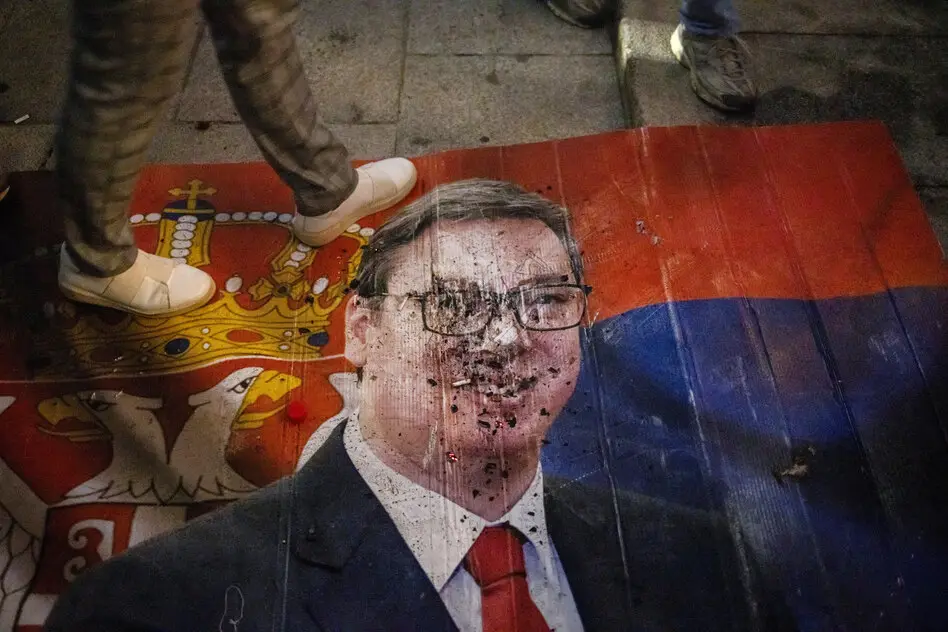
In Serbia, it was the anger of the streets that ultimately led to the fall of the government. The street also shows what the anger is directed against in the days after the parliamentary elections. People gathered in front of the television channels Informer, Pink and the public broadcaster RTS. Pink had eggs and bottles flying.
They broke into the building of the tabloid media and propaganda station Informer to confront editor-in-chief Dragan J. Vučićević. The police had to intervene. The student list distanced itself from this. But in recent years there have been repeated references to the hijacked media in Serbia.
After all, they were an important and loyal instrument of Aleksandar Vučić's regime. Always loyally at hand, the government's messages were reliably conveyed to the outside world.
A collection of the best hits from media reads with disbelief and horror. Protesting students were called “terrorists” or (referring to the fascist Croatian movement) “Ustaša”. Hate campaigns against individual journalists or members of the opposition became the norm. False information was regularly spread on front pages. According to the fact-checking portal Raskrinkavanje, the tabloid Informer had 399 false or manipulative articles on the front pages - in 2025 alone.
This is the media landscape that has not allowed fair competition in Serbian elections for years. Almost all of the airtime went to the government and its supporters. The opposition was almost never reported; and if so, then only negatively. And yet the student list won 53 percent of the vote in the parliamentary elections on October 25 and will be able to govern alone with its array of doctors, university professors, actors and other public figures.
What was surprising was that President Aleksandar Vučić admitted defeat on election night - even though there had previously been indications in the pro-government media that he would not recognize the election. The victory of the student list, which emerged from a protest movement, was probably too clear.
Two years ago, a train station canopy collapsed in northern Novi Sad, killing 16 people. Botched renovations and corruption are blamed for the collapse. The project was presented as modernization and better links with the EU. Students began to occupy their university buildings. This resulted in a nationwide movement.
The students went door to door and organized protest marches to bring their message to the villages. They also had to defy the government's media machine.
Their eleven-point program focuses on the fight against corruption, independent courts and the depoliticization of the public sector. A separate point is the “liberation of the media”. The public broadcaster RTS is to be depoliticized. In the future, state funds should be allocated according to professional criteria instead of political loyalty.
“The relationship between RTS and the regime was not only submissive, but downright complicit,” said candidate Nemanja Karović after the election in the main news of the station. The student list does not want to control RTS itself, but rather to restore its independence. He also rejected the sudden attention: the day before, the movement had received twelve minutes of broadcast time, more than in the previous 45 days combined. This ingratiation is unnecessary.
The spirit of optimism can be felt in Belgrade these days. Even before the government is formed, a new tone is emerging in the media. RTS suddenly gives the student movement significantly more space. The regional public broadcaster RTV Vojvodina apologized to viewers.
“The public broadcaster has not fulfilled its mission for many years,” said presenter Goran Eror. Topics were reported secretly and uncritically. Now they want to win back the trust of the audience. The editor-in-chief of the first television program, Nenad Ćaćić, has resigned.
For Aleksandra Krstić, this change in tone is not surprising, but rather predictable. After the fall of the former head of state and later convicted war criminal Slobodan Milošević on October 5, 2000, a similar change of tone was experienced in Serbia, the journalism professor from the University of Belgrade tells taz. And that practically overnight. Today it shouldn't stay that way. "That wasn't enough then and shouldn't be enough today. Structural changes will also be needed," she says.
Because Vučić controlled the media landscape like hardly anyone else. He learned his trade as information minister under Milošević. After his SNS party came to power in 2012, control over media and advertising money became increasingly tight. State funds went to propaganda channels and tabloids. Critical editorial teams were excluded from public advertising contracts. According to reports from editorial offices, private companies also came under pressure not to place advertisements there.
Not only was the media itself taken over, says Krstić, but also the institutions that were supposed to control it. This includes the media regulator REM. "If there were measures, they were very mild. Almost none of the problematic television channels were sanctioned, at best to a very small extent," she says.
What is positive, however, is that media supervision now seems to be taking action. On Wednesday there were the first sanctions for the television channels Informer and Prva, which had to pause some programs early. The decisions were made unanimously in a committee that had been blocked by four-to-four votes until before the election. REM is scheduled to decide on additional sanctions on November 10th. 30 university professors called for the broadcasting license for Informer to be revoked.
Informer editor-in-chief Dragan J. Vučićević presents his previously pro-government medium as the “only opposition television station” and speaks of censorship. President Ana Brnabić and former Prime Minister Miloš Vučević were in front of the building on Wednesday to express their support.
Repairing the damage caused under Vučić will be a major task. First, the conditions for pluralistic media must be created, says political scientist and journalist Nikola Burazer. “We are talking about 14 years of uninterrupted, daily propaganda,” he tells the taz.
This is also about Telekom Srbija. The state-controlled company finances government-affiliated media and uses its distribution networks to determine which channels people can watch. Without changes there, the “liberation” of the media landscape will hardly be successful.
If hate speech were punished in the future, public discourse could also become less toxic, says Burazer. It remains to be seen how quickly the new government will take action. In any case, the expectations of the student list are enormous. Whether she does justice to them also depends on how she deals with the media. The new tone is a beginning. It has to prove itself when the new government itself is criticized.