
Germany taz
Premiere of “The Pond” at the Volksbühne: Waiting for the explosion of violence
Gisèle Vienne stages Robert Walser's short drama “The Pond” as a subtle study of abusive family relationships. The horror arises from hints. more...
Deutsch (original) ·Auto-translated to English
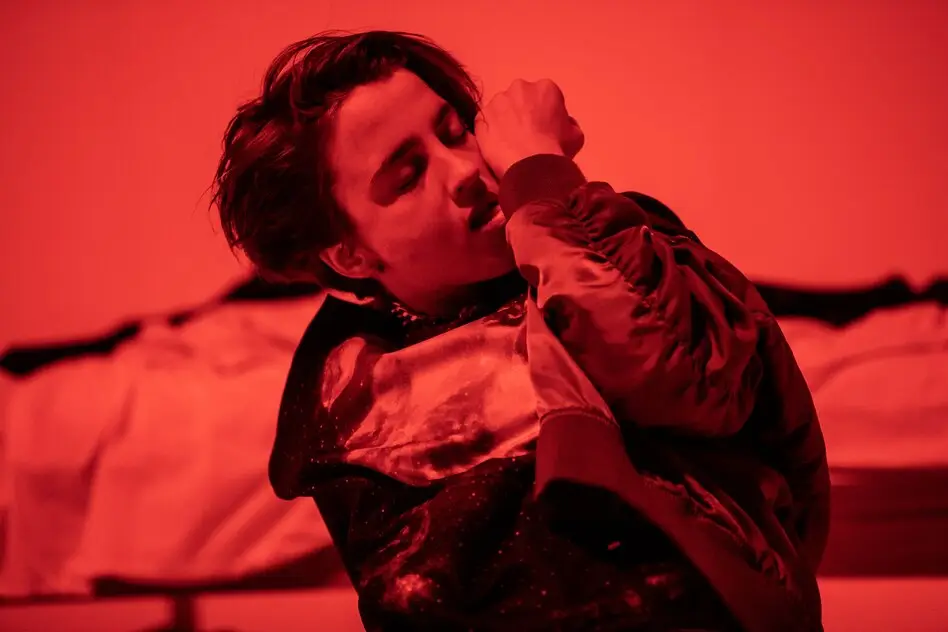
Everything is unbearable. The electronic, way too loud sound. The puppets staring into the audience like dead people in the white room. The emphasized, even tender calm with which a technician carries her off the stage. And the slow motion with which the two actresses appear. These sticky, stocky movements, as if they themselves were dolls without life, or rather with just a little bit of battery left, which, however, must be enough to overcome the painful abyss of the family present.
Adèle Haenel and Julie Shanahan, who embody all the roles in Robert Walser's short drama “The Pond” in Gisèle Vienne's adaptation on the boards of the Berliner Volksbühne, will not be able to shake off this slowed down unbearableness throughout the evening. They put the audience in a constant state of the proverbial “waiting for the next shoe to drop”, a nerve-wracking anticipation of the next noise that just needs to disappear, or in this case: a sudden outburst of violence, a terrible event, an endless amount of blood or a sudden standstill. But none of this happens.
In just over twenty pages in 1902, Walser wrote about the family hell in which Fritz, who felt unloved by his parents, faked his suicide by drowning in the pond, only to feel even more alienated from the world afterwards. Gisèle Vienne stages the piece, which premiered in Lausanne in 2021 and can now be seen at the Berlin Volksbühne, as a subtle study of abusive family relationships: violence, incest and psychological decomposition lurk as permanent possibilities and yet are never shown.
Haenel, who was herself abused by director Christoph Ruggia as a child between the ages of 12 and 14 and became one of the leading figures in the French Me Too movement with her public accusations and the subsequent trial, plays all the children's roles, while Shanahan takes on those of the parents with her skin-peeling laugh. It is also this jumping between characters, voices and moods that gives the piece its psychotic effect.
Vienne is a master of the implicit. Nauseatingly amplified body noises, drone sounds from black metal icon Stephen F. O'Malley (including Sunn O)))) and François J. Bonnet and brilliant monochrome lighting (Yves Godin) push the hour and a half on stage into something physically difficult to endure. The fact that explicit violence is neither carried out nor expressed and that catharsis can only be found in the intact bow of the actresses during the final applause leaves a metallic taste in the mouth. And yet Vienne elevates the fate of the individual to the status of the structure. Depicting them without recreating them is as difficult as it needs to be. Despite and precisely because of their unbearability.