
Germany taz
Politics professor on left-wing electoral successes: “Politics can be changed”
Left-wing electoral successes are not yet a turnaround, says political scientist Klaus Schlichte. Why he still has hope. more...
Deutsch (original) ·Auto-translated to English
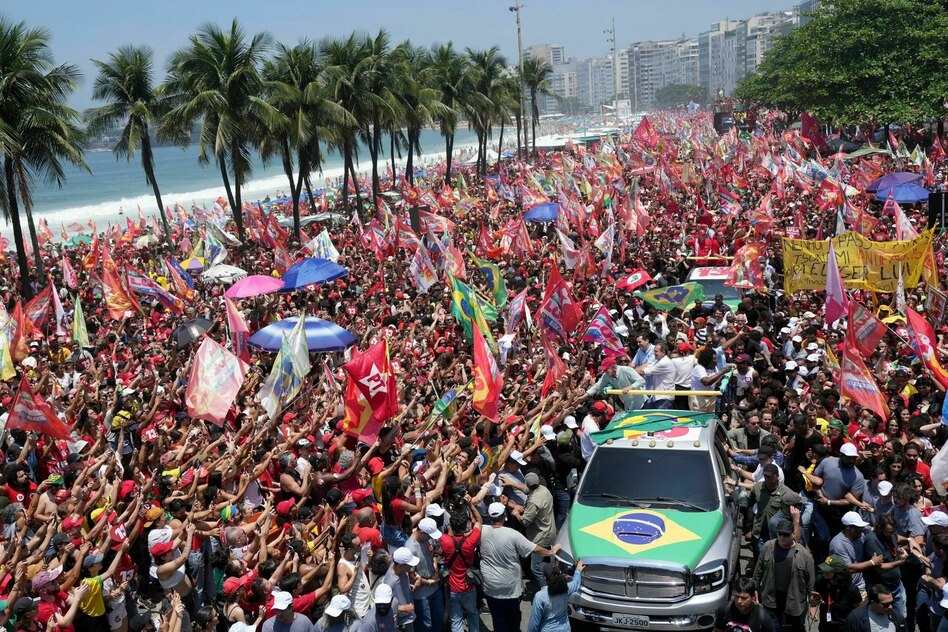
Left-wing successes in Brazil and Serbia give hope. Are we currently experiencing the beginnings of a shift to the left?
Brazil and Serbia are two countries out of almost 200 countries in the world. And they differ significantly from each other in their economic structure and domestic political problems. In Brazil, the composition of the parliamentary majority is still different than what was reflected in the presidential election, so it is not easy for Lula to implement a thorough policy. Society in Serbia has long been highly polarized. This also has to do with historical experiences and the relationship with the West.
What makes left-wing politics in these countries still attractive?
Both countries have strong left-wing traditions, but for very different reasons. In Serbia and the former Yugoslavia, the ideas of state socialism still have an impact today. Social equality, functioning public health care and free education are norms that continue to be present in the collective consciousness. The present is also measured by this, often with a certain nostalgia and exaggeration.
Klaus Schlichte has been Professor of International Relations and World Society at the University of Bremen since 2010. His current research topics include security policy, social dynamics in African societies, and military conflicts. He was spokesman for the “International Relations” section of the German Association for Political Science and spokesman for the “Political Sociology” section of the German Sociological Society.
There is a long tradition of left-wing and emancipatory movements there. These include the landless movement, trade unions and left-wing movements among young people. These political ideas apparently have a certain plausibility for a growing group of the population.
Are there similarities between left-wing and progressive election winners?
It is primarily an urban phenomenon. If you look at voting behavior in Europe, you can see a pattern that can also be observed in other parts of the world, for example with Zohran Mamdani in New York. The progressively oriented are predominantly located in the cities, often also in the academic milieu. In addition, there are population groups with which new political alliances are emerging. In rural areas and also in certain social classes within cities, however, this development is not necessarily shared. There is sometimes even a stronger backlash there.
What drives people apart politically?
On the one hand, this has to do with migration processes, and on the other hand, it has to do with disappointment with the liberal economic model. In the West it has led to an erosion of the middle classes rather than to their betterment. Many people have learned that political and economic liberalization has not brought them what they had hoped for.
You can see this in Africa, for example. There it is perceived that China has made enormous economic progress in recent decades, while the West's recipes have not led to comparable results in many countries. I also hear from African colleagues, who I definitely consider to be democrats, that they say: Democracy doesn't work. By this they mean, above all, that the economic results have fallen far short of expectations.
So is it not just the liberal economic order that is in crisis, but also democracy?
We have experienced various waves of democratization since the 19th century. Of course there were also setbacks. The triumph of democracy was followed by fascism and nationalism after the First World War. Some of the authoritarian governments, like in Spain, lasted until the 1970s. Then the military dictatorships ended, including in Latin America, and later state socialism in Eastern and Central Europe. There was great optimism at the time that democracy would prevail worldwide. But this development has been eroding for around ten to fifteen years. We are observing a significant decline in democratic standards. The world is becoming more authoritarian again.
Progressive phases are followed by a shift to the right. Then the pendulum swings to the left again. Is politics really that simple?
I think this is a popular metaphor that has its merits, but also its dangers. The picture is relatively simple and initially does not explain why the pendulum swings in one direction or the other. Of course, every political change creates winners and losers. Certain social groups benefit from development, others suffer disadvantages. This can give rise to political countermovements, but the differences between societies and historical situations are considerable. For example, German society today is completely different than it was in the 1920s. One cannot therefore simply assume that the same political laws always apply.
But that also means that a shift to the left is by no means guaranteed. Can we still hope?
Yes, I think so. This may also be a question of age. I am in my early 60s and have experienced a long period of political developments. For many of my generation, the present feels like a return to the early 1980s. At that time there was also strong rearmament, political polarization and hardened social conflicts. If you compare the present with the quieter 2000s and 2010s in Germany, you quickly get the feeling that everything is getting worse. But in the long term you can see that such situations can change again. Back then, events finally occurred that hardly anyone had predicted: the fall of the Berlin Wall and the collapse of the Soviet Union. Within a few months the historical situation had changed fundamentally.
People are becoming more self-confident and making higher demands on their living conditions. Through media, cultural exchange and migration, they are more aware of what living standards are possible elsewhere. This gives rise to political demands. That's why I'm not a pessimist. Of course there are resistances and distributional conflicts that cannot simply be resolved through elections. But I do believe that demands for better living conditions will continue to prevail.