
Germany taz
Mushroom content on social media: Why is everyone suddenly going mushroom picking?
Mushrooms are trending in real life and on social networks, where so-called mushroom influencers provide information about the creatures. What does this tell us about our times? more...
Deutsch (original) ·Auto-translated to English
A crowd of people has formed around a wiry man in a red rain jacket. A tattooed couple stands next to a mother and her children, who excitedly point small, colorful cameras at the floor. Next door the bass is pounding, people are partying in the small green area next to the Berlin trendy club Berghain, someone is driving past on his bike and hallucinating, perhaps on some mushrooms, another person whom he is loudly insulting. A group has agreed to go on a short walk that has little to do with the big city: We are here for the mushroom walk run by the German Federation for the Environment and Nature Conservation (BUND).
“Please don’t eat the mushrooms from here,” says the man from BUND right at the beginning. Between dog poop and who knows what other debris, that doesn't seem particularly advisable. There is still a lot to discover here. We found a Stinkhorn and a Kahler Krempling on this still warm September afternoon.
The latter was once considered edible, but is now classified as poisonous, says our guide. Consuming it can cause serious and, in rare cases, even fatal poisoning.
The children are the best mushroom hunters. Just as we're talking about one mushroom, they're excitedly pointing at the next one. Every few meters we find a new species.
Not only are there mushrooms in the small forest not far from the Uber Arena, but there are also many people who are interested in them. The BUND regularly offers its mushroom hikes here in autumn. It is also just one of many mushroom events that are currently taking place in Germany and are very well attended.
At Mushroom Day, organized by the Berlin-Brandenburg Mushroom Association. V. on October 19th in the Britzer Garten, dozens of visitors crowded around the fresh mushroom exhibition. A mushroom expert from the working group also confirms: collecting mushrooms is more popular than ever before. On the day of the exhibition there are also many young people in the group.
But why? What makes a leisure activity that for a long time smelled like an allotment garden, functional jacket and Sunday outing suddenly so attractive? Part of the answer can be found on social media. So-called mushroom influencers are sprouting up there and turning the nature hobby into entertainment on the screen.
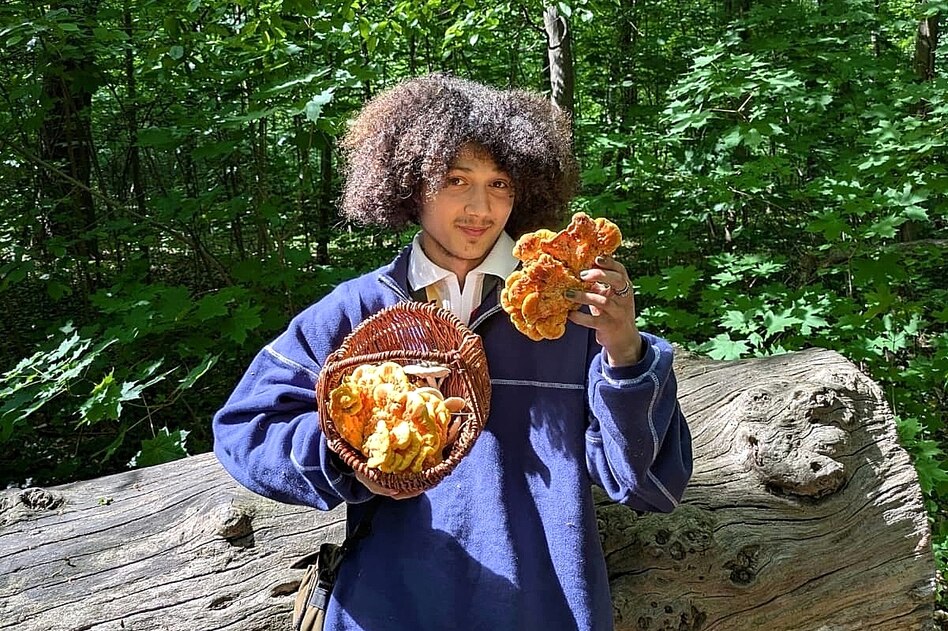
One of the most famous is Tristan Jurisch. At 17, the now 21-year-old was the youngest mushroom expert in Germany. Around 300,000 people now follow him on Instagram under the name “pilzaddicted”. He is a regular guest on talk shows, such as the MDR format “Riverboat” or in Arte documentaries. The rapper Ikkimel and the comedian Tahsim Durgun have also been mushroom picking with him.
At the latest, it is clear that people who you would not expect to find in the forest are now also interested in collecting mushrooms. And yes, it's cool. So cool that it doesn't seem strange when Julisch's mushroom discovery video is accompanied by "Glamorous" by Fergie. Pop culture and mushrooms belong together now.
Also: Mushrooms are made for social media because of their aesthetics. We know the bright red toadstools. A purple lacquer funnel is, as the name suggests, inky blue. “No plant HATE, but mushrooms have more color,” writes Julisch when he once found such a mushroom and posted it on Instagram. Some mushrooms are reminiscent of coral, some literally melt away when they ripen. Nature provides the colorful photo motifs for free in the undergrowth.
And they have interesting common names, which are therefore easy to remember. There is the group of milklings or the pointed knightling. Of course, many of the names also make excellent insults. Clear winner in this category: Outrageous Rübling. This is a reddish-brown lamellar mushroom that gets its name from its smell of rotten cabbage. At the fresh mushroom exhibition in the Britzer Garten it is therefore housed in a plastic container and has a yellow sign on it: “Not an edible mushroom”. Green and orange labels also indicate which species are edible and which are poisonous.
The people from the outdoor laboratory in Brandenburg only spent one day collecting and found hundreds of different mushrooms for the exhibition. It looks like a museum here - but the exhibits don't last long. You actually have to treat mushrooms like you would meat, says a mushroom expert. Because they contain so much protein, they break down quickly and must be stored in a cool place.
When you pick your own mushrooms, you quickly hear the enthusiastic voice of Tristan aka “Mushroom Addicted” in your head: “an excellent edible mushroom”, “good edible mushroom”, “tasty” or “very poisonous”. Anyone who looks at the mushroom content learns a lot about edible mushrooms and the most important characteristics of these intermediate creatures that are neither plants nor animals.
But the enthusiasm cannot be explained with Instagram alone. Mushroom picking also fits in at a time when many people are looking for activities away from screens. Anyone who goes collecting has to move, look closely and train their own perspective.
You also have to slow down. Is that actually a fungus under the leaves? Is it the same as the one in the photo? Which features are crucial? The forest becomes a search area, every tree stump becomes a possible location. That's why interest in mushroom picking has increased during the corona pandemic.
In times of rising costs of living, it is no wonder that young people in particular find it attractive to collect something that is free for everyone. And that you don’t need any expensive equipment. Many forest areas are also available to everyone, and you are allowed to collect mushrooms - at least for private use. Mushrooms promise adventure without long journeys and exercise without pressure to perform.
Well, maybe you shouldn't necessarily pick mushrooms in the green areas of the big city. And you should also know your stuff really, really well, because if you mix up mushrooms, you can ultimately die in the worst case scenario. But fortunately there are now basket tests in almost every major city where you can bring your collected mushrooms to be identified, in Berlin for example at the Free University.
Back at the mushroom walk in Berlin, the participants bend over the ground. The man in the red rain jacket points to another specimen, explains how to recognize it and answers questions. The children tear the mushroom out of the man's hand to photograph it. Others leaf through their information booklets or take photos to identify mushrooms, which they then upload to Google's image search. In the small green area next to Berghain, everyone is not so dissimilar in their fascination with mushrooms.