
Politics · taz · · 2h
Parliamentary elections in Russia: The silence before the “election”
Deutsch (original) · Auto-translated to English
It's best not to say anything at all - that's what election campaigns can look like. “The candidates didn’t show up in our studio, so I’m saying goodbye to them,” said an emotionless spokeswoman dressed in flaming red. On August 31, she was scheduled to moderate a campaign debate on the regional TV channel Oka in the Ryazan region, but all six speakers' desks positioned to her left and right remained empty.
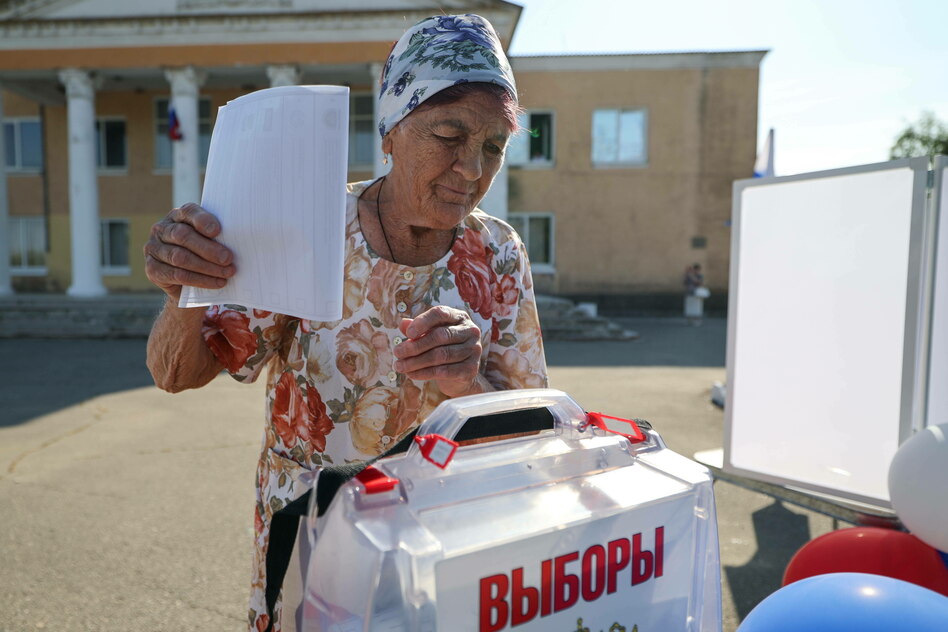
From September 18th to 20th, all eligible voters in Russia are called upon to cast their votes to determine the new composition of the State Duma. These are the first parliamentary elections since the beginning of Russia's all-out war of aggression against Ukraine, which violates international law, in 2022. At the same time, elections for 39 regional parliaments are taking place, and the governorship will be reassigned in eight regions.
The Russian power apparatus seems to have everything under control and has taken precautions for a passable result, but the war-related conditions are extremely unfavorable: violent drone attacks on the Russian energy infrastructure, gasoline shortages, significant inflation rates and rising tax burdens. The immense costs of war are increasingly being passed on to the population.
Although economic growth is expected to be low in 2026, inflation is rising. Frustration with the situation and anything but rosy future prospects should remain a private matter. Anyone who acts defiantly, even if it's just signing a petition together at a gas station, as in Volgograd, will be punished or arrested straight away. There are also internet blockages. They don't find any support, but a large proportion of people have now learned to live with it.
Only around a third of those surveyed support the Kremlin party United Russia, which currently has an absolute majority in the Duma. This emerges, for example, from data from the state opinion research institute WZIOM. In order to still be able to meet the plan requirements, the lead presidential administration resorted to other tried and tested means in addition to the usual pressure on public sector employees. Statements about possible election fraud in polling stations are now prohibited as they undermine trust in the electoral system.
There is almost no independent observation at polling stations anyway. Digital voting, as is possible in 32 Russian regions, is de facto excluded. There are calls for online voting in the hallways of Moscow, and there are also plenty of such notices on the streets of the capital, at least far more than party advertising. Of course, there will be no serious election observation at the polling stations either.
Even United Russia has reduced its spending for the upcoming elections. Because the party will win either way. Half of the 450 seats are allocated by direct mandate, with the capital Moscow alone accounting for 16 seats. Experience has shown that United Russia will largely, if not completely, fill this with its representatives.
These elections can best be summarized under the motto: Don't start discussions. This creates strange situations. Aleksei Chernov, candidate of the Party for Direct Democracy, made a statement lasting only a few seconds in support of families with children during election debates on Channel One. He then refused to use up his speaking time.
The belligerent communist Nikolai Bondarenko from Saratov, on the other hand - one of the most popular cadres of the Communist Party KPRF - insisted on tearing United Russia to shreds in front of the camera. He was promptly convicted of publicly displaying extremist symbols and excluded from the elections. The pretext was the distribution of a photo of opposition politician Aleksei Navalny, who died in custody in 2024, on a Telegram channel linked to Bondarenko.
The electoral commission uses similar methods to eliminate candidates from the liberal Yabloko party. Currently, 122 of them are still allowed to stand for a direct mandate - and the trend is falling. Yabloko was the only party with a clear anti-war program that initially received approval for the elections. In August, the Supreme Court upheld a flimsy lawsuit filed by the ultra-nationalist Rodina (Homeland) party alleging copyright infringement and foreign funding. The Central Election Commission then removed Yabloko's list from its register. The party is also facing strong opposition in the regional elections.
Compared to the 2021 elections, when there was a lively election campaign in some Moscow districts, the few stands of individual parties are hardly noticeable. There is a lot of activity in front of the Dynamo stadium, and it is also swarming with police. A representative of the Nowyje Lyudi (New People) party, which currently has 15 deputies in the Duma, seems a bit lost in his post. For the young man, it is his first choice. He is collecting signatures to lift the internet blockade. He explained to two interlocutors in their mid-20s that this petition would first be introduced to the Duma before the president gave his say.
“We are not dealing with a parliamentary democracy, but with a presidential one,” argues the party representative. He would ideally like to see former President Dmitri Medvedev back in office because he started out as a “liberal politician”. His listeners do not hide their skepticism. But they are far more interested in whether mobilization will expand after the elections. Referring to insider sources, the Nowye Lyudi politician says no.
He would like to see a party that represents the interests of the entire population. Yabloko is “too liberal” for him. He also finds it inappropriate that Yabloko is calling for a state apology for the two wars against Chechnya (1994-1996 and 1999-2009, editor's note). Nevertheless, he attended the verdict against Yabloko in the Supreme Court.
The only chance to change something at the moment is to vote for any opposition party. He also works as a campaign worker for the Liberal Democratic Party and the KPRF. Then he interrupts himself. No, the KPRF doesn't deserve to be elected, they are Soviet party bigwigs. "You better vote for Novye Lyudi. You won't regret it!"
Read the full story at the source →
Source: taz