
Germany taz
Parliamentary election in Serbia: defeat for ruler Vučić
For 14 years, Aleksandar Vučić single-handedly determined his country's politics - until the student movement. Is a better future now dawning for Serbia? more...
Deutsch (original) ·Auto-translated to English
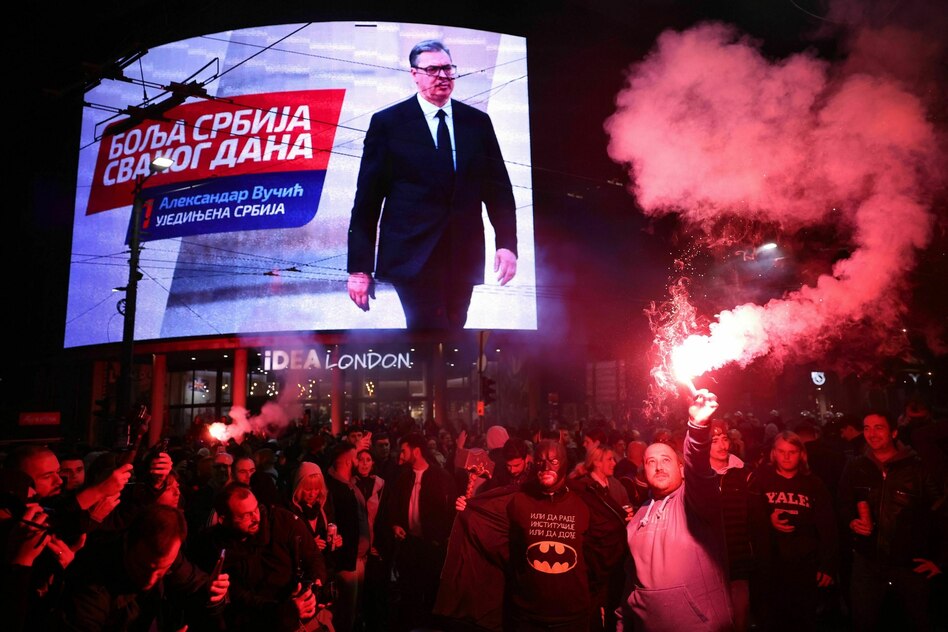
dpa | The new opposition student list surprisingly won the early parliamentary elections in Serbia. Long-time ruler Aleksandar Vučić admitted defeat. This means that the country is facing a change of power: Vučić had almost single-handedly determined Serbian politics in various roles since 2012, relying on Russia and China, and the country moved away from Europe. Who will now become head of government is still unclear, despite the brilliant election victory of the grassroots democratic student list (SL).
The vote was widely seen as a referendum on the country's leadership under Vučić and his Serbian Progressive Party (SNS). The official election results were pending that night. According to a forecast by the electoral research group Cesid, the opposition movement won an absolute majority with a good 52 percent of the votes, while Vučić's party got a good 39 percent of the votes. The voter turnout reached a record level of almost 70 percent.
When the results were announced, seemingly endless cheers erupted in the streets and squares across the country. In the capital Belgrade, motorcades raced through the city honking and fireworks lit up the night sky. Tens of thousands of people celebrated wildly in the central Slavija Square.
With their slogan “Serbia or the Mafia,” the student list hit a nerve. In the 14 years of his rule, Vučić turned the country into an autocracy. Its propaganda media spread hatred and malice, its “election machine” put pressure on citizens who depend on state and local government jobs, and party-affiliated thugs intimidated critics. But the majority of Serbs finally got fed up with the corruption and favoritism of the SNS - and showed Vučić the red card.
The list leader of the student movement, Ilija Srdanović (56), said on election night that he was proud of his fellow citizens who had hurled a clear no at the “tyrant” Vučić. He was convinced: “We are moving towards a more civilized and better Serbia.”
What is remarkable is that there are almost no students on the student list. She has set up a movement that does without leadership committees and makes its decisions in grassroots democratic assemblies. The list consists primarily of university teachers, doctors and artists. Their brief eleven-point program promises the restoration of the rule of law and democracy as well as the prosecution of corruption and crime.
The student movement emerged from protests following the collapse of the train station canopy in the northern Serbian city of Novi Sad in November 2024, which killed 16 people. Critics attributed the disaster to corruption and sloppiness on the part of the Vučić government. The subsequent student protests mobilized broad sections of the Serbian population and awakened a desire for change.
This hope could now be fulfilled. According to Cesid data, the student list won 139 of the 250 parliamentary seats, while Vučić's SNS has to go into opposition with 104 seats. There are also seven mandates for small parties from ethnic minorities.
Although Srdanović (56), a respected cardiologist from Novi Sad, headed the student list, he is not automatically considered a candidate for prime minister following the SL's election victory. The movement has not yet committed itself to personnel issues regarding a future government.
Vučić, in turn, resigned from his position as president at the end of September in order to become head of government if his party won the election. His presidential mandate would have expired in May next year, and after two terms in office he can no longer run for the position. But the 56-year-old has made a mistake with his tactical moves - the only thing left for him is the thankless job of being the opposition leader.
Serbia, a country with currently around 6.5 million inhabitants, has had the status of an EU candidate country since 2012 and began official accession negotiations with the European Union in 2014 under Vučić. However, the course of the previous Serbian leadership has largely caused the accession process to stagnate. The reasons included the dismantling of democracy, the restriction of media freedom and Vučić's adherence to close contacts with Moscow.
Serbia was the only European country other than Belarus not to accept the EU's sanctions against Russia when Kremlin leader Vladimir Putin launched a military attack on Ukraine in 2022. Russian agents and influencers can move almost freely in Serbia - apparently also on the way to sabotage operations in EU countries such as Germany. The Vučić government's propaganda media denigrated the EU and portrayed Russia and China in a rosy light.
Top EU representatives congratulated the student list on its election victory and promised them close cooperation. “We are ready to support reforms in the areas of the rule of law, media freedom, the fight against corruption and the strengthening of democratic institutions and to work together to advance Serbia's path to the European Union,” wrote EU Commission President Ursula von der Leyen and Council President António Costa in a joint statement on Platform X.
EU Commissioner Marta Kos, who is responsible for enlargement policy, said that after almost two years of protests for democracy, the rule of law and against corruption, people in Serbia took part in the election in historically large numbers. “The door to the EU is open and we are ready to continue on this path together,” she announced.
The student movement has rarely commented on the foreign policy course it would take in the event of a change of power. List leader Srdanović told the Montenegrin daily Vijesti that first the citizens of Serbia had to free themselves from Vučić's “mafia state”. If there is a rule of law and a free media again, it will be possible to have an honest and open debate about the strategic goals of future foreign policy.
Péter Magyar, the Prime Minister of the EU's neighboring country Hungary, was one of the first to express his congratulations. His stunning election victory in April ended the 16-year rule of right-wing populist Viktor Orbán, a close political ally of Vučić. Hungary will support the student list, Magyar wrote on his Facebook page. His congratulations are no coincidence: in fact, the change in Budapest filled the protest movement in Serbia with encouragement and inspiration, as was heard again and again.