
War & Militarism taz
Ozan Ata Canani is dead: in the end it was his country too
Ozan Ata Canani, son of a Turkish guest worker, sang in German. The pioneering work of the rocking bard and democrat was only recognized late. more...
Deutsch (original) ·Auto-translated to English
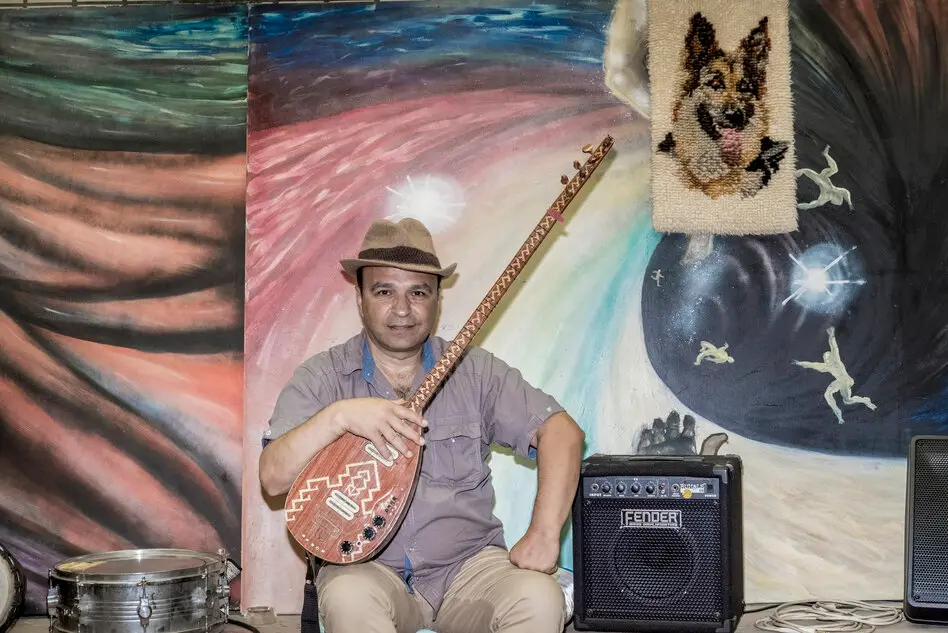
Ata Abi still wanted to smoke. So we stood in front of the door of the hotel in Braunschweig for a long time and talked about this and that. It was an untypically cold September evening, the day before it had been hot. A jogger ran past. Ata said it was far too cold to voluntarily run around outside. He walks through his living room every day and listens to music. Why trudge through the cold?
He then expressed outrage that Turkish Islamists, who set fire to the hotel housing Alevi musicians, poets and intellectuals during the Pir Sultan Abdal cultural festival in Sivas in 1993, continue to live unmolested in Germany. 35 people were killed. Ata found this unbearable. How could it be that in a democratic country these people are not prosecuted for their actions and walk around freely? He later proudly said that he had been invited to the Federal Republic's central celebration of the 65th anniversary of the recruitment agreement with Turkey.
Shortly before, he had sat on stage at a Generation Gold event, performed his songs, and, as always, told his stories and encouraged us all to sing along. That wasn't even two months ago. It was announced on Saturday that the musician had died. Ozan Ata Canani leaves behind a narrow but historic and unique body of work.
The cassettes that he released as a young man decades ago were only noticed in Germany by the community of Turkish origin and in Turkey itself. Turkish music, both that from Turkey itself and the songs written and sung by Turkish guest workers and immigrants in Europe, took place outside the German market and German attention. But Ata had already torn a crack in this wall - because he had decided to sing in German too. This earned him an appearance with Alfred Biolek on his popular television show “Bios Bahnhof”. Ata greatly appreciated Biolek's vision, intelligence and openness.
Ata was 15 and had only been in Germany for a few years when he wrote “Deutsche Freunde” in 1978, an extraordinary German pop song that is now part of the canon. Because Ata sang his German text about people like himself - who live "between two worlds" - to Anatolian wedding party sound: "I am Ata and I ask you where we belong now?" The “German friends” he addressed in his song were not the German people he interacted with on a daily basis. He was referring to the West German politicians in Bonn, and he emphasized that every time he performed his song.
When he was thirteen, his father brought him to Bremerhaven, then the family moved to Cologne. There, young Ata saw swastikas daubed on the walls of houses and the slogan “Foreigners out!” He didn't know that from Bremerhaven. He discovered Max Frisch's famous sentence on the cover of an IG Metall magazine, and so Ata sang: "Workers were called. But people came. Not machines, but people. Our German friends, they enjoy life."
Alfred Biolek was one of the few who understood that this song gave the children of guest workers a voice and expressed their situation in a brilliant artistic move: Anatolian sound, Turkish rhyme scheme, German lyrics. He invited Ata and his band to his show, just as he also brought punks and the young wild ones of the new wave onto his TV stage, such as the Limburg band The Wirtschaftswunder, with which an Italian guest worker named Angelo Galizia sang. “The people from the first generation laughed at me,” Ata later said about his idea to sing in German. “The second generation heard me half and half.” The third generation, however, would understand him.
Ata was a musical child who was encouraged by his grandfather. This memorized his grandson's songs and lyrics and was the archive that Ata could access when he returned to his Turkish hometown. As a boy, he had already been on stage in Germany with his great role model Aşık Mahzuni Şerif. At the end of the 1970s he was active in Cem Karaca's band Die Kanaken, when the Turkish singer suddenly found himself in exile in Germany. Karaca, a star in Turkey, had only wanted to record an album in Cologne when he received news of a Turkish arrest warrant. Ata also played with his bands at weddings for many years.
His first career as a bard came to an end in the mid-1980s. However, a recording of his performance at Bio survived on YouTube, where it was rediscovered, shared and ripped by a new generation. I can still remember the evening when I heard “Deutsche Freunde” for the first time. I was putting on music in the taz café when Deniz Yücel simply handed me a USB stick: Play this. I did that and everyone immediately danced to Ata's song.
A little later, Imran Ayata and Bülent Kullukcu sent him to the studio to re-record “Deutsche Freunde” for the compilation “Songs of Gastarbeiter”. The old tapes ended up in the trash after a breakup. This began Ata's second career as a musician, which has now come to an abrupt end.
Two albums have been released in recent years on the Berlin label Fun in the Church, an imprint of Staatsakt. “Wait My Country, Wait” was released in 2021. The title song told a story that many children and grandchildren of guest workers know and brought to tears at Ata's concerts: people who long to return to their homeland throughout their lives, but only return to their country after their death to be buried there. Ata wanted the song to be dedicated to all guest workers “who have lost their lives here in Germany and in Europe”.
“Wait my country, wait” filled a gap of several decades and built a bridge from the themes and aesthetics of the early 1980s to the present. It was only the 2025 album “The Democracy” that presented the wide range of Ata Canani’s music and poetry. His German songs were in the tradition of songwriters since Wolf Biermann, his Turkish songs could compete with those of the Aşıks, the singing poets of Türkiye. On this second album he dedicated a song to the victims of the Sivas massacre and accused the “false believers”.
"Strangers became friends, now it was finally our country. Our fathers' fathers paved the way for us," he sang in his homage to the first generation of guest workers. The fact that Ozan Ata Canani himself was now recognized as an artist, albeit late, clearly filled him with pride. When he performed, he was celebrated as a pioneer and chronicler, and the boys paid him respect.
“You don’t give up what you’ve fought for so easily,” says the title song “The Democracy,” in which he took a stand against neo-Nazis and right-wing extremists and pointed to human dignity as the measure of all things. Ozan Ata Canani was an avowed democrat, and as such he valued and defended his Germany.
Ata was a humanist and a political mind. He had a sense of humor and a big heart. And he was a rocker. When he connected the Bağlama to his effects devices, he tinkered with the person at the mixer until his long-necked lute had the hard, metallic sound he wanted to hear. When Ata played, he did not display sentimental Orientalism. With his lute he blasted out pain, anger and sadness. She was the organ to express his feelings. Ozan Ata Canani was born in 1963 in the southeastern Anatolian city of Maraş. He died in his new country. His songs will outlive him.