
Germany taz
Otto Mühl, not an artist, but a perpetrator: Vienna Actionist Twilight
The new Vienna Actionism Museum actually wanted to rehabilitate Otto Mühl as an artist. But it is now failing because of Mühl as an abuser. Summary of a nasty story. more...
Deutsch (original) ·Auto-translated to English
Museums are trusted, even by those who don't go there. It's not quite as big as with friends or family, but far bigger than with parties, churches and social media, which rank equally low in a study by the Berlin Institute for Museum Research on trust in social institutions.
This trust gives power. In the case of the art museum, this is not just symbolic or limited to the distribution of resources and gratifications in the art system. The attribution and dissemination of what art is moves values and markets beyond it, and has an impact on the lives and experiences of people who have not chosen to access art at all.
This is particularly true for the works of the pedosexual offender Otto Mühl (1925–2013), who was sentenced to seven years in prison in Austria in 1991. Art institutions that have promoted Mühl for decades do not escape their responsibility towards the victims of Mühl's sexual violence in the sect that was focused on him as a guru and which existed under the name Aktionsanalytic Organization (AAO) from the beginning of the 1970s until its dissolution in 1990 at Friedrichshof in Burgenland, even by referring to artistic freedom.
A reading at the Burgtheater during Claus Peymann's time allowed him to portray himself as a rebel who had been unfairly or at least punished too harshly by the conservative establishment. An exhibition at the Vienna Museum of Applied Arts (MAK) mocked Mühl's “seven-year creative state retreat”. Shows in the Leopold Museum and Museum of Modern Art Foundation Ludwig (mumok) contributed from different perspectives to integrating Mühl into the narrative of Austrian art history after 1945.
Since then, works from the late 1980s have repeatedly appeared in Austrian galleries, museums and auction houses that no longer have anything to do with Actionism, were created in Mühl's sect, clearly depict victims of abuse in figurative painting or are related to abuse. They pose the risk of re-traumatization for everyone who experienced psychological and sexual violence as children and young people in the sect's coercive system.
Mühl was convicted of lesser crimes. The only legal defense left for those affected is personal rights, according to the Viennese lawyer Maria Windhager, who is currently conducting a test case at the Graz regional court. The fact that what happened is now on record through their witness statements is a step forward for many of those affected.
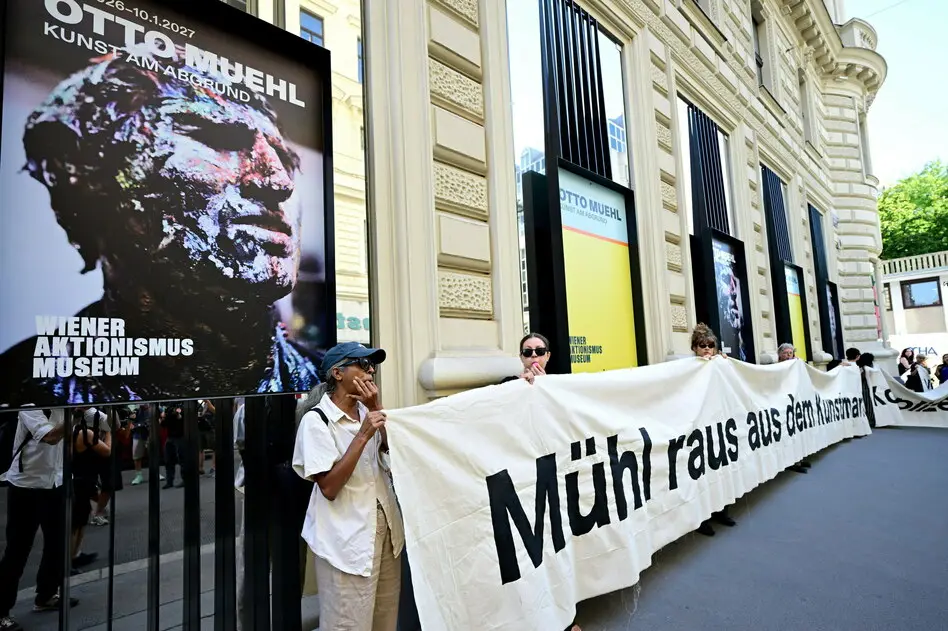
In the Mühl case, a concept of autonomy that seeks to view art in isolation from life practices ends up in both self-contradiction and a zone of moral untenability. This is also why a current exhibition curated by the former director of the Vienna Albertina Klaus Albrecht Schröder in the private Vienna Actionism Museum (WAM) on Otto Mühl fails. On the one hand, the show claims to let Mühl's work stand on its own, "neither making the meaning of his art disappear through his crimes nor relativizing the crimes through the meaning of his art."
The title “Art on the Abyss,” on the other hand, flirts with abuse. The ambivalence in the wording opens the way to Mühl's trivialization of his crimes in a romanticized self-staging as an artiste maudit. The attempt to validate his oeuvre as a complete work of an artistic genius fails several times. Entire complexes of works are hidden, which are exactly what Schröder wants to acquit from the works he shows: “evidence of his crimes”.
What can be seen remains a torso. Still photos from the Actionist era, such as the “Leda and the Swan” campaign, perhaps only show what a former Wehrmacht member imagined sexual liberation to be like. Other works are quite simple epigonal approaches to figures in art history from van Gogh to Rainer Fetting.
In the show, two attempts at transfer fail: to extend the modest reputation that Mühl enjoys in the actionist context of the 1960s compared to other representatives to the entire output; but also the plan to upgrade the showroom of a private collector's initiative with the trust that the public places in the word image "museum". The WAM will end its public operations in January 2027.
Otto Mühl claimed to abolish the separation of art and life in the collective of the community as a total work of art, so to speak. The “pure” view of art, on the other hand, abstracts Mühl’s victims into collateral damage in everyday life, depriving them of their voice, identity and agency.
The Mühl case apparently affects the cultural capital of public museums, which were involved in its normalization and sometimes glorification, to such an extent that doubts arise as to whether they are even in a position to adequately deal with their own role in this case. There are calls for this task to be transferred to an independent commission equipped with appropriate research resources.
Ulrike Schiesser, Managing Director of the Austrian Federal Office for Sect Issues; Hedwig Wölfl, psychotherapist and head of the Viennese child protection center die möwe; Maria Windhager and the former collection manager at mumok, Marie-Therese Hochwartner, approached the responsible minister and vice-chancellor Andreas Babler at the beginning of the year. There are role models for such a commission. According to the Art Restitution Act of 1998, a commission for provenance research works independently of the individual houses in the museums and collections of the Republic of Austria.
However, as was learned at a meeting of the Federal Office for Sect Questions in Vienna at the weekend, such an independent research project will not take place for the time being. Babler had signaled his willingness to act. The implementation at the civil service level, on the other hand, is similar to a Musil parallel action, which, true to the literary model from “Man without Qualities”, sets up a replacement action that counteracts the original intention to act.
The five directors of the Austrian federal museums were commissioned to create a general guide on how to deal with violent art. This already exists, as the museum directors said. The responsibility for this remains with the houses. Researchers and the representation of the interests of victims depend on them.
There is no talk of further processing, of funding for the development of the extensive film and video archive at the former cult location on the Friedrichshof, for example. The political justification was strange to some conference participants. They don't want to encroach on the autonomy of the federal museums so as not to set a precedent for an impending right-wing government to intervene in the art system.
And yet progress remains. With the Federal Office for Sect Issues, established by law as a public institution, a state agency, no longer just NGOs or individual initiatives, is leading the debate and establishing a different language beyond art historical mechanisms of authoritative attribution of value, which dismisses any criticism of it as an objection of unscientific concern. It not only clarifies terms, but also allows survivors to rediscover their own experiences in an interdisciplinary context.