
Germany taz
Opera “The Flying Dutchman” in Berlin: With Wagner against Wagner
Milo Rau brings Wagner's “Flying Dutchman” to the stage at the Deutsche Oper in Berlin. He had previously traveled through Israel to play the anti-Semite's music there. more...
Deutsch (original) ·Auto-translated to English
The Flying Dutchman stands alone on the beach. Behind him is the surf, threatening to swallow everything up. And dead bodies everywhere. Tomasz Konieczny's Dutchman takes his steps as heavy as lead. His shoulders are tilted forward and drag his neck. It's as if a weight that he physically feels but we don't see is weighing him down. Richard Wagner gives his Dutchman a whole aria in the first act to feel sorry for himself, because for him there is "Nowhere a grave! Never a death!"
Konieczny sings as if something was inevitably turning inside out. The Deutsche Oper orchestra under the direction of Giedrés Šlekyté accompanies him in a focused and warm manner. He stops in front of the corpse of a young woman, kneels down and carefully places his jacket over her upper body. Sarah von Schwarze picks him up and puts the jacket back in his hand.
Von Schwarze and Shlomi Moto Wagner accompany the performance from the side stage ramp. Milo Rau went on tour with both of them in Israel last August to promote the music of Richard Wagner. 25 years ago, Daniel Barenboim broke the taboo of playing Wagner in Israel. In Rau's Berliner “Flying Dutchman”, the video recordings form the backdrop for the stage action. They can be seen in close-up on the back wall of the stage.
In the central bus station in Jerusalem and in front of the Israeli-Palestinian theater in Jaffa, the Israeli singer Tamara Nishri sings, among others. Senta's aria. And so you see Nishri Senta's longing for the Dutchman blaring into the summer evening sky, and at the same time Aušriné Stundyté is on stage as Senta, stretching her hands upwards and it's as if she were picking up every single note right there. The viewer's gaze tries to read the large faces of the Israeli audience. Meanwhile, Stundytés Senta leads her own life on stage.
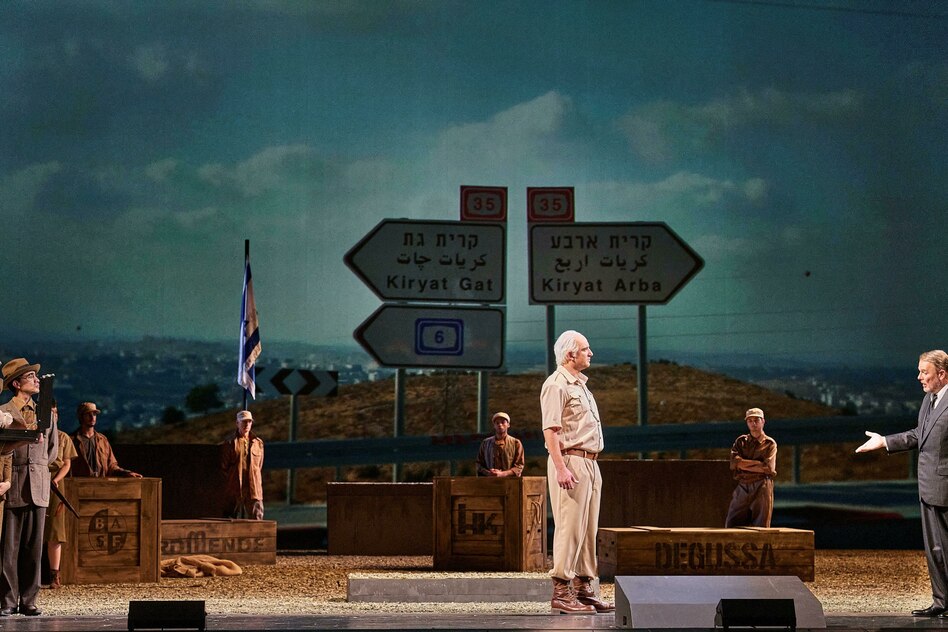
In his third opera production, Milo Rau juxtaposes several levels. With Sarah von Schwarze and Shlomi Moto Wagner, he introduces two narrators who tell their family history before the overture, going back to the Second World War. The overture accompanies the performance of the soloists, who report on the momentous decisions their ancestors made during the Second World War. And so the framework is set for a further level: Holländer's guilt, which causes him to wander on the world's oceans and from which he wants to be redeemed, becomes German guilt, Senta's father Daland becomes one of the founding fathers of Israel and Erik, who is in love with Senta, already an outsider in Wagner, becomes a Palestinian.
A clever documentary theater dramaturgy accompanies the scenic action by assigning the three acts to three thematic complexes of German-Israeli relations: the founding of the state in 1948, the Munich Olympic attack in 1972 and the inauguration of the memorial for the murdered Jews of Europe in Berlin in 2005. In a few sentences projected on the screen, the mixed cause-effect situation is brought to the point. The duet between Daland and the Dutchman is scary, while Milo Rau sees two statesmen in front of the Israeli and German flags.
At Wagner's, Daland "sells" his daughter out of greed for Holländer's treasures. Rau gives Tomasz Konieczny a briefcase. Submissively humble and at the same time aggressive, he forces the briefcase with a contract on compensation payments on Tareq Nazmi's Daland. In the stage setting of the “Memorial to the Murdered Jews of Europe” (stage: Anton Lukas), the choir intones “Dear neighbors, wake up and follow us,” while the relevant light blue has conquered the state-supporting two-parter.
Shlomi Moto Wagner and Sarah von Schwarze stand on a hill in August. They look towards Gaza and talk to the artist Ashraf Afifi from Gaza City on the cell phone. He says: “Guilt is narcissistic.” It has to turn into responsibility in order to change something. Afifi has the last word, Giedrés Šlekyté dabs the remaining bars into the room with the orchestra. The head is full of associations in all directions. The feeling of overwhelm that often comes over you when you listen to Wagner is absent this time. You listened differently. With Richard Wagner against Richard Wagner. And against the endless spiral of violence.