
Germany taz
Open letter for associations: “A blocking law is unconstitutional”
Over 200 people from trade unions and science speak out in favor of the right to socialize. The Basic Law must be respected. more...
Deutsch (original) ·Auto-translated to English
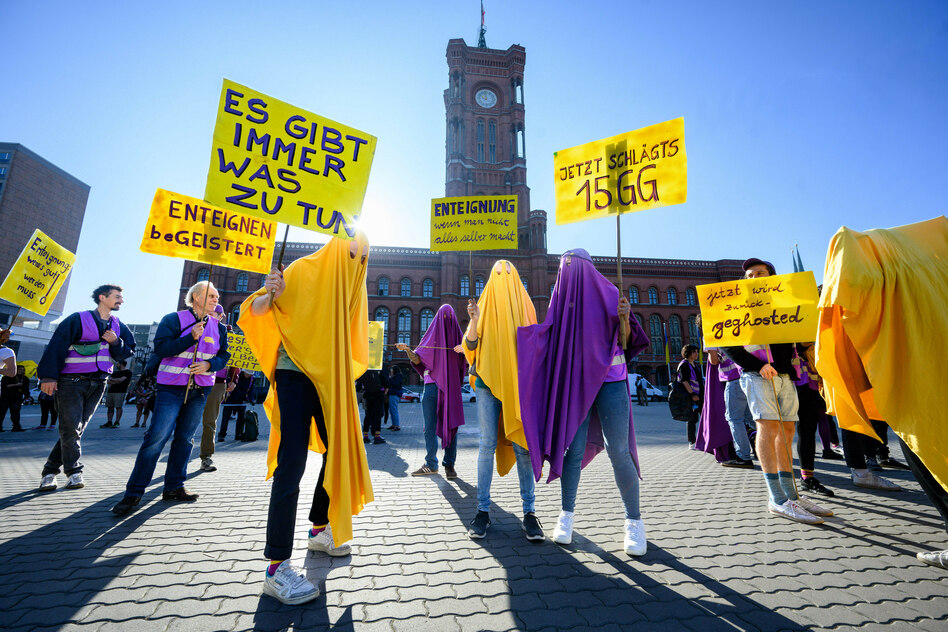
More than 200 people from science, culture and trade unions speak out in favor of the right to socialization. They are calling on the federal government to respect the Basic Law and not to undermine Article 15 “through a blocking law”. This is what it says in an open letter published this Thursday. Article 15 is the hotly debated article of the Basic Law that explicitly allows socialization but has never been applied.
The closer a red-red-green state government gets to Berlin, the closer this scenario becomes. Finally, the Left, the Greens and the SPD agreed in exploratory talks to socialize large private housing companies. These should therefore continue to retain a base of 10,000 apartments, but the housing stock that exceeds this should be transferred to common ownership for compensation. The original plan set the limit at 3,000 apartments, but that couldn't be done with the SPD. A law should be presented by mid-2028.
The very idea that this could be implemented terrifies the current black-red federal government. Back in July, the coalition announced that it would prevent Berlin's socialization plans with a new law - and that's exactly what the open letter is aimed at. It was signed by, among others, the economist Isabella Weber, the Verdi chairman Frank Werneke, the chairman of IG BAU Carsten Burckhardt and the actresses Corinna Harfouch and Katharina Thalbach.
The signatories agree: regardless of the substantive position, the question of socialization must be “decided in the democratic process”. A blocking law prevents exactly that. It would be “unconstitutional, contradict the founding consensus of 1949 and disregard the will of the population,” says the open letter, which explains these three points in more detail.
The signatories consider a blocking law to be “unconstitutional”, regardless of how it could be implemented. Both a simple federal law that imposes a ban on the states and a framework law that has the purpose of “making socialization more difficult or preventing it through additional conditions” would “eliminate an article of the Basic Law without having the necessary two-thirds majority in the Bundestag and Bundesrat to change the constitution,” they argue.
Reference is also made to the history of the Federal Republic. The Basic Law emerged “in 1949 from the experience of the massive abuse of economic power in the Nazi war economy and the expropriation of Jewish fellow citizens.” The Basic Law therefore protects private property in Article 14, but also states that “property has an obligation” and “should serve the common good”. Article 15 also distinguishes “personal property from economic power resources” and gives “future generations the opportunity to organize parts of the economy for the common good.”
Co-signatory Isabella Weber, who wrote the book “Antifascist Economic Policy,” explains: “At the Potsdam Conference in 1945, all Allies agreed that the concentration of companies had to be ended in order to ensure the restoration of democracy.” Against this background, the German Basic Law provides for the possibility of socializing land, soil, natural resources and means of production. This is “part of the anti-fascist orientation of the Basic Law”.
Finally, the open letter appeals to respect the will of the population. In 2021, a majority in Berlin voted in a referendum for the socialization of private housing companies that own more than 3,000 apartments. The attempt to “subsequently block this decision from a higher level” signals: “Majorities don’t count if they run counter to economic interests.”
How exactly the federal government wants to thwart the socialization plans in Berlin is still unclear. One thing is certain: Chancellor Friedrich Merz (CDU) confirmed the plan after the Berlin election. The Federal Ministry of the Interior, led by Alexander Dobrindt (CSU), is responsible for implementation. But that doesn't reveal any details yet. A spokesman for the ministry told the taz: “The coordination processes on the project within the federal government are ongoing.” Federal Justice Minister Stefanie Hubig (SPD) doubts the sense of socialization, but recently pointed out that a blocking law would be “constitutionally non-trivial”.