
Germany taz
November pogroms: commemoration in the bitter cold
At the Jewish cemetery on Schönhauser Allee, Berliners remember the victims and warn against the resurgence of anti-Semitism. more...
Deutsch (original) ·Auto-translated to English
Although the sun shines through the bare branches of the trees, it is cold on Monday morning in the Jewish cemetery on Schönhauser Allee. A tourist guide shows a group of seniors the area and gives them a lecture about the historical development of the cemetery. About 10 people are in the Lapidarium, a white, simple and modern building for old gravestones, which is located right at the entrance. The seniors examine the 64 historical gravestones that could no longer be assigned to their graves after the Second World War.
Around 11:30 a.m., 20 to 30 people gradually gather in front of the entrance to the lapidarium. They form a semicircle around a large plaque on which is attached a 2-meter-tall Star of David made of metal bars and on which are written the words: "Here you stand in silence. When you turn, be silent."
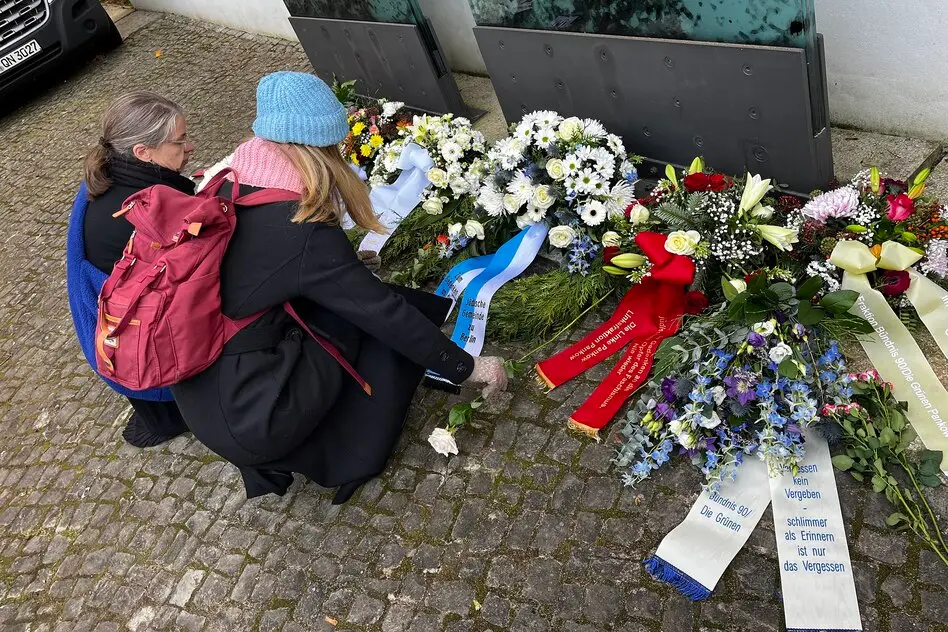
Three participants' small cars and a construction waste container seem a little out of place. Likewise the two police officers who guard the event and the cemetery. Despite the rather unceremonious but still quiet scene, the first participants begin to lay wreaths in front of the glass table.
The victims of the Reichspogromnacht on November 9, 1938, which took place exactly 88 years ago on Monday, are to be commemorated at this location. The organized violence erupted throughout the German Reich on the night of November 9th to 10th. Before the eyes of the police and the Gestapo, more than 7,000 shops were destroyed and around 30,000 Jewish men were deported to concentration camps. In Berlin, synagogues in Charlottenburg, Wilmersdorf and Mitte were also set on fire and around 12,000 Jewish men were deported. Many did not survive the inhumane conditions in the concentration camps.
88 years later, members of the Jewish community in Berlin and members of the association of those persecuted by the Nazi regime - Association of Antifascists (VVN) and Berliners gather to remember these crimes. After looking at the thoughtful faces of those present, it becomes clear that the group is mainly made up of older people. Nevertheless, a rather young man is the first to appear in front of the congregation and begins to speak.
It is Fabian Bunschuh, head of the Pankow district council. After a few words about November 9, 1938, he moves on to the present with the sentence “Since that day, anti-Semitism has still existed in our society.” Even today, violence against Jews in Germany is increasing again. The powerlessness experienced in the fight against the newly emerging anti-Semitism is particularly tragic for the descendants of the old perpetrators.
He explains that maintaining the culture of remembrance is becoming less important with each passing year and new topics are coming to the fore, without mentioning the Middle East conflict in question by name. “Every year (…) we lose more contemporary witnesses,” he adds.
Bunschuh hands over the floor to Sigmount A. Königsberg, the anti-Semitism representative of the Jewish Community in Berlin. The tall man with gray hair and tinted glasses begins his speech with a quote from Erich Kästner: “The snowball should have been kicked out in 1928, which later became an avalanche.”
The last person to speak is Jutta Harnisch, representative of the VNN. She looks into the past and outlines to the freezing audience how the graphic artist and writer Peter Edel experienced Max Liebermann's funeral as a teenager, which took place in the same Jewish cemetery and was almost impossible to carry out due to the surveillance and harassment of the Gestapo. Finally, she quotes Fritz Bauer, the public prosecutor during the Auschwitz trials: “Nothing belongs to the past, everything is present and can become the future again.”
The freezing people leave the cemetery, leaving behind the colorful wreaths with their printed, warning ribbons.