
Germany · taz · · 1h
Nobel Prize in Physics: On the trail of cosmic ghost particles
Deutsch (original) · Auto-translated to English
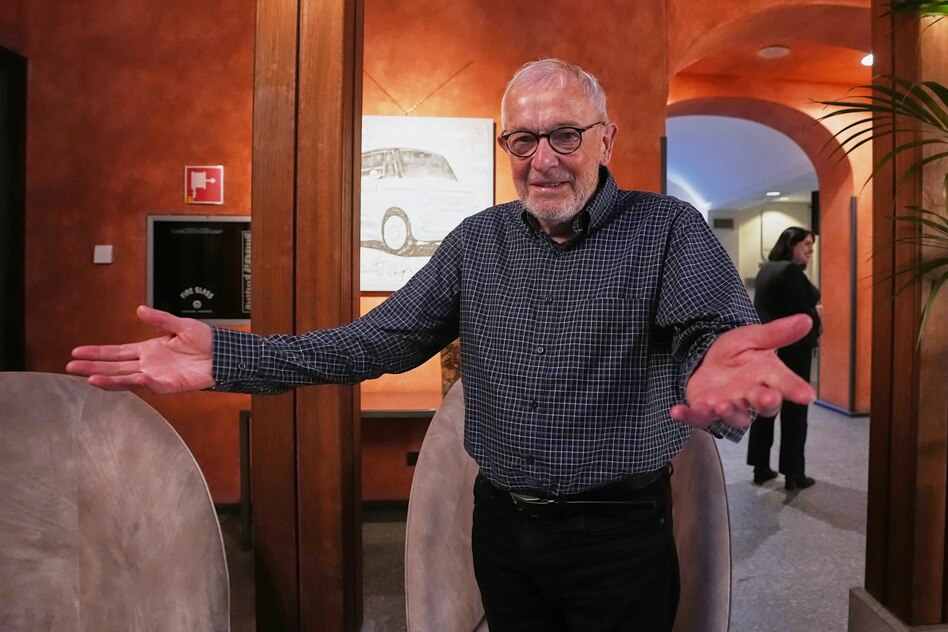
It was as if a new window into the depths of the universe had opened at the South Pole in 2010. Together with hundreds of colleagues around the world, Francis Halzen has built a very different kind of telescope there. The scientists use this to search for high-energy cosmic neutrinos, also known as ghost particles.
These messengers from distant space make the invisible visible. They tell stories about extremely high-energy processes in the universe: about huge black holes, so-called blazars, that actively devour matter, or about stellar explosions, also called supernovae.
For this completely new way of exploring space, the Belgian-American astrophysicist Francis Halzen will receive the Nobel Prize in Physics on Tuesday, endowed with 12 million Swedish crowns, the equivalent of around one million euros. This is the fifth Nobel Prize awarded to research on neutrinos.
Their existence fascinates researchers and at the same time presents gigantic puzzles again and again. Unlike other elementary particles, little is known about them. Especially since they are difficult to detect and therefore actually behave almost like ghosts. But they are everywhere. Every second, billions of neutrinos flow not only through space, but also through our bodies, surrounding and penetrating us and the Earth - completely unnoticed. Because they have hardly any mass, no charge and only rarely interact with matter.
The ghost particles arise from high-energy processes in the cosmos. An example of this is nuclear fusion in the sun, which produces neutrinos in addition to light.
Star explosions and black holes produce much more energetic neutrinos. Because neutrinos do not collide with matter and are thereby deflected or scattered, they do not lose any information on their journey. If you measure them, they arrive on Earth virtually unadulterated after billions of light years on their journey through the universe. This allows researchers to clearly trace their place of origin and the processes during which they were created.
The only problem is: the high-energy ghost particles are rare - but how do you find them?
To detect them, Francis Halzen built a different kind of telescope. He already had the vision for this in 1988. The telescope has no radio antennas, is not even aimed at the sky, and is called IceCube. Embedded three kilometers deep under the ice sheet, it consists of thousands of light sensors that monitor a huge space of around one cubic kilometer in the hope of finding one of the rare high-energy particles there.
Deep beneath the ice there are few interfering signals. At the same time, the Earth itself acts almost like a gigantic protective shield through which neutrinos can fly through without any problems, but other particles are stopped. When a neutrino hits an atomic nucleus, it produces what is known as a muon flash of light. The researchers can measure this in the ice and thus track where the neutrino came from. The measurement space is so large to increase the probability of this rare event.
Construction was completed in 2011 and soon afterwards the researchers were able to detect the first neutrinos, which must have originated far away in our solar system. In 2017, IceCube was able to detect neutrinos for the first time, which presumably come from a distant galaxy.
The project goes far beyond one person. Similar to the particle accelerator CERN, there is an international research network behind IceCube. Over 450 people from 14 countries and 58 institutes are conducting research with the ice telescope.
Nevertheless: “Francis Halzen is the soul of IceCube,” says Elisa Resconi, professor of experimental physics with cosmic rays at the Technical University of Munich and a member of the international project. Halzen recruited her to IceCube in 2000 and brought in many of the younger generation. Especially since he always kept the researchers together. Anyone who works on neutrinos is always frustrated. Because there is a lot we don't know about them yet and new methods, procedures and calculations always have to be invented.
Halzen and other researchers are now working on new locations for additional telescopes, spin-offs of IceCube, so to speak. It is important that the telescopes are built in locations that are relatively undisturbed and have a large volume of transparent material, says Resconi. One place for this is the Pacific Ocean. Resconi is planning the construction and is pushing forward the P-One project, short for Pacific Ocean Neutrino Experiment. Perhaps a new window through which researchers can soon look.
Read the full story at the source
Source: taz