
Germany · taz · · 2h
Nobel Prize for Medicine: Victory for basic research
Deutsch (original) · Auto-translated to English
Markus Rothermel, Professor of Neurophysiology and Optogenetics at the Magdeburg University Hospital, told taz on the phone that he almost no longer believed that optogenetics would finally be honored with the Nobel Prize. Optogenetics has revolutionized neuroscience as a method. With it, a kind of light-sensitive switch was found that can be used to switch individual neurons on and off.
Only through them can Rothermel and many other research teams around the world now really begin to understand the brain and its individual neurons; where attention arises, how nerve cells form memories or feelings. The research world owes this opportunity to three scientists in particular who received the Nobel Prize in Medicine on Monday: Peter Hegemann, Georg Nagel, both professors in Germany, and Karl Deisseroth, from the US University of Stanford.
Optogenetics has already been considered a Nobel Prize winner in recent years. And time and again, other areas of research should be acknowledged first. And in general, the researchers needed a lot of patience before their findings were really recognized.
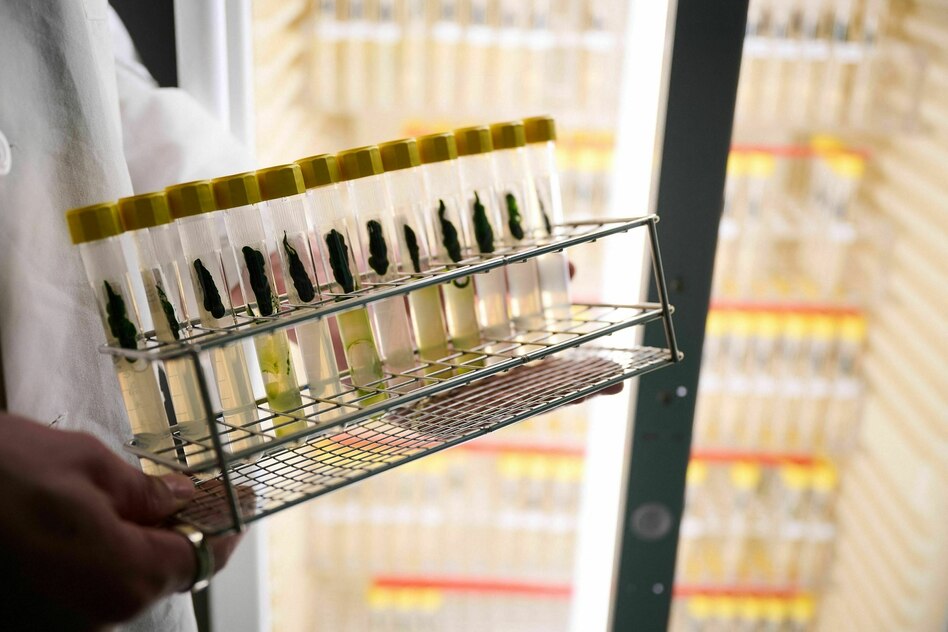
The decisive factors for the breakthrough were curiosity and a bit of luck, as is typical for research. The department didn’t even start out in neobiology. It was the green alga Chlamydomonas, found in puddles, ponds and lakes, that aroused Peter Hegemann's interest. It has a red eyespot and can always move where the light conditions are best for photosynthesis.
This is made possible by a photoreceptor in the eye spot, which is very similar to the human visual pigment rhodopsin. Algae rhodopsin is built into the cell membrane, the barrier that separates the cell from the outside world, and it forms a channel. When light falls on it, the channel opens, transferring positively charged particles from one side to the other and thus generating an electrical voltage. The channels in the brain that activate neurons and transmit signals work in a similar way.
But for a long time, many research colleagues did not want to believe in the light-sensitive ion channels. It wasn't until 2002 that Peter Hegemann and Georg Nagel, who was a research group leader at the Max Planck Institute for Biophysics in Frankfurt at the time, achieved the breakthrough. They were able to show that the channel actually triggered electrical signals in milliseconds.
The US neuroscientist and psychiatrist Karl Deisseroth is also interested in their results. He finally managed to build the light-sensitive channel into neurons and later even into the brain of a living mouse by introducing the corresponding genes for the light channel. And indeed: depending on light, neurons can suddenly be switched on or off.
Her method finally allows a real look into the brain and answers to the questions: How memories are created, how emotions are formed and how attention is created. Markus Rothermel is researching the latter at the Magdeburg University Hospital. To this day, we still don't know how the brain actually works. Also because the individual components, the small electrical units called neurons, could not be controlled in detail.
The methods were simply crude: electrical impulses only stimulated areas and all neurons within them, although these can have very different functions. In one area there can be neurons that actively transmit nerve signals and others that block them.
Therefore, for a long time, researchers could only establish correlations but not prove causality. They knew that when a laboratory animal or human behaves like this, we see activity in that area. For example, Rothermel's research group was able to know that the region of the brain they were studying is important for attention-dependent processes.
But for a long time they were unable to prove that the activity of a certain type of neuron in this area of the brain causes a test animal to behave in a certain way. This is exactly what optogenetics does. The researchers can program exactly which nerve cells the light-sensitive channels are active in and manipulate these cells in a targeted manner.
Johannes Vierock knows that this is also possible in clinical use. He experienced the many successes very closely with Peter Hegemann. Starting with his bachelor's degree, he worked in his laboratory from 2009 to 2022, ultimately becoming a doctor. He now works on applications for vision and hearing loss as a professor at the University Hospital of Göttingen.
For the past few years, the others in the field have repeatedly been wondering whether Hegemann would get the call from the Nobel Committee. Now everyone who works together in this field worldwide is very excited. “It’s particularly nice,” he thinks, “that the Nobel Prize focuses on basic research.” He shows that it’s worth dealing with the smallest things and the whole world.”
Because the discovery was found in an area that really doesn't suggest neuroscience. With the question of how algae perceive light. “Nobody would have thought that this algae would play a role in the brain,” he says. And also not that, as shown for the first time in 2021, blind people would be able to see rudimentarily again. Viereck is now continuing to research the possibility of more. And technology could also possibly play a role in the future in the areas of Parkinson's disease, schizophrenia and epilepsy.
Read the full story at the source
Source: taz