
Anti-fascism taz
New face, old concept: eternal fascism
The “old” fascism is based on enormous, moral-free values. And the “new” fascism? Connects to digital neoliberalism. more...
Deutsch (original) ·Auto-translated to English
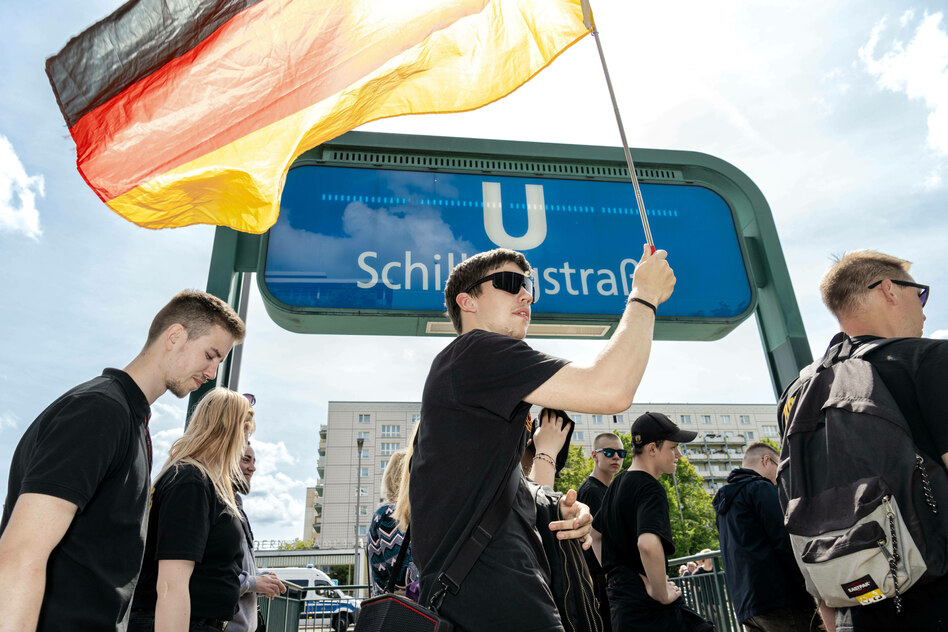
They were never gone, the ethnic nationalists, the incorrigible Nazis, the zealots who strive for racist and sexist “purity”. The philistines who forego any kind of freedom out of fear of the freedom of others, the fascists. There is the “eternal fascism” that Umberto Eco spoke of and which can be precisely identified by its language, its goals, its images and its ways of acting. This potential for fascist reaction threatens as long as there is a capitalist class society with a restless petty bourgeoisie in the middle.
Their influence on society is greater the weaker the social, intellectual and cultural counterforces are. This includes the dissolution of the political organizations of the workers, who ultimately have to feel more represented by the right than by the social democrats, the trade unions and the left-wing intellectuals. After all, it was not just since neoliberalism that workers were promised a rise to the petty bourgeoisie. Anyone who doesn't manage this advancement has only themselves to blame - and when things get up, they end up in the precariat. As an individual.
And yet the triumph of right-wing extremism at this time cannot be explained solely by the continuity of “eternal fascism”. The new fascism is certainly exactly the same as the old one in many core areas. But there are also some differences from historical fascism. National Socialism in Germany, for example, cannot be explained without its close ties to industrial capitalism. This is not just a matter of interdependence and corruption, this give and take between the terrorist state and the large economic complexes, as can now be observed again in the USA.
The taz is an independent, left-wing and opinionated daily newspaper. We have been arguing in our comments, essays and debate texts since the taz was founded in 1979. We often cannot and do not want to agree on an opinion. That's why you'll find some completely opposing positions here - all part of the very broad left-wing spectrum of opinions.
Rather, it is a joint development of capitalism and fascism on the basis of worldviews: the transformation of society into a huge, efficient machine freed from all morality and reason. The fascist of this type wants to become part of the machine, the “ornament of the masses” aestheticizes this mechanization, just as militarization and war do.
The new fascism, on the other hand, must combine with digital neoliberalism. Instead of mechanical, it’s about “fluid” fascisation. Because this neoliberalism also promised and demanded fundamental subjectivization to its partisans, something of the subject hedonism as well as the subject paranoia remains among activists and followers of the new fascism. For the movement, this has the massive advantage that contradictions, non-simultaneities and obvious lies can be dealt with much more elastically than with historical fascism. The new fascism does not have to be “uniformed,” and its masses must be less mechanical than flowing.
Capitalism in the period of historical fascism had adapted perfectly to regimes such as those under Hitler, Franco or Mussolini, and its representatives knew only too well how to enrich themselves through “Aryanizations”, arms contracts or cheap labor from prison camps. With the new fascism, however, the situation is rather the opposite: it adapts perfectly to the needs of post-neoliberal oligarch capitalism.
And while historical fascism aimed at one major and exclusive phenomenon, the connection of industrial capitalist progress with the mechanized people in Germany or the connection of fascism and Catholicism in Spain, the new fascism lives precisely from a variety of scenes, milieus, movements, ideologies, narratives that can be organized in relation to a person (Trump in the USA) or a symbolic center (AfD in Germany), while otherwise the connections between them can remain loose.
While the left is a community of ideas (and therefore somewhat unstable and divided), the right is essentially a community of faith (in whose rites and stories even the most absurd things can be united). The belief that unites the most diverse groups on the right arises from negation: the apocalypse is imminent and, as Naomi Klein writes in “End Times Fascism,” there is no longer an outside to the catastrophes that are preparing for it, unlike in historical fascism. The energies are therefore directed inwards, towards a “cleansing” of one's own society, towards a fundamental requirement of silence, towards the repression of reality in religious madness. A faith community is not about solutions, but about salvation. This creates a complete resistance to reason and morality.
But all of these characteristics of the “new” fascism, the intimate connection with neoliberalism, the fluid character of fascisation (not least in social media), the subjectivist residue (declared as “freedom”, practiced as the residue of individual liberality and consumerism), the diversity of scenes and milieus, the apocalyptic, pseudo-religious orientation of the big right-wing narrative, the pop character of many right-wing productions – they are at the same time strengths and weaknesses of the new fascism.
Right-wing movements (like MAGA) can disintegrate into their individual parts when the unifying symbolic figure disappears, hedonistic subjectivism can triumph over political organization, the apocalyptic energy can weaken, the pop component can be absorbed into new cults, and last but not least, the pact between the tech oligarchs and the new fascists can be dissolved at any time. Not to mention that democratic civil society may also reorganize itself as a new anti-fascist force. When she begins to resolve her own conflicts and recognize the opponent in his true form.