
Germany taz
New director of the Schauspielhaus Düsseldorf: Kleist is his favorite author
The new artistic director Andreas Karlaganis has made an impressive start at the Düsseldorf Schauspielhaus. He relies on experiment and continuity. more...
Deutsch (original) ·Auto-translated to English
Wilfried Schulz was director of the Düsseldorf Schauspielhaus for ten years. It was a formative era, because never in the history of the elegant house on Gustav-Gründgens-Platz did an artistic director have to overcome so many crises in such a short time. It started with Schulz finding difficult conditions when he took over as director in autumn 2016, because the post-war modern building by the Düsseldorf architect Bernhard Pfau with its curved, white facades was closed due to urgently needed renovations.
The first premiere therefore took place in a circus tent on Königsallee: humanity's oldest surviving written drama, “Gilgamesh”, staged by the then in-house director Roger Vontobel as a trashy musical revue with hip-hop and primal mud on the tent floor. Next to Christian Erdmann, André Kaczmarzcyk raged through the spectacular, deliberately low-threshold evening. During the Schulz era, Kaczmarzcyk later developed into the star of the ensemble, who was able to go it alone many times and rose to become the gender-fluid inspector in the TV crime drama “Polizeiruf 110”.
Schulz had to play in temporary arrangements for three years; the rehearsal stage at the train station, called “Central”, became the main venue. After the renovation, the Central was established as a second house for the Junge Schauspiel and the Bürgerbühne, now Stadt:Kollektiv. Schulz decisively opened the house, which had previously been bobbing along with a weak profile, into the city. He produced tirelessly, not always something significant, but the program was increasingly well received. He also brought the great Bob Wilson to the house, who gave Düsseldorf several legendary productions.
Schulz also mastered the pandemic with its lockdowns with his characteristic skill, and he countered the increasing radicalization of society with an iron will to democratize and further open up the theater. Under the label “D’haus” he brought the house to an occupancy rate of over 85 percent. Bob Wilson's "Sandman", staged in 2017, leads the ranking of productions with 57,149 spectators in 82 sold-out performances.
A well-ordered house that the new general manager Andreas Karlaganis took over at the start of the season. He wisely lets Bob Wilson's “Sandman” continue playing, so he doesn't rely on a hard break with his predecessor's era. Karlaganis is an experienced theater man who has previously worked in the second row, but at the very top addresses. Before his designation for the Düsseldorf office, his career went through the Berlin Schaubühne, the Munich Residenztheater and the Zurich Schauspielhaus to the Vienna Burgtheater, where he was most recently deputy artistic director.
He is now using his networks as well as the good reputation of the Düsseldorf house to bring in or bring back some star actors, such as Christoph Luser or Anna Schudt, who became famous as Dortmund's “Tatort” detective.
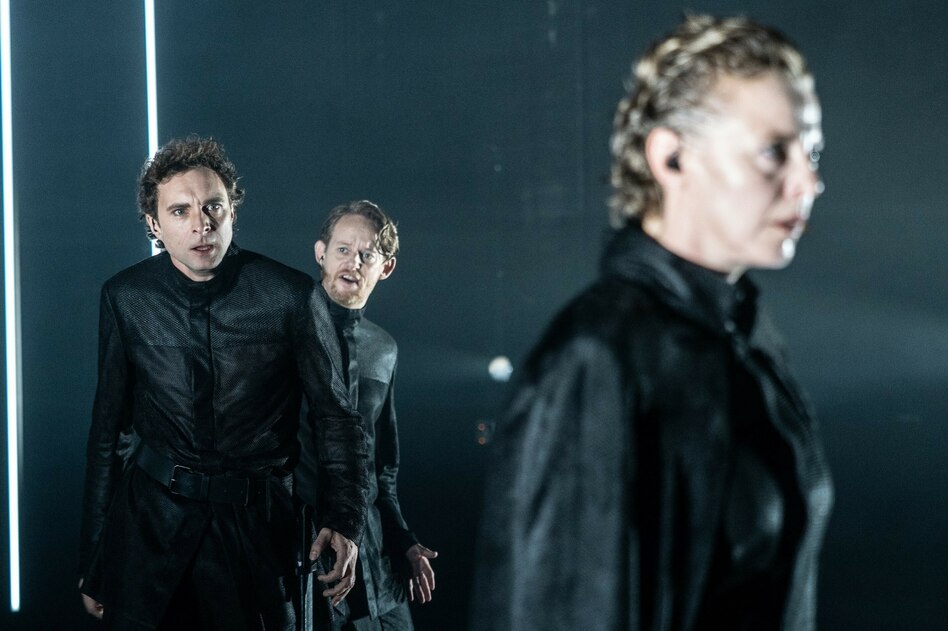
The start of the season and thus the signature production for Karlaganis' aesthetic reboot belongs - as with Schulz ten years ago - to André Kaczmarzcyk, who now plays the title role in Heinrich von Kleist's last drama, "Prince Friedrich von Homburg". The decision to cast such a cast is much more than just a clever move by Karlaganis to reconcile the audience with Ulrich Rasche's highly demanding, unwieldy production through the audience favorite. Because André Kaczmarzcyk finds new top form in Rasche's direction, an ideal Kleist actor, at the same time captivated and liberated by Ulrich Rasche's mercilessly strict choreography.
With Kleist, Karlaganis also sets a signature in terms of content; his declared favorite author, Kleist, is considered difficult, especially his last, enigmatic drama, which wanders confusingly around questions of duty and obedience, around militarism and nationalism. As always, Ulrich Rasche, as his own set designer, has built a barren room with a series of fragile light rods in which the characters move in precise steps on the constantly rotating revolving stage.
They run against inner resistance; the speech act itself is a physical, energetic one. The prince is a dreamer and a radical free thinker at the same time. Kaczmarzcyk plays him as if in a clairvoyant trance, with emphasis and at the same time removed. Rasche puts a double at his side, Yannik Stöbener, who seems to have already suffered the death sentence that threatens the prince. Both of them circle around each other until the prince accepts his prince's judgment and is pardoned and elevated.
In addition to Kaczmarzcyk, strong and extremely present actors shine in Rapid's directing, which is calculated on graph paper and is both rhythmic choreography and textual high mass: Lucia Kotikova as Natalie, Patrycia Ziolkowska as the cold, sovereign Elector, Christoph Luser as the hot-tempered Colonel Kottwitz and Patrick Güldenberg as Count Hohenzollern. A highly poetic and psychologically brilliant evening quickly succeeds and Andreas Karlaganis makes a debut with an exclamation point. Because this is not easily consumable theater and certainly not an evening with easy language.
The following new productions in the Great House do not reach the artistic level of Rasche's breathtaking Kleist ritual, but they deal with big material and reveal that the director appreciates formal experiments. For example, when director Lucia Bihler relocates Federico García Lorca's “Bernarda Alba's House” in Alice Birch's somewhat silly new version to a surreal horror dollhouse and puts the five imprisoned daughters in bright green children's dresses and crowns them with huge propeller hair bows. This is also a strictly choreographed, musically timed and virtuoso acting evening.
Music also plays a key role in Barbara Frey's direction of Anton Chekhov's "The Seagull": an old transistor radio keeps switching on seemingly at random, sometimes crackling passages from Bach's "Italian Concerto" and sometimes sentimental hits can be heard. Frey directs with experience, the playful ensemble is led by Anna Schudt's moody Arkadina, the evening entertains, makes you think, but it doesn't quite reach the height that characterizes Chekhov's art, which oscillates between comedy and tragedy. Nevertheless: an overall impressive start for Andreas Karlanganis.