
Germany · taz · · 3h
A new beginning in Armenia: The home that no longer exists
Deutsch (original) · Auto-translated to English
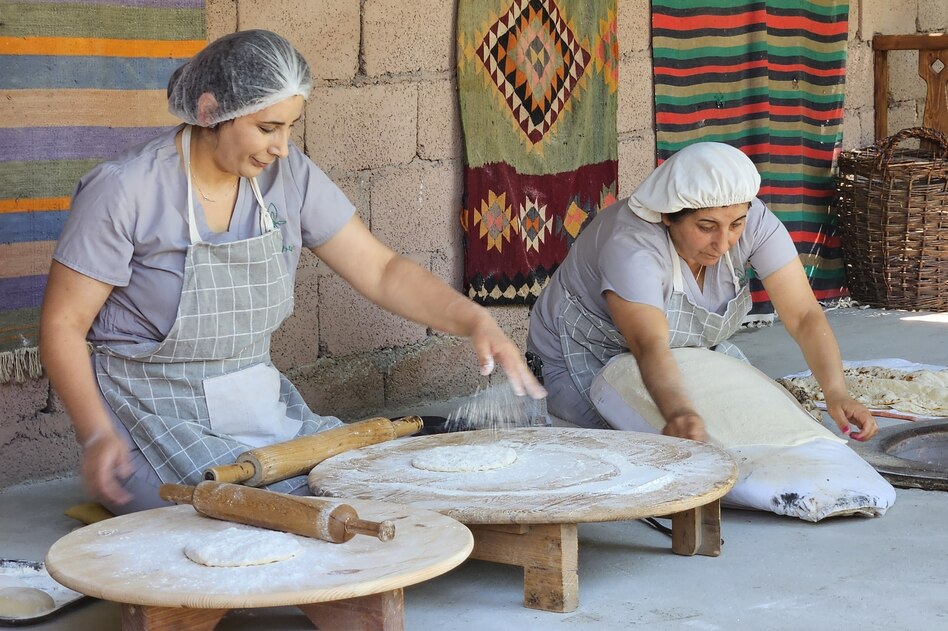
The Mamik guesthouse is located high above the Armenian capital Yerevan, on a slope from which Mount Ararat can be seen on a clear day. A school class is visiting on this early summer morning. Children knead dough, it smells of yeast and warm flour. Lusine Baljan teaches the children how to fold the dough correctly, just as she did in her homeland of Nagorno-Karabakh. A home that the 53-year-old lost three years ago.
After Armenia lost large parts of Nagorno-Karabakh in a six-week war in 2020, Russian peacekeepers were supposed to secure the existing borders. But when Azerbaijan cut off the mountainous region from the outside world for months and launched a military attack on September 19, 2023, this guarantee of protection proved worthless.
In a lightning offensive, Azerbaijani troops overran the Armenian enclave, which has always been inhabited by a majority of Armenians, but which became part of Azerbaijan under international law after the end of the Soviet Union - the origin of a decades-long conflict.
The highly armed Azerbaijan won it in a very short time three years ago. Armenia offered no resistance; the Russian troops watched. There was no massacre of the civilian population, but around 120,000 people had to flee. The images of the kilometer-long motorcade winding its way over the only pass road into Armenia went around the world.
The day after she arrived in Yerevan, Vanuhi Simonyan, the Armenian-born operator of the neighboring guesthouse, knocked on the door: “Can I help you?” Shortly afterwards, Baljan started working at “Mamik”. The guesthouse, which was originally intended as a place of Armenian culture, has since taken on a new role. School classes and tourists learn about crafts and recipes from Nagorno-Karabakh, sing songs and bake the typical herb bread. The work and the routine helped Baljan to at least somewhat cope with the loss of her home.
Like Baljan, most of the refugees ended up in Yerevan. However, the city was not prepared for the arrival of tens of thousands of refugees. The rental market, which was already strained by Russian war emigrants, has become even more tense. Those who have found an apartment often pay eighty percent of their income for rent, says Lianna Petrosyan.
She was herself expelled from Nagorno-Karabakh, first from her hometown of Hadrut in 2020, then finally in 2023. When she arrived in Yerevan, she collected requests for help from other refugees on Facebook and got involved with them. Because the response was so great, she soon founded an information and advice center for displaced people, which she still runs today.
Today, five people work in their office just outside Yerevan's city center. Even three years after the expulsion, the team has enough to do. The most pressing problem remains housing: there is hardly any government emergency aid left. Only the most vulnerable groups, people over 63 or with severe disabilities, receive rental assistance. Everyone else is alone.
Armenian citizenship remains a major hurdle. Those who come from Nagorno-Karabakh are ethnically Armenian, but do not have an Armenian passport, but rather a document from the former, internationally unrecognized Republic of Artsakh. For decades that hardly played a role. Since 2023 it has had everyday consequences. Officially you are “temporarily entitled to protection”. This could mean not getting a proper job. Or no visa to travel abroad.
Naturalization for Karabakh refugees is a simplified procedure that no longer requires proof of language skills. In practice, however, the online system overwhelms many older people and often takes longer than the official three months.
“Acquiring citizenship is a problem for many, both emotionally and financially,” says Petrosyan. After all, the number of naturalizations has recently increased. By the end of June 2026, around 40,680 people displaced from Nagorno-Karabakh had received Armenian citizenship. But this hasn't changed the laborious process, says Petrosyan.
This procedure is also familiar to a Nagorno-Karabakh woman in her twenties who wants to remain anonymous because of her work for an NGO. She came to Yerevan to study before 2020. When the enemy troops rolled in, her parents and brother followed. She submitted an application for naturalization in July and is not expecting an answer until the end of the year at the earliest.
The decision to apply was not an easy one: "The passport from Artsakh is my last connection to my homeland. If you give it up, you close a chapter," she says. At the same time, she needs Armenian documents, because without an Armenian passport she is sometimes refused a visa.
What also concerns them is open hostility. Karabakh Armenians, often identified by their dialect, often experienced hostile looks or hateful comments, she says. On the bus, in the gym, in the beauty salon, among people who don't know who is sitting next to them. There are also hate comments online. All of this is being reinforced by the top government: Prime Minister Nikol Pashinyan has repeatedly sharply criticized Nagorno-Karabakh Armenians. “If even the first man in the state spreads hatred, it just spreads,” says the young woman.
She supports real peace - but only if it is based on reciprocity. What the government is currently selling is a “protective peace” ordered from above. Baku's demands are being given in instead of resolving conflicts and open questions. It also requires the will of both sides.
As evidence of a lack of respect on the part of the other side, she cites an incident in mid-September: an advisor to the Azerbaijani president showed Armenian manuscripts to foreign diplomats at the Gandzasar monastery and mocked their authenticity. The Armenian cultural heritage in Nagorno-Karabakh goes back thousands of years.
Many in Armenia fear that Azerbaijan, which is three times as large and militarily superior, will make further demands. There have been repeated incidents at the border, which was not completely demarcated, since 2023. At least there was no new war
A peace treaty still requires a constitutional change by Armenia, which is still a long time coming. The Armenian constitution contains a preamble that can be read as a territorial claim to Nagorno-Karabakh. In order to abolish it, Pashinyan would need a referendum and a two-thirds majority in parliament, which he does not have even after his election victory in June. Azerbaijan's Foreign Ministry reiterated on September 9 that the constitutional amendment was a condition for the signing.
A planned road and rail corridor through southern Armenia is closely linked to a peace agreement: It is intended to connect the Azerbaijani heartland with its exclave Nakhichevan, without the previous detour via Iran. Baku has been calling for such a direct connection for decades - thanks to a fundamental agreement brokered by US President Donald Trump in August 2025, the Trump Route for International Peace and Prosperity (TRIPP) is now actually to be built.
Despite some open questions, the project is making progress: In August 2026, the USA, Armenia and Azerbaijan founded a joint development company, and in September the two countries agreed on the border demarcation along the route. There is disagreement about whether this is Armenia's best chance for lasting peace or whether TRIPP will whet Azerbaijan's appetite for more.
Three years after the expulsion, everyday life in Armenia has become routine for most refugees. Nevertheless, the longing remains. Many have not given up hope of returning to Nagorno-Karabakh. “There is not a single person among our displaced people who does not care for them,” says aid worker Lianna Petrosyan. However, with international mediation, not with military force.
Meanwhile, in the “Mamik” guesthouse, Lusine Baljan and her visitors continue to bake the traditional herb bread from Nagorno-Karabakh. As long as the recipes, the songs and the stories are passed on, the homeland remains alive. If only in memory, high above the rooftops of Yerevan.
Transparency note: The research in Armenia was carried out at the invitation of the German Friedrich Ebert Foundation.
Read the full story at the source
Source: taz