
Germany · taz · · 3h
Internet and commerce: turning point of an age
Deutsch (original) · Auto-translated to English
When it became apparent a good quarter of a century ago what power could be contained in a technology called the Internet, some already saw the collapse of the system on the horizon: “Considering that the redistribution of control is already happening, can the redistribution of wealth and our collective creativity still be a long way off?” asked the tech magazine “Wired” on October 1, 2000.
With “Redistribution of Control,” the US media alluded to a platform that significantly challenged the legislation of the analogue world: Napster. The program was able to scan and catalog all music files on its users' computers. In the resulting database, networked music fans around the world could search for and download tracks – free of charge.
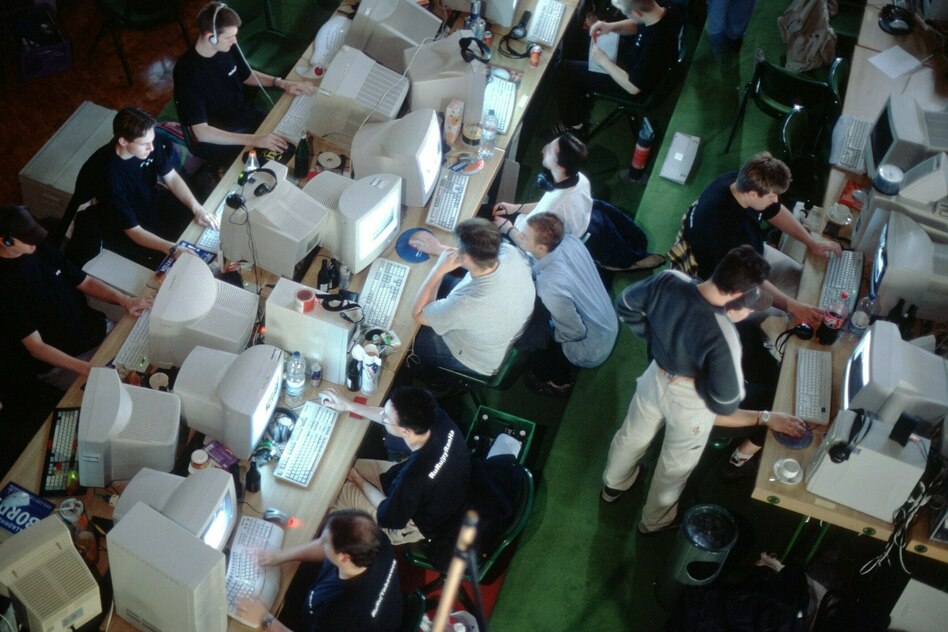
Most households still had slow 56k modem connections running over the telephone line, which meant that downloading a single piece of music could take a quarter of an hour. In mid-2000, just under a year after it was founded, there were still around 4 million active users on the portal.
In July 2000, a US district court issued a preliminary injunction against Napster. The exchange's Achilles heel was its centralized structure. Although the platform never offered music files itself, it acted as an intermediary and was therefore legally vulnerable. In this form, Napster was shut down in July 2001. A commercial restart of the platform failed.
At the same time, other platforms emerged on the Internet in 2001 whose concept seemed anarchistic: "It's kind of surprising that you can just create a website and let people work," said the co-founder of the online encyclopedia Wikipedia, Jimmy WalesNew York Timesquote.
The principle of his digital lexicon was simple and trustworthy. Whoever felt called upon to do so could write articles, add to them, and change them. According to Wales, the resulting social pressure would cause Wikipedians to remain friendly and stick to neutral formulations and facts.
Only someone who knows a different version of the Internet than the current one can speak like this. Until the early 2000s, the non-commercial part of the World Wide Web consisted of sites that were operated by private individuals or small groups out of curiosity, fun or to network with like-minded people.
Still completely unaffected by the dynamics of what is now called social media, people revealed their contact details online, published private photos, wrote about their small animal breeding, their model railway or their most beautiful holiday experiences. At the same time, a significant portion of retail has already moved online with online shops such as Amazon and eBay.
Napster had fundamentally questioned the concept of ownership in the digital space. For file share enthusiasts, copies of digital media belonged to no one. However, an alternative approach already existed with Wikipedia: digital content is public domain. The Creative Commons organization, which was also founded in 2001, was intended to provide the licensing basis for free content from text to video.
The larger the utopia of the freely associated digital community became, the more it protruded into the material capitalist reality: web space, physical servers, were rare and expensive. Much of the early Internet was based on the server capacity of universities or dedicated Internet enthusiasts. The bursting of the dot-com bubble in 2000 made it abundantly clear what was missing to fully commercialize the Internet: a business model.
A company soon offered one, which would become one of the most valuable brands in the world. Google AdWords was the name of the service launched in 2000, which later interpreted search queries and website content and was able to display appropriate advertisements. Anyone looking for information about the Mediterranean, for example, was served the right cruise right along with the search results.
More than a product, Google provided the digital world with a principle: websites and online services did not have to make money themselves, instead they paid with the attention of their users - and increasingly with their data.
The resulting interactions between the advertising industry and the online world still determine a significant part of the Internet today: Many apparently free platforms want to know as much as possible about their users and retain them for as long as possible: accept cookies, activate notifications, turn off ad blockers; Like, Follow, Subscribe.
Since the term “Web 2.0” began circulating among IT journalists around 2004, something had changed. The “Wikipedia principle” inspired the participatory web; on many platforms, users could now leave comments, create their own content, upload it and share it with others. The connection to the advertising industry and improved transmission speeds enabled a moderate network revolution - and also contributed to the end of illegal file sharing.
With the release of the iPod mp3 player in October 2001, and even more so with the launch of the iTunes music store in 2003, Apple offered an affordable alternative to data piracy, which was under strong legal pressure. Decentralized platforms like LimeWire or Kazaa circumvented the copyright vulnerability that brought down Napster, but were often slow and complicated. But the iPod was chic and iTunes was convenient. The way for the streaming economy was clear.
There isn't much left of the cozy front yard internet of the early noughties today. In contrast, the effects of capital concentration in the digital space are unmistakable. As the sociologist Philipp Staab pointed out in his book “Digital Capitalism”, the Internet is now largely owned by a few companies that have bizarre market power compared to the analogue economy. Tiktok, Instagram,
In light of this, Wikipedia almost seems like a non-commercial bulwark. But now the AIs are taking action: content created by humans is now training data for the large language models of chatbots. Community knowledge collected over decades is ending up in the hands of corporations.
Looking back, the year 2001 can be seen as a turning point in the Internet age: courts began to enact new laws: age verification, data protection declarations, terms and conditions. Most media locked themselves behind paywalls and subscription models. A large part of the web is now a privately organized ecosystem.
The free exchange of data between individuals, limited only by bandwidth, was not followed by the digital communism dreamed of by the tech utopians, but rather by the (re)appropriation of the network by the state and capital.
Avoiding the commercialized Internet has become more difficult, but still possible: Since the pioneering years of the Internet, the open source community has been developing ad-free, free and open-source alternatives to numerous apps and platforms. The funds for this mostly come from donations. What this chapter of Internet history also teaches is that there is a crucial difference to the analogue society: the alternative is not just conceivable. It already existed, and it still exists.
Read the full story at the source →
Source: taz