
Germany taz
Navid Kermani about his hometown: “I like being a stranger”
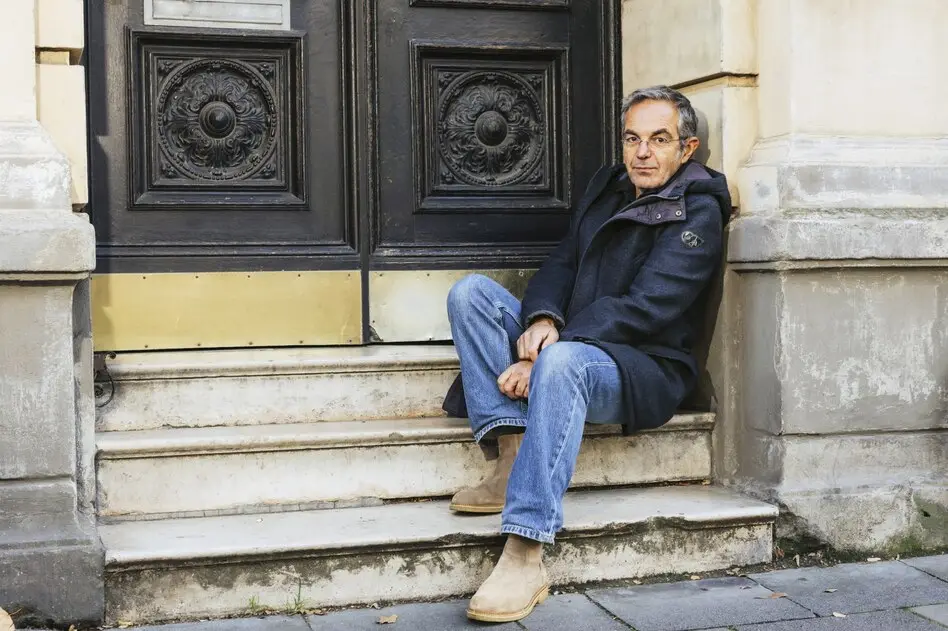
The author Navid Kermani lives in Cologne. He doesn't celebrate carnival, he doesn't speak Kölsch. And has written a declaration of love for the city: “Köln. E Jeföhl”. more...
Deutsch (original) ·Auto-translated to English
taz: Mr. Kermani, does your love for Cologne require a lot of care?
Navid Kermani: Loving a city also means being able to be angry with it, to see it critically. I am often very critical of developments here. That's part of it. If you're upset about something, it's important to you. Otherwise you wouldn't care.
Navid Kermani (58) was born in Siegen, but as a child he wanted to go to Cologne, to the cathedral and to the local football club Eff-Zeh, i.e. 1. FC Cologne. The city appears again and again in his books, especially the Durst pub and the Groß Sankt Martin church. In one of his children's books, a girl, a rabbit and a bear explore the Eigelsteinviertel in Cologne. A collection of his texts about Cologne was published this summer: “Köln. E Jeföhl”.
Cologne (approx. 2,000 years old) was founded by the Romans, conquered by Napoleon and the Prussians finished building the cathedral. Today the city prescribes to its residents the Cologne Basic Law - Et es wie et es. Et kütt like et kütt. Et would still have emmer joot jejange. – Serenity and joy of life.
taz: Vice magazine once wrote: "Cologne is a lot of things - ugly, chaotic, provincial - but not a beauty, and certainly not a cosmopolitan city. And yet: the people of Cologne love it. They are completely unreasonably too proud of their city and constantly make it known - just like all the other shit that's bothering them at the moment." Is that correct?
Kermani: (laughs) Of course that's not true. And if I, as a Cologne resident, were to say that it was true, then the quote wouldn't be true either. Of course there is this extreme local patriotism and that is a bit absurd. But there are reasons for that too.
Kermani: The people here are friendly, as many people who come here describe it.
taz: Why is this the case here in this city?
Kermani: Cologne is a city founded and built up by immigrants, a colony, that's already in the name Colonia. It is the only city in Germany in which, long before the word multiculturalism existed, it was part of the self-image that people were different. This is a fixed theme in folk songs, for example, and I have often experienced this as a reality, this self-evident fact that every Jeck is different. Of course there were Nazis here too, there was Pro Cologne, today there is the AfD. But just the fact that diversity is part of the city's self-image means something to me. Long before diversity was hyped up in the media and advertising, the song “Viva Colonia” was played at every FC Köln game. 50,000 people sang and continue to sing the phrase “We are multicultural” every time. To be honest, as a young person, it got under my skin every time an entire stadium committed itself to this sentence.
taz: You told the “Kölner Stadt-Anzeiger” that you would rather live among do-gooders than among cynics. What is this to you, a do-gooder?
Kermani: There is a fairly broad mass in Cologne that can be mobilized very quickly for good causes. When fairy lights were unthinkable elsewhere, there were hundreds of thousands of demonstrations against racism here. For many people here it is a matter of course. This may not always be differentiated and there is also a sense of self-assurance involved. And you can always put that into perspective by saying that people do it because it's good for them. But it's better than demonstrating against diversity.
taz: The term do-gooder has become more of an insult today.
Kermani: That's why I reverse it. I think do-gooders are good. Should you be ashamed that it breaks your heart when you see starving children?
taz: You have lived here in the Eigelsteinviertel in Cologne for almost 40 years, your favorite pub is around the corner, you can walk along the Rhine to your mother. What does that mean to you?
Kermani: It's just a way of life. You don't have to specify a lot of things. If I decide at 20 to 8 that I want to go to the concert at the Philharmonic this evening, then I can still make it on my bike. And the fact that the Rhine is nearby is simply a great luxury.
taz: What does a river like that do to a city?
This text first appeared in wochentaz, our weekly newspaper from the left!
Every week, wochentaz is about the world as it is – and as it could be. A left-wing weekly newspaper with a voice, attitude and the special taz view of the world. New every Saturday at the kiosk and of course by subscription.
Kermani: Water is always the gateway to the sea. This is distance. That's a way out. An open world. I've always enjoyed living in cities with water, I've been to Isfahan a lot and I've also enjoyed living in Cairo. I always look for cities that have a lot of water, whether sea or river. We know that people have lived here for many centuries. Things have changed, but the flow has remained. That gives you a different breath. It makes a difference whether I jog along the river or through the park. By the river or by the sea, thoughts and daydreams expand and the mind moves elsewhere.
taz: You grew up in Siegen and describe yourself as being influenced by Protestant-Calvinism. Do you even fit in in yucky Cologne?
Kermani: Nope. But I always find a certain element of strangeness beautiful. I like being in places where I'm not entirely at home. I also grew up as an Iranian boy in a fairly German environment. Of course, this didn't just bring me advantages. But my world was somehow bigger, I had two worlds, that's how I felt as a child. I like having that outside view. I like being a stranger.
Kermani: I don't celebrate carnival. I don't speak Kölsch. I'm not as affable as many people here. But I would say that I have now become a part of this city, a long-term observer.
taz: Why did you stay here so long?
Kermani: It's just the city where I ended up. And in contrast to my travels, it is of course good to have a place where the world changes at a snail's pace. Where things are familiar to me. I moved into this apartment as a student, when it was still a shared apartment. Then we bought it, my parents came to Cologne, we raised our children here. And now the children are out of the house again. My mother is now 93. I still walk along the Rhine to visit her.
taz: Was it also important to you that the Iranian community in Cologne is so strong?
Kermani: Sure. I have a lot of friends of Iranian origin and it makes a difference that there are regular Persian concerts in the Philharmonie. As far as I know, something like this first happened in Cologne and not in Berlin or Munich. And these concerts are full.
taz: What kept you in Eigelstein, which is also a district that is much sung about in Cologne songs?
Kermani: We had already thought about moving, but in the end it didn't work out. Then everything became more expensive. The children loved growing up here, so we stayed. But a lot of things annoy me now.
Kermani: There is a lot of miserable prostitution here today. There is crime, drugs are being sold, there are addicts on the sidewalk, drunk corpses, the poverty has become very visible, but there is also a certain level of neglect among the many partygoers, which is more of a phenomenon of prosperity. There used to be strange, rowdy guys, there were street prostitutes, but it was different, it was more like normal business, they also lived here, you met them in the supermarket and you often got into conversation with them. You also heard more Kölsch on the street, there were many long-established, wonderfully old-fashioned shops, so that's largely a thing of the past. And yet it remains a very Cologne district.
Kermani: Simply because of the diversity. It's still very mixed. Everyone is together, there are the trendy bars, the long-established ones, we have the best restaurant here too, Le Moissonnier. I like this mix. I'm interested in weird guys. This isn't a judgment, I don't want to be friends with every one of them, but even the strangeness is interesting at first. And there is more of this mix here in the district than anywhere else.
taz: You also once wrote that you couldn't live in any other German city. What else makes Cologne special for you?
Kermani: The time travel I can do here. It is an old city that is really incomparable here in Germany. This shapes the attitude to life. I think the calmness of the people here, their friendliness towards strangers, also has something to do with it. People have lived here for 2,000 years. I'll be at the Romanesque church of Groß Sankt Martin in fifteen minutes. A lived church where people really still sing. Where church services are beautiful, where you slip out of time for a moment.
taz: You also write a lot about your local pub, the Durst, a small, long-established pub. What's so great about being thirsty?
Kermani: The mix of people is phenomenal. The pub was opened in the 90s by young people, probably students, most of whom are still there today. And new generations are always coming along. Many have creative professions or are artists, there are all kinds of people and, to be honest, normal drunks. Especially after midnight, things often mix and sometimes get crazy. I like to sit in the corner and watch, although not as often as I used to. My book “Forty Lives” was largely written out of thirst, through encounters or simply by fantasizing there.
taz: It seems important to people that there are such meeting places that defy time.
Kermani: That's right. But they do change. New people are coming. And that is the basic feeling that living in old cities gives you, that you are a tiny part of a long river. That there was something before you and something comes after you. This results in a calmness, a relativization of the here and now.
taz: You repeatedly travel to war and crisis areas. You were in Bucha, in Ukraine, you traveled through Sudan. What draws you there?
Kermani: It's mostly curiosity. You get a different view of life. What is important and what is not. And on the other hand, I feel a responsibility. I notice that the less important it becomes to those around me, the more important it becomes for me to report from these countries. The people here in Germany, the public and the media are becoming less and less interested in the world. I would like people to at least be aware of what is happening in Sudan and Ethiopia.
Kermani: When I started working for the Frankfurter Allgemeine as a student, things were different. The editor Frank Schirrmacher sent me to the most unlikely places. The main thing is that it becomes somehow interesting. I didn't have to justify anything. Once I was supposed to fly to Tajikistan just because I knew someone there. That wasn't questioned at all, it was normal.
Kermani: And the readers read it, which was great. Suddenly a window opened to Tajikistan. And I think they were good lyrics too.
Kermani: Today it is extremely difficult to convince newspapers of something like that. It doesn't pay off. The readers don't care. And if it's difficult for me, what's it like for a young author? That's another reason why it's important to me to keep going as long as I can. And I'm more interested in it than the self-centered debates that are often discussed here in the media.
taz: In your book “When our hearts open right away” you complain that after your trip through East Africa hardly any media was interested in the resulting book “In the other direction now”. Today we are also talking about Cologne, not about Sudan. What does this say about our attention?
Kermani: That's just absurd. I like the Cologne book. But the attention paid to a Cologne book compared to the drudgery I did for a book about Africa and its political, global significance is bitter. The lack of interest in other regions of the world will cost us dearly. You see, I no longer appeal to empathy, but rather to utility. If we do not try to control what is happening in the world, then developments will befall us that we cannot handle.
taz: When you return from one of your trips and go to the stadium of your beloved FC Köln, do the emotions that surround football sometimes seem strange to you after you have just had encounters with death, suffering and hope?
Kermani: There are already clashes immediately after a trip. Once I left a wedding for a reporting trip. That's weird then. At the same time, on trips like this you get a feeling that even the little things are important, as long as they are real. Play is important, singing is important, celebrations are important, love is important, sex is important. A visit to the stadium is not a contradiction. Nobody in Sudan is disappointed that people celebrate weddings or watch football here. Man does not only consist of great and noble thoughts. But what really becomes less important after such existential impressions are the many upsets that characterize our debates and also the things that usually upset you in everyday life. I see that as a win.
taz: Is that perhaps something that the people of Cologne have understood with their hedonism?
Kermani: I presented the Cologne book with Henning Krautmacher, the former frontman of the Höhner, and with an orchestra. There was a lot of singing. It was heartwarming how the whole room knew the songs and sang along. You automatically sing along. And the picture of us on stage was also nice: Henning Krautmacher, as he is, moderated by Shary Reeves, also a girl from Cologne, but with a different skin color than Henning. And I obviously come from somewhere else. It was great to experience how music and the connection to Cologne create a commonality, no matter where the parents come from.
taz: It sounds like you're not completely opposed to carnival.
Kermani: The carnival has been ruined for me in recent years because it has become such a mass event that even leads to binge drinking. But at its core it's great. Which city today still has folk songs that everyone knows?
taz: Vice wrote at the end of the article about Cologne quoted at the beginning: "If you can't beat them, join them. Just always be drunk and only half sane and you will have a wonderful time here. Kölle Alaaf." What has to happen to meet you in costume at a carnival session?
Kermani: Because I now know Henning Krautmacher very well, I think it will happen that I will end up in the middle of it. Especially since I see more and more the beautiful sides of carnival, the songs, the folk carnival, the celebration together in the squares. My enemy image is in the process of dissolving. At some point the city has me and I sway along.