
Germany · taz · · 1h
NATO receives the Peace of Westphalia: “Thank you, Friedrich” and an appeal to Europe’s responsibility
Deutsch (original) · Auto-translated to English
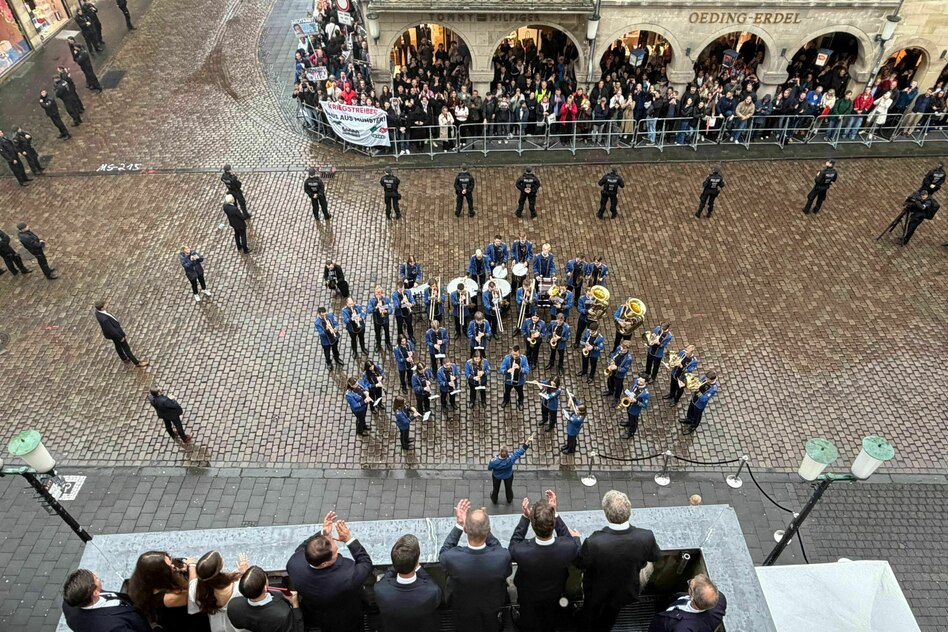
What the world needs now, is love – the celebrations for the awarding of the International Peace of Westphalia Prize in Münster began with this classic by Jackie DeShannon. Of all things, love and an anti-Vietnam War song? Seriously suitable for the awarding of the prize to NATO, the transatlantic military alliance?
Even in the run-up to the award ceremony, there was more than just irritation; there was massive criticism from civil society. And on Thursday several peace groups demonstrated in Münster. NATO stands for rearmament, for military equipment, for deterrence with weapons. In the logic of the prize donors, it is for stability, security and peace in Europe. In this area of tension, Chancellor Friedrich Merz must give the eulogy for NATO Secretary General Mark Rutte and the alliance. And he seizes the opportunity.
Even before Russia began its full-scale invasion of Ukraine in 2022, many people, including French President Emmanuel Macron, said that NATO was “brain dead” and actually finished. The war is a test for the alliance. Within a very short time, new alliances were established within the states in order to fend off the Russian aggressor.
Today, joint drone walls are being built, maneuvers take place at regular intervals with the Baltic countries, Poland or Finland, Sweden and Denmark, and the Bundeswehr is setting up its own brigade in Lithuania. Almost all NATO members are increasing their spending on armaments and defense. 5 percent of economic output is the magic formula that the alliance was able to agree on after numerous negotiations and smugly celebrated for it at the last two NATO summits in The Hague and Ankara.
But with the high expenditure on military equipment, criticism of exactly this attitude is growing, when at the same time the cost of living is rising, social benefits are falling and the war in Ukraine is lasting longer and longer, the next harsh winter is looming and there is no end in sight. Thanks to tight budgets in many member states, financial commitments are becoming tighter, and right-wing extremist and right-wing populist parties and movements are jumping into the wake of those who are suing for peace negotiations from the wrong addressee.
In addition, there are targeted attacks from the Russian side in NATO countries. Almost every day there are reports of drones invading the airspace of the Baltic countries, acts of sabotage and cyber attacks. In August, the federal government also had to attribute a very serious drone incident at Halle/Leipzig airport to Russia.
The International Peace of Westphalia Prize is endowed with a total of 100,000 euros. The Economic Society for Westphalia and Lippe usually presents the award every two years to individuals and groups who are role models for commitment and willingness to engage in dialogue to maintain peace and independence in Europe. And on this slide the Chancellor is now sailing in Münster. With a justification for NATO and more rearmament.
“Our freedom is at stake,” he said in his eulogy. "Through a new era of great power politics, in which we must also re-establish our transatlantic partnership. Through technological revolutions that are changing our world faster and more profoundly than anything we have known before." And by Russia's violent, expansive revisionism. “This threat is not abstract.” Russia is breaking the most basic rules of international law and the European order in Ukraine with extreme brutality. It is therefore right to support Ukraine with all our might.
Merz doesn't skimp on horror scenarios either. “If it is not possible to stop Moscow, then sooner or later the Russian war machine will turn against us, against NATO itself,” says the Chancellor. And what would happen then? A drone fight in the Baltic countries like in Donbass? Ballistic missiles on major European cities, like Kyiv or Kharkiv? In the end, would we Germans also feel the horror of war firsthand again? The Chancellor asks himself all this in his speech and concludes that this must be averted with all our might. "We Europeans are not a belligerent in this war. But we are not neutral either. We are not mediators. We are on the side of Ukraine's freedom."
Of course, Russia must be persuaded to enter into serious peace talks. But the Kremlin only understands the language of strength and when NATO meets it as a unit. This is also why Merz explicitly mentions the meeting between German Foreign Minister Johann Wadephul and his Russian counterpart Sergei Lavrov in New York on the sidelines of the UN General Assembly. Experts don't agree on whether the short conversation really achieved anything, but at least there was a conversation. And that's what Merz is trying to get at: Not only are we going to upgrade our weapons and strengthen the Bundeswehr, we're also going to pull all the diplomatic strings.
And he insists, much more emotionally than you would expect from Merz: We will not allow ourselves to be divided in Germany either - not by hybrid attacks, not by agitation on social media controlled by Moscow bots and not by the slogans of the AfD and its Russian backers. The hall applauds. The Chancellor is not always guaranteed such approval and goodwill in these times. “Our support for Ukraine is not an end in itself.”
Only good things come from Merz to NATO Secretary General Mark Rutte. “You hold the alliance together in challenging times, with a transatlantic and European compass, with irrepressible energy and unshakable confidence,” praises the Chancellor. The two have already spent a large part of the day together. Merz and Rutte visited the German-Dutch corps in Münster together with the Dutch Prime Minister Rob Jetten. The corps has been securing NATO's eastern flank in Estonia and Latvia since July.
Despite all the pithy words, the laudations in Münster and the short interviews with the other prize winners seem a bit alibi-like: the church network socioMovens from Dortmund, which brings together young people from Central and Eastern Europe, also receives a prize. SocioMovens shows how trust can grow and contribute to peace, said Hendrik Wüst, Prime Minister of North Rhine-Westphalia at the start of the event. This strengthens solidarity across borders, which is essential for peace in Europe.
Young people who do voluntary work and, on the other hand, a combat-ready alliance that demands even more support, a matter of course and also money from all people in the NATO member countries. And thus also the Chancellor of those who live in Germany. Merz then wildly belts out a euphoric “Thank you, Friedrich!” in contrast to.
“One” – another classic – by U2 will also be performed at the awards ceremony. “One for all, all for one” – a popular, snappy NATO motto, if not the most important one, which is used at pretty much every opportunity. And something that the Chancellor is probably hoping for too.
Read the full story at the source
Source: taz