
Germany taz
Obituary for Science Senator Turner: The excitement
George Turner was Senator for Science in West Berlin at the end of the 1980s. At that time, students occupied the universities for months and demanded his resignation. more...
Deutsch (original) ·Auto-translated to English
Only good things about the dead. The message from Berlin's Science Senator Ina Czyborra (CDU), in which she announced on Wednesday that her predecessor George Turner had died, follows this motto. At the blessed age of 91. With Turner, it says, Berlin is losing a great science politician. “His work represents the conviction that an efficient science system needs people who take responsibility, question what already exists and have the courage to break new ground,” writes Czyborra.
And that's surprising. In fact, during Turner's time in office, thousands of people questioned the status quo and had the courage to take new paths. But one person is definitely not: the Science Senator.
The independent Turner was responsible for West Berlin's university policy from 1986 to 1989, as part of a black-yellow coalition under the then governing mayor Eberhard Diepgen. Things were not particularly good for the universities in the years before the fall of the Berlin Wall. Some seminars were so overcrowded that places were raffled off; some institutions, such as the renowned interdisciplinary Latin America Institute at the Free University, were to be dismantled at the request of the professors. In addition, there was a heavily criticized reform of the Berlin university law and, even at that time, a housing shortage and dissatisfaction with the social situation.
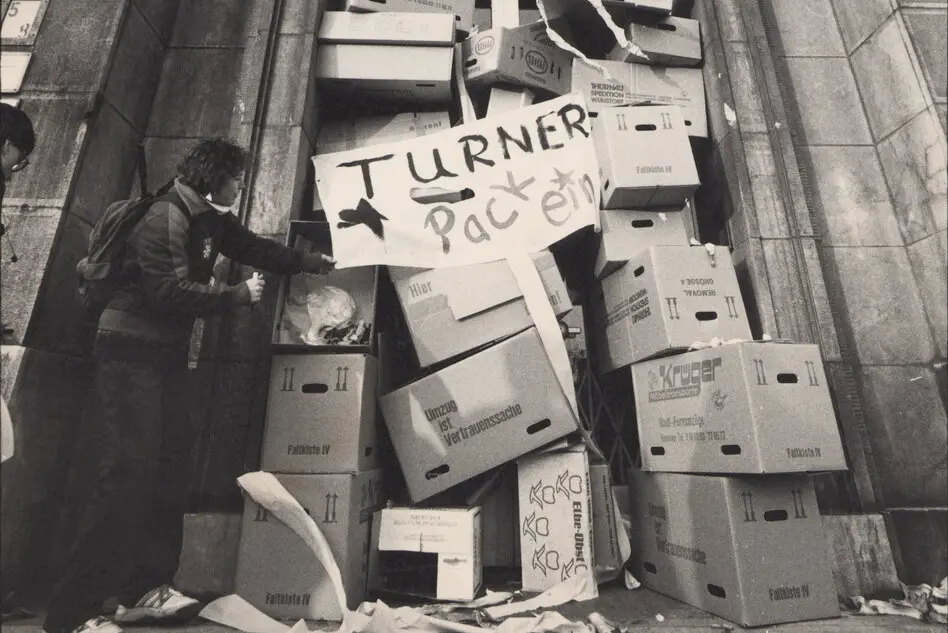
The last straw came at the beginning of December 1988 when the scientific dignitaries celebrated the 40th anniversary of the Free University, at which the students had to stay outside. They started with a wild snowball fight in front of the door. And within a few days, the protest at individual institutes grew into Unimut, first across Berlin and then in other cities in the Federal Republic.
Almost all university buildings in Berlin were occupied for weeks. The Free University became the Liberated University. The students met in Dahlem for hours-long general meetings and started hundreds of autonomous seminars to educate themselves. Colorful demonstrations marched through Berlin every day, bringing scientific findings to the city with creative actions.
The movement's demands included, among other things, the resignations of FU President Dieter Heckelmann and George Turner. “Turner, turn off,” protest banners said.
For many, the Science Senator was simply a “turn-off” – because he supported the violent police operations to evacuate occupied institutes. And because he abruptly rejected the students' core demand for more participation at their universities. He not only rejected the desired quarter parity in the committees, but also wanted to abolish the remnants of co-determination that still existed. Turner explained this in an FU information in February 1989.
When that appeared, it was already clear that he would not remain in office. Surprisingly, in the House of Representatives election at the end of January, there was a majority for a red-green coalition for the first time - definitely a result of the student protests.
Turner was a man without ideas, it was said in a taz report at the end of his term of office. Participation is a foreign word for him. If there's one thing he's mastered, it's the cyclist's principle of "humping up, pedaling down." Instead of eliminating grievances at the universities, he is only concerned with how the structures can be better sealed against any rebellion.
But should you only write good things about the dead? Well then: “He saw universities as places of academic freedom, excellent research and social responsibility,” says the statement from today’s Science Senator. The fact that he forgot about the younger generation ultimately politicized the generation of students at the time.
The author went on strike at the University of the Arts (today: UdK) in 1988/89.