
Germany taz
Obituary for Lutz van Dijk: Persistent campaigner for more humanity
Lutz van Dijk, activist and taz author in Cape Town, is dead. His work carried South Africa's hopes for a better society to the world. more...
Deutsch (original) ·Auto-translated to English
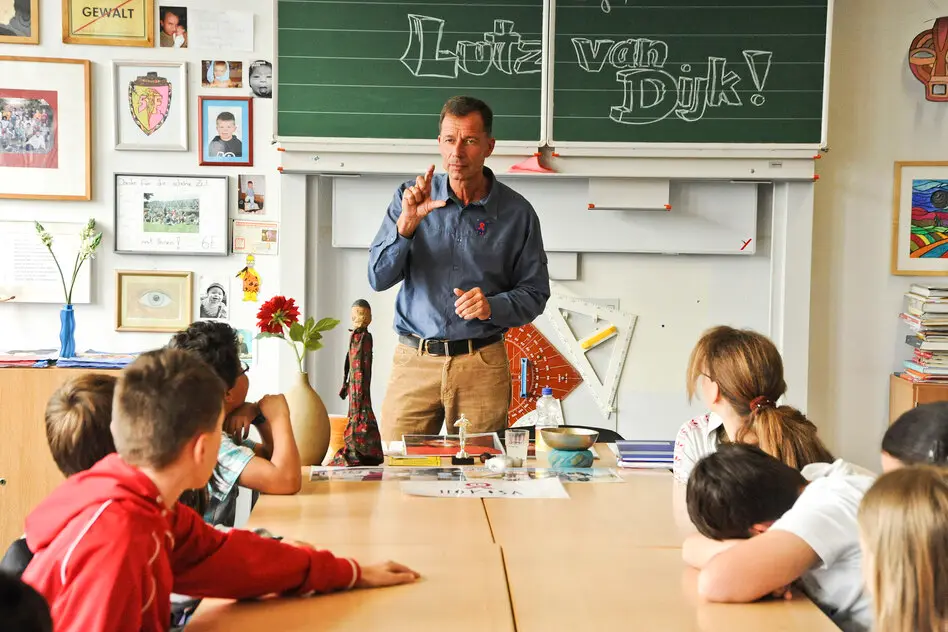
Lutz van Dijk traveled in many different ways. As an activist in South Africa, he worked against xenophobic violence and for AIDS orphans. As an author and journalist, he wrote against intolerance and forgetting.
As a taz author in Cape Town for several years, he took a hard look at the country's grievances and at the same time highlighted the courageous opposing forces. He was opinionated, argumentative and sometimes uncomfortable. He called himself “persistent,” but he left no one indifferent. His last years were marked by Parkinson's disease; he died on November 17th at the age of 71.
HOKISA (Homes for Kids in South Africa) was the name of his children's project in the Cape Town township of Masiphumelele, with which Lutz van Dijk became famous in South Africa. It began in 2001, spurred on by the dark shadow that South Africa's gigantic HIV/AIDS pandemic cast over the fragile young democracy and whose devastating social effects have now been almost forgotten.
One of the first residents of the home was an HIV-infected baby who was abandoned by his parents in a cardboard box and who construction workers found and brought to HOKISA. The work with the children inspired dozens of books and hundreds of public appearances and statements.
Lutz van Dijk was born in West Berlin in 1955; his parents “had no words for the horrors of the Nazi era,” as he says in one of his last interviews: “As a teenager, I gave up and just wanted to leave, no matter where.” He became a garbage collector in New York, a teacher for difficult-to-educate children in Hamburg, an employee of the Anne Frank House in Amsterdam, and he took on Dutch citizenship and a Dutch name. He campaigned against South Africa's apartheid from afar and was banned from entering there. It wasn't until 1997 that he was finally able to go.
“I spent my first morning in the country in Cape Town, where Archbishop Tutu opened the youth hearings before the then Truth and Reconciliation Commission in a large community hall in May 1997,” he wrote to the author of this obituary many years ago. “Hundreds of students came in classes to hear with their teachers the statements of the witnesses, mostly of the same age, who reported on imprisonment, torture and murder.
Despite the horrors of the immediate past, one thing and therefore everything was so different: that from now on, recognition was finally given to those who were previously persecuted and disadvantaged, and the resulting hope that from now on everything would change radically and forever.
The failure of these hopes, and at the same time the tireless attempts to bring them back to life - that shaped Lutz van Dijk's work for decades, from his book about the truth commission in 1999 to dealing with HIV/AIDS, the fight against hatred and xenophobia to the horror of the Covid-19 pandemic.
Van Dijk wished South Africa "a new youth beyond ANC populism" back in 2011 and wrote: "South Africa doesn't need more charitable donations, but social and legal structures that finally visibly overcome the terrible differences between rich and poor. Structures must be anchored that mandate sharing and thereby simply make it easier to be good."
Being good – that was a life motto that was worth the effort. In 2023, Lutz van Dijk was able to celebrate a late success when the German Bundestag specifically commemorated the queer Nazi victims for the first time, five years after he had launched a petition. Some of his most succinct texts in the taz deal with death.
When Frederick Willem De Klerk, South Africa's last white president, died in November 2021, van Dijk showed how white mourning once again excluded black people. “Now there is national mourning with flags at half-mast, but I still don’t know where my son’s body was buried,” he quoted a 78-year-old black woman as saying.
Just a month later, Desmond Tutu, the world-famous South African anti-apartheid archbishop and Nobel Peace Prize winner, died. In his detailed obituary, Van Dijk, who knew the deceased well, visibly described Tutu's modesty, his openness towards children and his legacy of integrity and courage.
From 2024 onwards, he parted ways with those of the taz, and Parkinson's disease limited his diverse activities. In the end, the illness progressed rapidly and he moved back to the Netherlands, where euthanasia is legal. He announced his death in advance via a farewell email to his confidants. “After careful consideration with our family doctor and my husband Perry, I have decided to end my life gently.” True to his own wisdom: “You have a life and you are responsible for it.”