
Politics taz
After the parliamentary election in Israel: “No to a racist government!”
Thousands of Israelis demonstrated in Tel Aviv on Saturday for a Jewish-Arab government coalition. But the political situation is messy. more...
Deutsch (original) ·Auto-translated to English
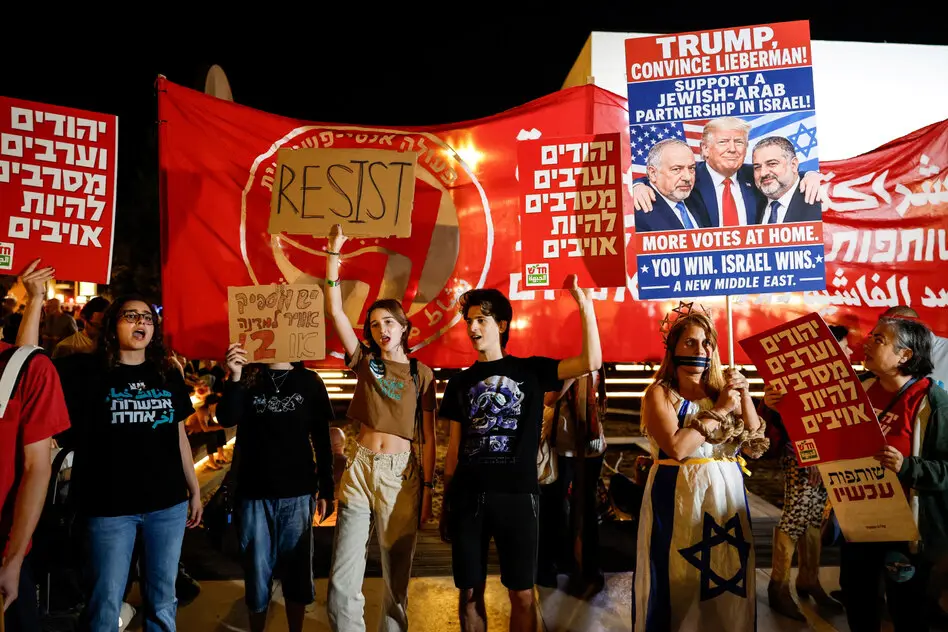
Friday evening at Habima Square in Tel Aviv. Thousands of Israelis shout slogans, some with megaphones in their hands. "No to a racist government! Gadi Eisenkot, you are the hope! 67 mandates!" They have gathered to support a Jewish-Arab government.
Almost a week ago, Israelis went to the polls to elect a new parliament. But there is no clear path to a government majority. 53 seats for the Netanyahu bloc, 48 seats for the bloc around challenger Gadi Eisenkot, and 19 for the mainly Arab parties.
Alon-Lee Green from the Jewish-Arab grassroots movement “Standing Together” is also standing on Habima Square. The aim now is to put pressure on the leaders of the Eisenkot bloc to join forces with the Arab parties. “The Netanyahu camp is spreading the message that they won because they got 53 seats and the leaders of the Eisenkot bloc only got 48. But in reality we won, the opposition won because we got 67 seats.”
Other civil society groups also gathered at the square. Members of the communist Jewish-Arab Chadash party unfurl a large banner, others drum. Activists from “Looking the Occupation in the Eye” and “Peace Now” distributed flyers: “Partnership now!”
But the political situation after the elections is more complicated than it seems here. Most of the Zionist opposition parties - with the exception of the Democrats - had promised during the election campaign not to enter into a coalition with Arab parties. Gadi Eisenkot had excluded them for not complying with his conditions. However, Bennett and possibly Eisenkot now appear to be willing to accept their support for certain initiatives - without becoming part of the coalition.
Not so Avigdor Lieberman from Israel – Our House. He will not work with the ultra-Orthodox, the Arabs or Netanyahu and will not accept a minority government supported by the United List - a coalition of the radical left and Arab nationalist parties Hadash, Ta'al and Balad. Instead, he is open to accepting a Likud that excludes Netanyahu as a Knesset member.
On the other hand, the conservative Arab party Ra'am shows willingness, as it did in 2021, to enter into a government coalition with Jewish parties. The United List, in turn, has made it clear that although it will not join a future coalition, it would support a minority government under Eisenkot. In return, they expect significant concessions, such as a halt to house demolitions by Palestinian terrorists and a fixed budget to combat rampant crime in Arab communities.
But after the euphoria over the first election results, there is now despair among the Arab parties in view of the political deadlock, especially among Ra'am. Some believe new elections are the most likely. That would be catastrophic for them and the anti-Netanyahu camp: new elections would probably benefit Netanyahu and the extreme right, even given the expected lower voter turnout.
The protest ultimately moves from Habima to Rabin Square, where then-Prime Minister Yitzhak Rabin was murdered by the religious-nationalist terrorist Yigal Amir almost exactly 31 years ago. At the end, the crowd sings the song for peace, Shir LaShalom. The song, which premiered in 1969, has become an anthem of the left-wing peace movement.
Meanwhile, a kilometer away, at Habima, there are still a few counter-demonstrators, almost a hundred Netanyahu supporters with kippot and Likud flags. “The Jewish state will remain a Jewish state,” a speaker shouts into the megaphone: “No state of all its citizens!”
From Wednesday, President Itzhak Herzog will receive representatives of the parties and then give one person - in this case either Netanyahu or Eisenkot - the mandate to form a government. He can then try it first.