
Politics taz
After the AfD's election victory: How is the cultural scene in Saxony-Anhalt?
According to the election program, the AfD is planning a “patriotic cultural policy”. And now? A site visit to the Magdeburg institutions Volksbad and Moritzhof. more...
Deutsch (original) ·Auto-translated to English
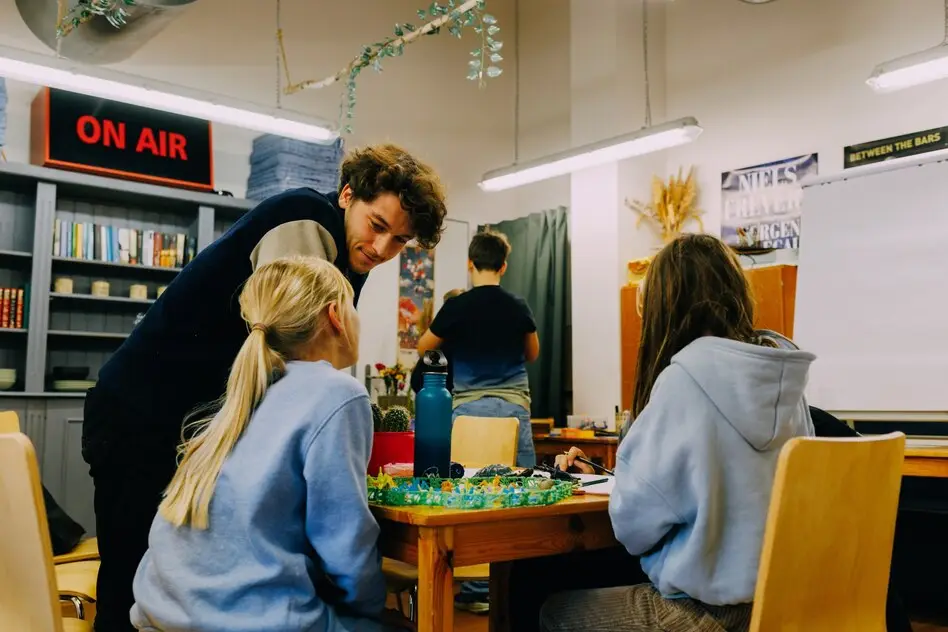
The children look enthusiastically at the young project manager. The eight to twelve year olds sit in a cozy room under the roof. “Who wants to take the photo?” asks Nicolas Neßler. Fingers snap into the air. Sophie uses the tablet to take photos of the little Smurf on the glass bottle. A girl with blonde hair holds the production up to the camera. Today it's about miniatures. How can these be staged? Why play with size, perspective and light? Click. The photo appears on the tablet. “What do you notice?” the media educator asks the group.
As a free holiday program, the children's jury meets in Magdeburg's Moritzhof. The Moritzhof is a local institution – this is where neighborhood meets culture. Cinema in the stable, readings and concerts in the barn, workshops under the roof and next to the archway invite you to linger. Since 2001, the renovated farm has been established as a meeting place for culture and community work in Magdeburg. There are people willing to discuss, people interested in and producing culture, and all sorts of other people who want to try things out.
But since the AfD's election victory in Saxony-Anhalt, culture in the state has come under even greater pressure. According to its election program, the right-wing radical party wants to implement a “patriotic cultural policy” in order to “cure” an “identity disorder” of the German people.
“There has never been a purely German culture,” says Jacqueline Brösicke indignantly. The managing director of Volksbad Buckau works at the other end of the state capital. The Courage women's center is located there in the middle of a district characterized by heavy industry. Today, in addition to Wilhelminian style houses, there is a lot of culture here - a technology museum, a puppet theater, a literature house and the former public baths.
Moritzhof and Volksbad are socio-cultural institutions that carry out important district work and enrich the cultural landscape in Saxony-Anhalt. The AfD in the state government brings new challenges. Katrin Gellrich and Christoph Hackel sit in the Moritzhof office while the children next door analyze the film.
Katrin Gellrich has been managing director for five years. The dramaturge from Zittau knows: “It depends on every single person who sits in crucial positions and how steadfast they are.” The ARTist! e.V. (which is behind the Moritzhof) receives the property from the city, but has to cover the costs themselves through income, donations and funding. Every year, the Vierseitenhof receives funding of around 220,000 euros - most of it comes from the municipality. “In the end, we are dependent on people in the city council, the majority of whom have supported us so far,” says Gellrich. The funding applications are submitted every year.
"I believe that Moritzhof and also Volksbad in Magdeburg fulfill an important function. So that it will certainly take a few more steps to make the decision: We will close it," reflects the committed managing director. Christoph Hackel is a co-founder of the association and has a degree in business administration. For him it is clear that socio-cultural work is aimed at everyone. Queers, migrants, pensioners, children – they should feel comfortable here. "You are not welcome here if you behave disrespectfully towards others. Discriminate against others and do not recognize basic democratic values," has been written on the website for a year. The values that the cultural venue represents are diversity and democracy.
Even though the election of the right-wing extremist state parliament president was a black day for the team, the Moritzhof is not currently under acute threat. But things could look different in 2027. “We can only concern ourselves with the present and the next few months because no one can understand what will really happen,” explains program planner Hackel.
“In the past, we have always found ways to cope with new challenges and circumstances.” What concerns him is: What actually happens when the audience is no longer well-disposed? At the moment that is far from the case. Particularly in the cinema, attendance figures have been at a high for the past two years.
"This year we all looked more consciously at why we do this and under what conditions? And how can we continue to do this in the future?" says Katrin Gellrich. Nevertheless, there is now great uncertainty in the local cultural scene: it is still unclear how things will go financially in the next few years. Will the state government intervene indirectly in the city budget?
Nevertheless, it is clear to Christoph Hackel: “I don’t see that we are submitting programmatically.” But the question in the future is how to formulate funding applications. “I can imagine that in a year, when the first decisions have been made, we will be able to better assess how radical the approach is and whether it will all go through and be legal,” reflects Gellrich.
Things are different at Volksbad Buckau. This has two pillars - socio-culture for Magdeburg and the surrounding area and the women's center. “That means we do women’s education and advice, and we do socioculture for everyone,” says managing director Jacqueline Brösicke. Certain offers from the association, such as legal advice, are specifically for women, while others – readings, concerts and exhibitions – are aimed at everyone.
The 64-year-old was already involved in a lesbian group during the GDR era. She was there when the Women's Initiative Magdeburg e.V. was founded in 1990. The association has now been running the venerable public pool since 2006. This place is also dependent on funding. Around a third come from the countryside. This would allow an AfD state government to decide on the future. “We are fighting for equal opportunities,” emphasizes the activist. "That's what they call 'gender madness'. They want to abolish all of that. We'll have to see how they do it. But we expect that we'll get less funding or perhaps no more funding at all."
This would mean that offers such as advice on domestic violence would no longer be available. This cannot be countered in the future through donations alone. The same applies to the six other women's centers in the country. None of them would be able to compensate for the loss of equality funding from the state budget. Germany ratified the European Istanbul Convention to combat violence against women in 2017 and must now implement it.
Brösicke expects gradual changes; there will always be smaller and larger obstacles. This applies to culture, but especially to women and queers, she emphasizes. "Politically speaking, we will not give in here, we will make it a big deal. There will be resistance!", swears the feminist. “I have experienced so many state governments with this association that I will not let this party intimidate me!” Many women have already supported the association, and artists are also increasingly offering their help. “I assume that we will still be there in five years.”
Now it's time to wait and see. Because as long as the state government is not constituted and the budget is not fixed, the effects remain vague. Everyone reports one thing: the more the country tilts to the right, the more civil society comes together. The institutions are already countering the AfD's declaration of war with a strong network. “I think what we have really achieved this year is that we as cultural workers are very well networked,” emphasizes Katrin Gellrich from Moritzhof. This also includes mutual advice on how to deal with right-wing structures.
This is reflected in the nationwide initiative “Culture is diversity and home”. The word home is deliberately placed in relation to diversity. The word occupied from the right should be reoccupied. Numerous institutions have signed, such as the Cultural Foundation of Saxony-Anhalt, the Bauhaus and even individual artists.
“There has never been such a close collaboration between institutionally supported institutions and free culture,” enthuses Gellrich. The motto is to persevere – also with the help of networks beyond national borders. “I feel a great wave of solidarity, especially in the area of socio-culture,” reports the managing director of the Moritzhof. "It's very valuable to know: We are not alone, and it doesn't matter to people from other federal states whether actors die here."