
Politics taz
After the elections in Serbia: The big sigh of relief
Serbia's independent cultural scene stood with the student movement against the government. With their election victory, she now hopes for real change. more...
Deutsch (original) ·Auto-translated to English
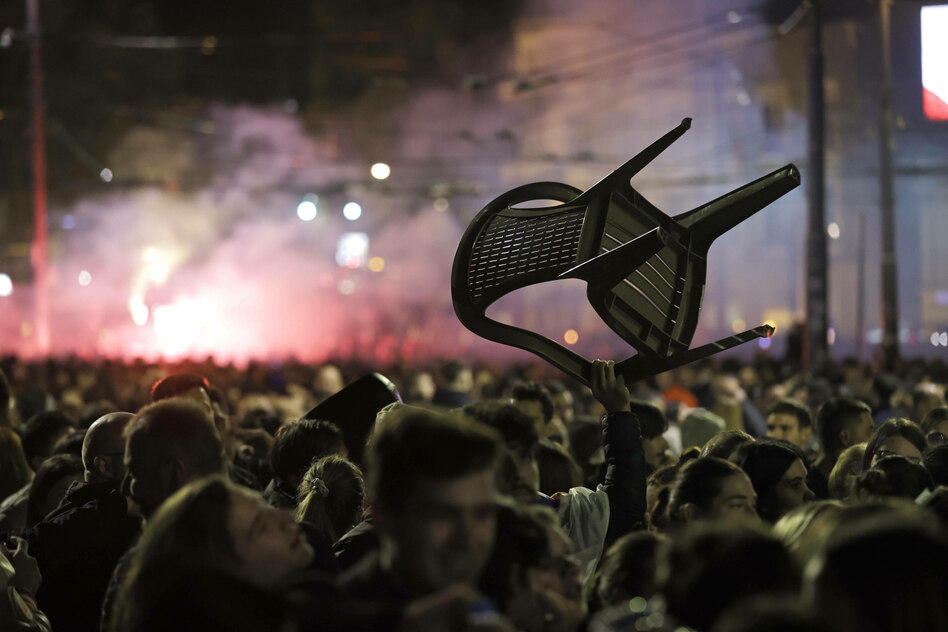
At 9:30 p.m. on the evening of October 25th, a roar goes through Belgrade. Screams of joy, especially from young voices, and fireworks would give even an unsuspecting person an idea of the students' victory in the early parliamentary elections. Then Aleksandar Vučić unexpectedly announces his own defeat. Until 4 a.m. the whole city is a single sound body: cars honking, champagne corks popping out of open car windows, vuvuzelas roaring, people screaming with excitement. There is noise and cheering everywhere, as if the Serbian capital itself were shaking.
According to the independent monitoring organization CRTA, the student list comes to 51.5 percent, the ruling party SNS to 40.4 percent. The gap is surprising: surveys had previously seen students at around 40 percent. The exuberance is overwhelming. Nobody I ask today on the night of the decision would have thought such a convincing victory was possible.
At night, the motto “The students are winning” has already become “The students have won” in the vernacular. The evacuated Ćacilend, in which pro-Vučić people were demonstrably paid for their existence, quickly becomes a self-service shop of history: some take a barrier fence, others a pole, and still others the tarpaulin. On the Slavija, the chairs of the Ćacis are then lifted over their heads and carried away dancing.
What yesterday served as a backdrop for Vučić's show of power has now gone down in Serbian protest history as a souvenir. The nationally known street artist Pijanista already has an idea of what should become of the “artifacts”: an art biennale. There should be no shortage of material in Ćacilend, which partially burned down that evening.
The already overwhelming victory of such a new list run by students is particularly impressive due to its grassroots democratic structure, in which every student has a vote in the plenary session of their faculty. There are also the Great Assembly of Delegates (“Veliki sastanak delegata”) and the Serbian Assembly of Delegates (“Srpski sastanak delegata”), the plenary structures in the cities and nationwide. The students did not form a party, but “just” formed a list that they then put up for election.
The conscious difference to previous party politics that was sought here shows: democracy is not just an electoral process, but a collective practice. I was able to see this for myself during numerous visits to the plenary session of the Faculty of Philology in the first half of 2025: different speeches were articulated with various hand signals, the agenda was consistently adhered to, and competencies were clearly assigned. The students' election program testifies on 1,200 scientifically tested pages: This movement knows exactly what it is doing.
When Serbia's students rose up against the government, the cultural scene soon stood by their side. In addition to science, whose professors supported the occupations of the faculties for months, it became an important ally of the protest movement. The clear verses of the poet Radmila Petrović are read enthusiastically, especially by young people. She and the independent publishing house she founded have long been considered an important voice of political awakening. “This is the beginning of the end for the current government,” Petrović told taz days before the election. “Change can no longer be stopped.” Actresses, musicians and theater people also organized their own actions, created independent stages and made repression public.
I meet Virdžinija Đeković in a Belgrade café a few days before the election. She teaches at the Faculty of Dramatic Arts (FDU) - where the student occupation movement began in November 2024. After pro-government attackers attacked students who were remembering the victims of the Novi Sad train station collapse, the professors expressed their solidarity with them. Within a few weeks, almost all of the country's state faculties were filled.
For Đeković, it is no coincidence that students from the art college of all people started out: art and culture make social conflicts visible and open up spaces in which resistance finds a form.
In the meantime, this resistance has also created its own structures. The Independent Cultural Scene of Serbia (NKSS) connects cultural workers and documents the political pressure they are exposed to. The Community of Art and Culture (ZUK), which was newly founded in the wake of the protests, shows solidarity with the students.
The “Ne-Bitef”, for example, was created at the end of 2025 as a counter-model to the traditional Belgrade theater festival Bitef after its management was replaced for political reasons. A central institution was replaced by a decentralized program at numerous independent venues.
By the way, reports Đeković, this is a classic form of intimidation. For several years now, the management of cultural institutions has no longer been appointed as directors, but rather as “temporary incumbents”, which means they can be dismissed every year.
Other cultural projects are also looking for new paths. The music festival Exit, founded by students in 2000 as part of the resistance against Slobodan Milošević, publicly supported the protest movement. According to the organizers, it then came under increasing political pressure and lost state funding. In 2026 the festival took place in Montenegro for the first time.
With the “Black List” they supported the election with a festival program. In October, the cultural workers created a stage for those who said they had lost contracts, funding or performance opportunities because of their critical stance.
The name refers to informal “black lists” that artists have been reporting on for years. Especially since 2018 and 2019, it has become increasingly difficult to get independent projects funded by the state, explains Đeković. The lists are not officially documented; Rather, their impact is reflected in those who no longer receive invitations, who are unable to use rooms or who are left empty-handed when it comes to funding decisions.
Culture responds to this by organizing itself - often without public support, without fees and with improvised technology. This year, the traditional Niš Film Festival took place in the open air, without fees and with organized electricity accumulators. It still had more visitors than the state festival.
Virdžinija Đeković volunteered all day to monitor the fair conduct of the elections. Nevertheless, she is still on her feet on the historic evening. From Trg Republike, Republic Square, people, accompanied by honking cars and bikers, stream across the central street Kralja Milana to go first to the government headquarters and then on to Slavija Square. "It's incredible. A big sigh of relief."
When, a few days before the election, she spoke with a smile about Vučić as the soon-to-be deposed president and the end of his party, I greeted Đeković's confidence with sympathy, but also with disbelief. Now I have to admit to myself: she was right.
But Aleksandar Vučić, who is now moving into the opposition, will cause disruption. The many directors, mayors and decision-makers at local and regional levels remain in power as his extended arm for the time being.
The real challenge will be to break up the criminal-autocratic structures that have grown over the years - and to prevent the political change from failing because of old networks. But the demonstrators know this today on Slavija, the traditional protest site in Belgrade's city center. Too often they were disappointed.
But now they are taking matters into their own hands. By deposing this largely corrupt autocrat, the students have practiced a prime example of democracy. They not only won an election victory, but also tested a different form of democratic organization. The celebrations will continue here until early in the morning.