
Germany taz
After the parliamentary elections in Serbia: I breathe differently
Serbia has been rejoicing since Aleksandar Vučić's election defeat. Our author used to be part of the student resistance herself. more...
Deutsch (original) ·Auto-translated to English
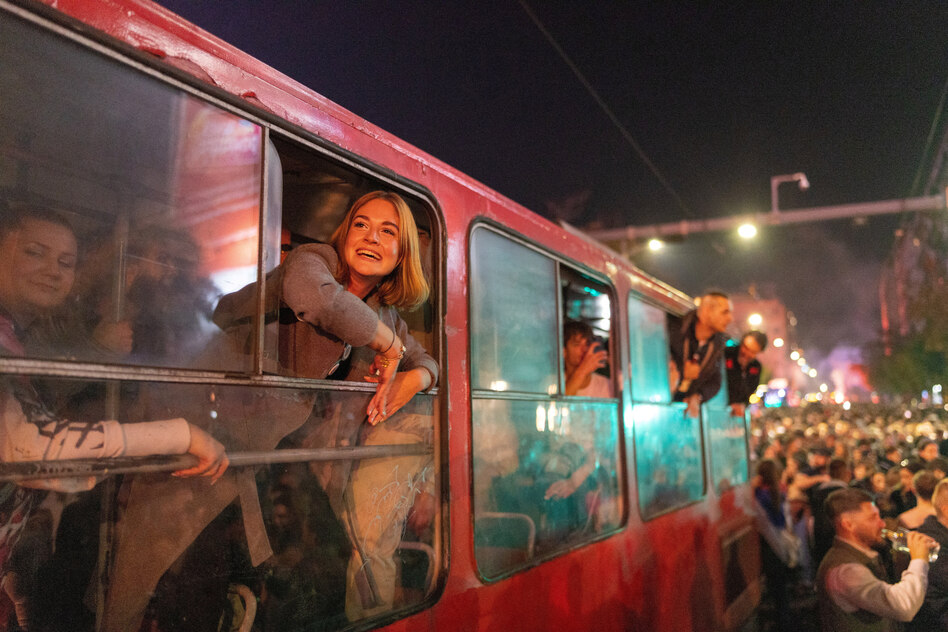
T he October 25, 2026. Early parliamentary elections in Serbia. A sunny day. Full of anticipation and hope, but also tension and fear. Everything is very intense, everything is very contradictory.
These are fateful elections in Serbia. You could almost say – again. It's about a second chance for the country.
A student movement born out of two years of protests has emerged as the main political challenger to autocrat Aleksandar Vučić. When the canopy of the newly renovated Novi Sad train station collapses on November 1, 2024, killing 16 people, something begins that will change this country. Because this means that even the last person has understood what corruption, nepotism and lawlessness actually mean. They can kill.
This text first appeared in wochentaz, our weekly newspaper from the left!
Every week, wochentaz is about the world as it is – and as it could be. A left-wing weekly newspaper with a voice, attitude and the special taz view of the world. New every Saturday at the kiosk and of course by subscription.
In the evening, Vučić announced on television that the entire station, except the canopy, had been renovated. A lie that is not only blatant, but also brazen and empathetic.
Students start organizing mourning rallies. Vučić's regime sets thugs against them. Not once, several times. At the end of the year, all faculties at the country's four universities were blocked. Numerous large rallies across the country will lead to the largest protest in Serbia's history in Belgrade on March 15, 2025. All rallies have as a central point minutes of silence, one for each victim. First 15, then unfortunately 16.
This collective silence, over 16 long minutes, with tens of thousands or, as on March 15, with more than 300,000 others, does something to you. 16 minutes is long. Hundreds of thousands of people are an enormous number. And there is total silence. No cell phone rings, no dog barks, no baby cries. There were a lot of small children, a lot of babies at these rallies. No one has ever whined or cried near me. This fact perhaps best describes the special energy of these minutes.
However, on March 15, Vučić's regime decides that 12 minutes is enough and fires an illegal sonic cannon into the silent crowd. People instinctively run. A deadly mass panic can only be prevented by the calm reaction of many protest veterans. Many participants have been on the streets of Belgrade for decades.
After that nothing is the same anymore. The students are now calling for early elections, Serbia will be suffocated by tear gas and police violence in the summer of 2025. After many years there are again people in political exile and those arrested. People spend months in prison on trumped-up charges. The repression is becoming harder and more open.
Hence the tension on October 25th - despite clear signs of a victory for the students. The turnout is huge and as the day goes on it becomes increasingly clear that the incredible is possible. Towards the evening, hundreds of special police units are deployed around the Central Election Commission in Belgrade, together with gangs of thugs who have set up their illegal camp since March 15 in a public park next to the presidential office in central Belgrade.
Everything points to violence, as in previous months. The polling stations close at 8 p.m. The tension rises to an almost unbearable level. 9.30 p.m., Vučić's press conference. His final sentences are drowned in a general cry of relief and cheers that can be heard from my neighborhood through the closed window. He has admitted his election defeat. The police and the thugs leave. The purpose for which they were opened in the first place must now be determined.
Half an hour later I'm walking through Belgrade laughing and crying, being hugged by strangers in the same emotional state of emergency.
We are currently making history. However, this is the second time I've written this kind of story. In the first episode I was a student myself and part of the Otpor student resistance. Back then, we made a significant contribution to the overthrow of ex-president and dictator Slobodan Milošević. So I'm walking through Belgrade on October 25th, 2026 and thinking about October 5th, 2000. Despite all the differences, emotionally it's very similar.
I breathe differently. It may sound pathetic or banal, but it is actually true. That oppressive feeling in your chest is suddenly gone. You breathe more freely when you get rid of an autocrat. It's an incredible feeling, but overthrowing two autocrats is enough for me for now.
26 years ago, it was the Otpor student resistance that pushed 18 opposition parties into an electoral alliance and thereby achieved an election victory against Milošević. That was the previous choice of fate. After that, the student resistance was dissolved very quickly; no one likes such a powerful group as a check on their own power. Just three years later, Zoran Đinđić, Serbia's first democratic prime minister, was shot. It seemed like it was all in vain. By 2012 at the latest, with the coming to power of Aleksandar Vučić, who had transformed overnight from a Serbian radical nationalist into a pro-European politician, it no longer just seemed that way, it was certain.
It was painful to see someone whose political foster father is the convicted war criminal Vojislav Šešelj and who was Milošević's information minister during the Kosovo War being courted by everyone internationally. Even when he unerringly transformed Serbia into an autocracy, abolished freedom of the press, put the institutions at the service of his party and manipulated the elections more and more openly. Nothing in this country happened without his knowledge and blessing.
This nationalist Vučić, who was initially purified for tactical reasons, became increasingly structurally open. In 2021, ex-general Ratko Mladić was finally convicted by the International Criminal Tribunal for the Former Yugoslavia (ICTY) for, among other things, the Srebrenica genocide - and his glorification immediately began. In the state-controlled media and very aggressively in public spaces. Murals with his likeness were guarded by thugs, and private owners were not allowed to remove them from their facades.
When Mladić was given a funeral with state and military honors in Belgrade, contrary to the current legal situation in Serbia, there was suddenly great international outrage and surprise. But this did not result in a change of course. Less than three days later, Vučić was welcomed with kisses and hugs by French President Macron in Paris.
Since 2016, there have been repeated mass protests against corruption in infrastructure projects, against corrupt and environmentally harmful mining projects, against election fraud, against ever-increasing violence. So there was already a good foundation for mobilization. But then the students came and made the impossible seem possible. They walked all over Serbia several times, for days. To speak to those to whom only state propaganda has previously spoken.
They not only crossed Serbia on their bikes, but also cycled all the way to Strasbourg. And they completed a relay marathon to Brussels. Tears were shed again and again at the reception events for the students across the country. But none of the sadness. They were tears of hope, of emotion, of liberation, and for many of my generation also tears of guilty conscience because these young people now have to do something that we didn't quite finish.
They learned from the previous ones, from our mistakes. Their demeanor is cohesive with grassroots democratic decision-making, they have no identifiable leaders, and they have decided to become part of the electoral process themselves. The student list was drawn up by them. There are no students on it, but academics, artists, farmers, activists; a total of more than half with doctorates. The students do not strive for power, but for the state. Their state, which they want back.
They have already achieved a step that previously seemed impossible - an absolute majority in parliament.
A difficult and long road lies ahead of them. In the past two years they have bloodied their feet several times. And yet they always arrived.
Aleksandra Tomanić, 47, is a member of the executive board of the Southeast European Society and a project manager at Pro Peace. She lives in Belgrade.