
World taz
After the train accident in Spain: Spain's pride becomes a problem
The mourning for the at least 69 deaths after Wednesday's train accident is mixed with the realization that the risks had been known for a long time. more...
Deutsch (original) ·Auto-translated to English
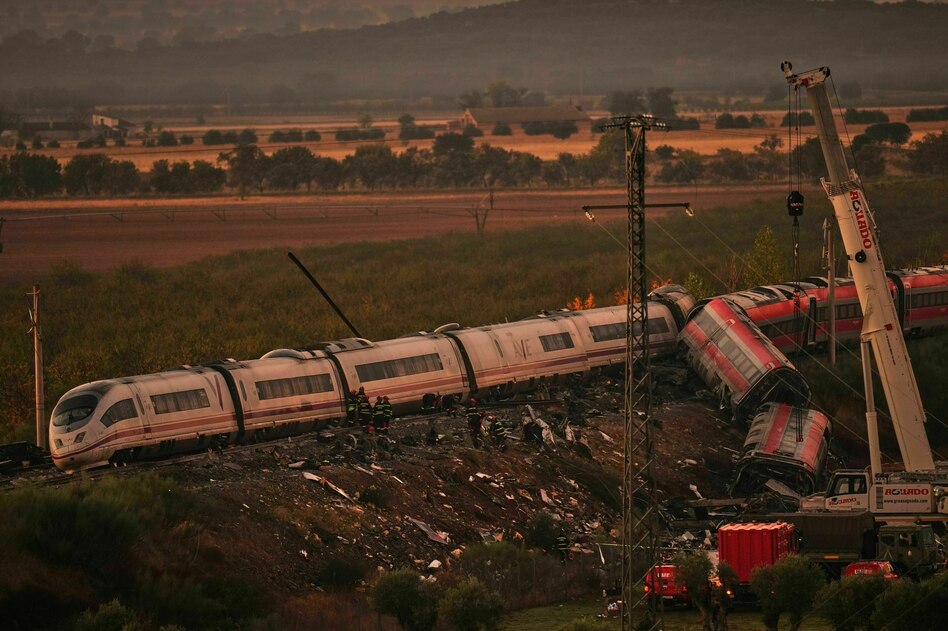
Once the national pride, the high speed of the Spanish railway is now the number 1 national problem child. “Confidence in the high-speed network has been shaken,” Prime Minister Pedro Sánchez has to admit after the serious rear-end collision on Wednesday 118 kilometers south of Madrid. There have been 69 deaths so far and search work is still ongoing.
It is the second serious train accident in just one year. Back in January, 46 passengers died in another accident on the same route from Madrid to Seville. It is now the government's task not only to investigate the causes of the accident, but also "to offer solutions so that such a tragedy does not happen again," explained Sánchez.
At almost 4,000 kilometers, Spain has the second-longest high-speed network in the world after China, well ahead of number 5 Germany with around 1,600 kilometers. AVE – Spanish High Speed – is the name of the trains that quickly became an export hit. For example, a train “Made in Spain” in Saudi Arabia connects the two pilgrimage sites of Mecca and Medina.
It all started right here, where the two accidents have seriously shaken faith in fast rail transport. In 1992, just in time for the World Exhibition in Seville, the route from the Spanish capital to the Andalusian capital was inaugurated. Since then, trains have been rushing back and forth every hour - and since liberalization, even more often depending on the time of day. 471 kilometers in around two and a half hours.
But the route is getting old. During the accident in January, a weld broke exactly where renewed rails meet old ones from 1992. Now it was a computer error that brought the security system to a standstill. Then came human errors.
The Commission for the Investigation of Railway Accidents (Ciaf) reiterated “the need to implement technical measures to reduce risks” as early as 2025, after several similar incidents with fortunately much less consequences. The fact that everything has to be controlled by hand and radio in the event of a security system failure is very “prone to errors, as this depends entirely on the human factor,” it continues.
It sounds like an anticipation of what happened on Wednesday. The control center in Madrid released the route for “normal operation” after a computer failure and automatic stop of six trains, instead of requiring the driver of the train involved in the accident to travel on sight at a maximum of 40 km/h. This then crashed into another stationary train 17 minutes later at 160 to 200 km/h.
Transport Minister Oscar Puente admits that there have already been 160 problems with the route's safety system this year. The security system from 1992 is currently being replaced by a new, European system. But after five years it is still not operational.
The problems became increasingly obvious. Delays are becoming more and more common, and minor and major technical defects are to blame. Added to this is the liberalization of rail transport. This leads to a much higher utilization of the routes than originally planned.
Salvador García-Ayllón, professor of transport at the Polytechnic University of Cartagena (UPCT), sees “years of lack of investment, poor planning and management of the system” as the main problem of Spanish high speed.
Spending fell significantly, particularly in the years of the euro crisis. And after that they didn't rise enough to offset the effects of austerity. According to a study by the European Union, Spain spends 95,860 euros per kilometer, while the EU average is twice as much.
“We could and we should do more,” says a spokesman for the Association of Traffic Engineers.