
Germany taz
Museum of Nazi History in Flensburg: Gestapo headquarters or “German House”?
An education center for the critical assessment of National Socialism is to be built in Flensburg. There is a dispute about the location. more...
Deutsch (original) ·Auto-translated to English
They are only a few hundred meters apart: the Flensburg police headquarters on Norderhofenden Street and therefore within sight of the fjord and the German House on Friedrich-Ebert-Strasse, where it is a slight climb up to Flensburg train station. The latter is a brick-and-mortar gift from the German government at the time, because the population of Flensburg had decided to belong to the German Reich in the 1920 referendum - and therefore against Denmark.
While the German House represents the eventful German-Danish history, things are different with the police headquarters: since 1934 it has also been the headquarters of the local Gestapo, which operated and persecuted people far beyond Flensburg and into Denmark.
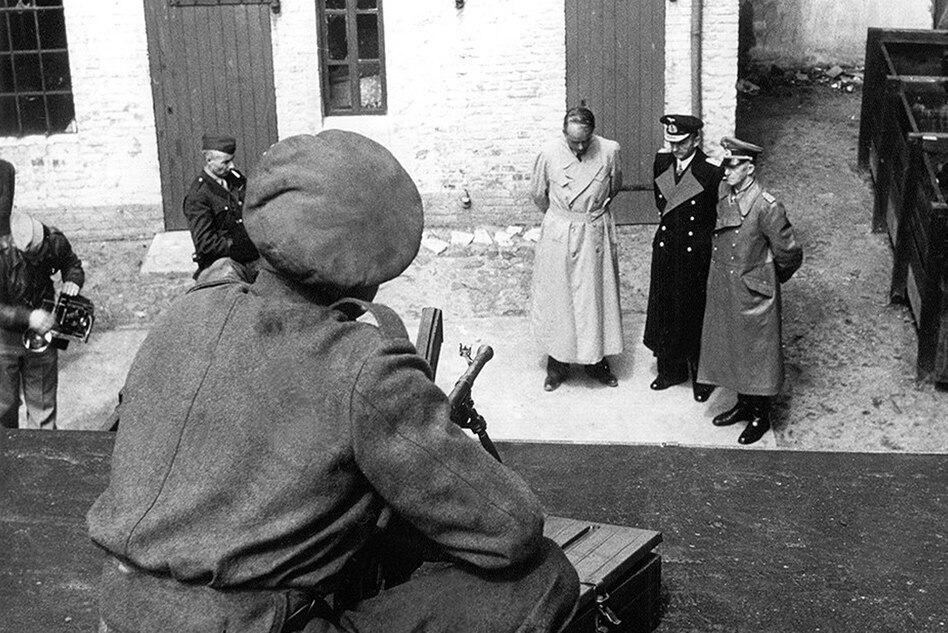
The former detention cells have been preserved, as has the meeting room in which Heinrich Himmler, Reichsführer SS, announced his last appeal in front of leading SS officers and concentration camp commanders on May 5, 1945. The inner courtyard is also preserved, in which Hitler's successor, Grand Admiral Karl Dönitz, and his picturesque Reich government, which had retreated to the Mürwik Naval School, were arrested several times - so much of the international press was present on May 23, 1945.
But the Flensburg council decided on the German House in its resolution to “set up a North German mediation center for the critical examination of National Socialism in Flensburg” because it is owned by the city and, according to a feasibility study commissioned by the city, is significantly cheaper in terms of costs than possible accommodation in the police headquarters, which is still in use. Planned opening: early 2030s.
Various Flensburg actors protested against the decision to locate the German House in an open letter, such as the long-time city leader Knut Franck, the writer Jochen Missfeldt and the former editor-in-chief of the Flensburger Tageblatt, Stephan Richter.
The historian Gerhard Paul also signed. He is a professor emeritus, one of the founders of visual history, but above all a Flensburg resident for almost 35 years and an expert particularly on late Flensburg Nazi history. Paul is also an exhibition organizer and was involved in the conception of the “Topography of Terror” memorial in Berlin-Mitte. “There is no need to organize a historical exhibition in a place that had nothing to do with the topic,” he says about the decision in favor of the German House.
As soon as the letter was published, which received a lot of attention, the situation changed. Because it became official what had long been just a persistent rumor: Flensburg's police are getting a new headquarters, which will free up the existing building in the long term. There is a problem: The building does not belong to the city, but to the state of Schleswig-Holstein - which has not yet commented on whether and what plans it is pursuing.
“It is undisputed that the police headquarters is the place with more history,” says Melanie Bach, the non-partisan city councilor responsible for culture and education – and bound to the council meeting’s decision. Even though the decision contains a note not to lose sight of the police headquarters' options, she expresses herself cautiously: "I don't yet have the binding information from Kiel that I could say: 'Dear politicians, don't you want to reopen your decision?'"
She emphasizes how important it was for the MPs to get the project so far into the planning and on track that it could no longer be reversed: "In the event that after the next local elections we get tendencies in the town hall that are willing to prevent the project."
Another headache for the city is that the police headquarters is in need of renovation. Bach refers to a report from the Ministry of Finance on the renovation effort in Norderhofenden. The city does not have this information, so the building complex cannot be reliably included in the planning.
Bach sees the withholding of the report as an indication that the costs are high and cannot be borne by the city. The Ministry of Finance writes that it is “not aware of” such an opinion.
Paul disagrees with the city's financial and time concerns. He himself recently developed a concept that envisages a memorial and learning place in Norderhofenden. Financing is to be ensured through the establishment of a foundation in which the federal government, state and city participate. He is already in discussions with possible participants. If you let him, he could design an exhibition within six months. "I know the sources, I know where the photos are, the documents; I also know where the Dönitz government's furniture is, it's all there," he says.
Bach, on the other hand, finds Paul's concept more than challenging. Implementation is unrealistic. At the same time, the city administration's plans remain vague: neither financing nor the concept have been clarified. The announced participation of civil society is also still theoretical. An advisory board should be founded and a call for tenders should be made for the concept exhibition. But how exactly and when that will be is unclear. The only thing that is certain is that participation in the location issue is not feasible.
“The city has gone a bit overboard with its idea of a ‘National Socialism mediation center’,” says Gerhard Paul. "This already exists in other cities. I don't know why we should do it again in Flensburg."
What is particularly and specifically different in Flensburg: "You can show here: How does a war end? What illusions do the actors involved have?" So Dönitz pursued the plan to campaign against the Soviet Union together with the British from Flensburg. It is also possible to show how leading Nazi officials went into hiding from Flensburg, equipped with new identities. The place where it happened here too: the police headquarters.
The historian emphasizes that a place to commemorate the prisoners and victims of the Gestapo and police is necessary. He is worried about experiences that have been made in Hamburg, for example, with the town hall as a former Gestapo headquarters: “Once the placement center comes to the German House, an investor will turn the police headquarters into a hotel or build condominiums there, and this unique, authentic place would be lost forever.”