
Germany taz
Balancing trash cans: “I hope I stay until I retire”
Ann-Kathrin Grüttner works for street cleaning in Bremen-Nord, but she has moved away from the city: she lives in the country with her horses. more...
Deutsch (original) ·Auto-translated to English
taz: How did you get into street cleaning, Ms. Grüttner?
Ann-Kathrin Grüttner: I originally worked as a gardener at the environmental company next door, but only ever had annual contracts. At some point, in your mid-twenties, you want a permanent contract. There was a tender here at the street cleaning department, and then I simply changed the door. I was involved in the winter service as well as the street cleaning, and my new operations manager had already been my operations manager there.
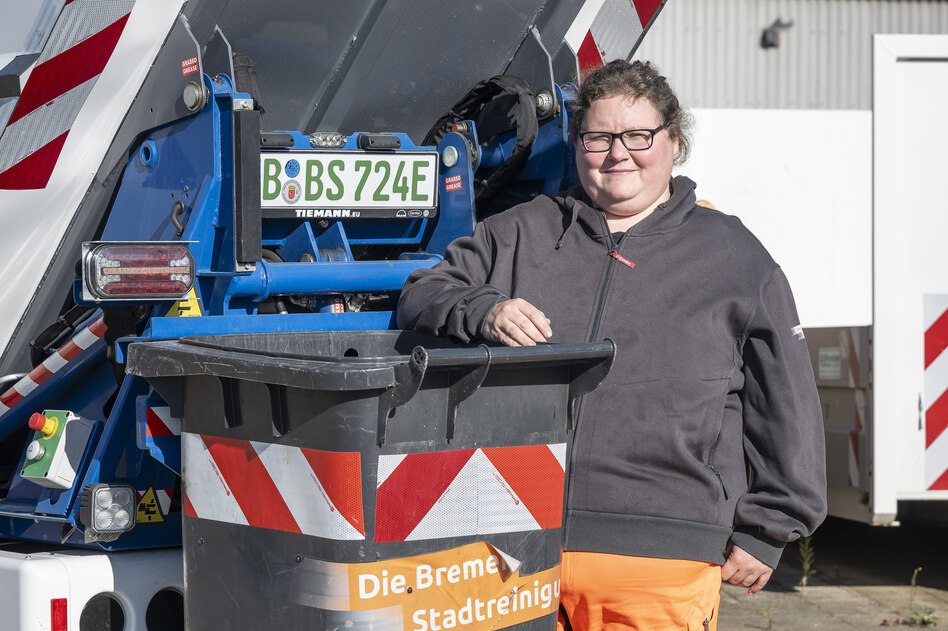
Ann-Kathrin Grüttner, 31, is a trained gardener. She has been working for Bremen-Nord street cleaning for 4 years. There she is responsible for emptying the public trash cans, but also works in the so-called hand crews, where drains are cleaned. Her favorite activity: driving tractors in winter service. She lives on a small farm in Lower Saxony, where she keeps horses, dogs, cats and other animals.
The Bremen-Nord street cleaning department is responsible for 300 kilometers of streets and 94 kilometers of cycle paths, but also takes care of the “public greenery” on the side of the road and 400 wastebaskets. There are also 10,000 drains in their area, 1,250 of which have to be cleaned by hand again and again. The vehicles used include sweepers and collection vehicles, which are slightly smaller than the garbage trucks for household waste.
The operations manager, Dieter Bauch, calls from the next room: We've always noticed her in a positive light, and when we were looking for employees, we asked if she wanted to change. The street cleaning department attaches great importance to immediately signing permanent contracts; it is a different company policy that you don't even start with these annual contracts.
taz: Are women the exception among employees?
Grüttner: There are around 25 of us plus here. And I'm the only woman.
Grüttner: Maybe they're afraid? I don't know, I don't know.
The operations manager from the next room: I come from the Berlin city cleaning department. Women have potential there, many more apply than here. Here women are still afraid to go out on the streets.
taz: Is this also a question of image campaigns? Overall, city cleaning has become faster.
Grüttner: It's just not a typical female job. And it's physically demanding. A nice colleague recently calculated that the bags that have to be lifted into the vehicle weigh 10 to 15 kilos.
The operations manager: It is a prejudice that women have less strength. Ann-Kathrin is equal to a man.
taz: When you were a teenager, what did you think you would become?
Grüttner: I completed two training courses. First as a design assistant. But I quickly realized that sitting at the computer wasn't for me. Then I applied for craft jobs everywhere, including as a painter and varnisher, and actually accepted the first job that came along as a gardener.
taz: Did it initially take you getting used to dealing with waste after gardening?
Grüttner: I also did that three times a week in the garden department. You might have to get used to it at first, it just stinks. But you get used to everything.
taz: How do you actually decide when enough garbage has been collected and the street is sufficiently clean?
Grüttner: Everyone has their own different standards. When is the street clean? If there is no garbage there, that is, real garbage.
Grüttner: I'm rather a sloppy person.
taz: Does the work have a bit of an educational element for you because you sometimes have to pull yourself together?
Grüttner: When it comes to trash cans, I know what would happen if I didn't empty them. I'm usually just a passenger in the hand column. If my foreman says do it, then I'll do it too. But I couldn't be a foreman.
taz: Do you think it's good that you can be recognized from a distance by your uniform?
Grütter: No. It would be nicer to be less conspicuous. But you might not get wrecked that way. Or you can pull one out from under the car because you can see where you are lying.
Grüttner: The freedom: I am alone most of the time and can plan where I want to go and what I feel like doing, how I organize my days, my work and my tours. And that it's a good team overall.
taz: Do you feel responsible for ensuring that Bremen-Nord is beautiful?
Grüttner: Yesterday I was here and thought to myself: Come on, people, you live here. Don't you want it to be nice? But Bremen-Nord is a little different than Lower Saxony, where I live.
taz: Do you ever say to people who throw something on the street: “Here’s the trash can”?
Grüttner: No, I'm not the person for that.
taz: Are people happy when you come by with your car?
Grüttner: Last week there were actually people who thanked us. But that is rather rare. This morning people were complaining that they were still sleeping and why there was a noise. Then I ignore that. We're just working.
Grüttner: We leave here at the farm at 6 a.m.
taz: If you come from Lower Saxony, when do you get up?
The operations manager from the next room: We're even earlier for winter service.
Grüttner: Exactly. We get a call from winter service at 4 a.m. I'm on road clearance duty. Then I drive a tractor. A lot of people say it's no fun. But there's nothing nicer than throwing the snow around in the morning when no one has walked through it yet. So with the tractor. Hand column is not my thing.
taz: What I always find fascinating is the calmness of the drivers of garbage trucks when there is a traffic jam behind them. Is this something you have to train yourself to do?
Grüttner: At some point you figure it out. If people think they have to stress about it, then I just slow down even more. If it takes a long time, I need five minutes - that's how much time every person on the road has.
taz: It sounds like the work has changed you too.
Grüttner: I think it's growing up.
taz: Would you say that city cleaning is a good place for this, especially as a woman? In the sense of “I’m not going to back down now, I’m going to keep sweeping here”?
Grüttner: That's not always easy. It's really cool when a colleague is there. I once had a situation where I was walking in front of our truck and cleaning storm drains. There was a very strange person near me, but I made eye contact with my colleague and thought: Hopefully he will come out soon and help me. That's what he said afterwards: If the person had come one step closer, he would have gotten out. I don't want to mess with people there.
taz: How do people react when you tell them that you work for city cleaning?
Grüttner: Some people ask, of course. Why are you doing this? But I hope I stay until retirement. I always get my money on time, I can start on time and finish on time.
Grüttner: My father is no longer alive. My mother is also in the public service, in cleaning. It was always important to them that I had a job where I was happy. And that's me here now. And I was able to fulfill my dream of owning a house.
Grüttner: A small rest farm that I bought together with my parents. Now I live there with my mother. There are maybe 10 or 15 houses on our corner and 300 people live in the village. But actually I come from Bremen.
Grüttner: I have seven horses and at some point it becomes a cost factor to hire them externally. We now also have dogs, cats, chickens, quails and turtles.
taz: Then don't put your feet up at home.
Grüttner: At some point in between. But rarely.
This text first appeared in wochentaz, our weekly newspaper from the left!
Every week, wochentaz is about the world as it is – and as it could be. A left-wing weekly newspaper with a voice, attitude and the special taz view of the world. New every Saturday at the kiosk and of course by subscription.
taz: Did your family show you the craftsmanship?
Grüttner: My grandfather. And I actually got my first cordless screwdriver as a gift when I was ten, which isn't really typical for a girl.
taz: Who helps you work on the farm?
Grüttner: My mother takes care of it. I wouldn't be able to do it alone. Of course, since my father was killed, one person has been missing. But you learn to deal with it.
taz: I hope the question isn't too invasive, but because you put it so openly: Your father was killed?
Grüttner: He was overlooked by a drunk and drugged driver. That shapes. We had bought the farm together six months earlier. Afterwards, everyone here at work stood behind me, which was a great support.
Grüttner: I was initially on sick leave. But even after that, when I said it wasn't possible, it wasn't a problem. The day I went to the police to be informed about the status of the investigation into my father's fatal accident, I was picked up by my two superiors.
taz: You seem like someone who speaks openly about this loss.
Grüttner: I learned that. I'll live with it for a few more years. If you keep repressing it, it will destroy you.