
Germany taz
With the borrowed dog in the Görli: The fourth child has fur
At the dog park in Görlitzer Park, Berliners quickly start talking to each other. So borrow the dog and get into the dog talk. more...
Deutsch (original) ·Auto-translated to English
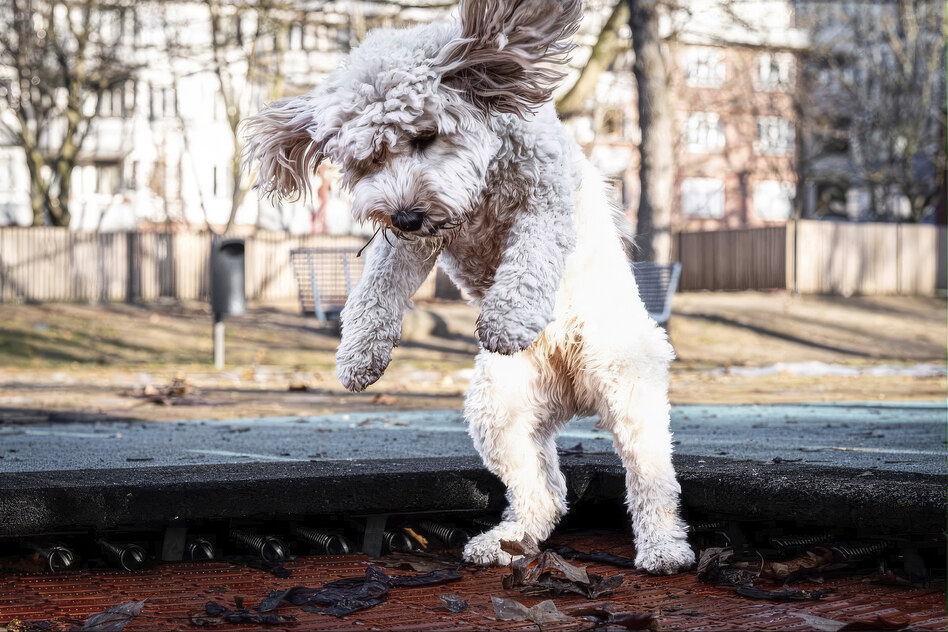
Let's start with a confession: I don't like dogs. Nevertheless, I grab the leash and take over for a few hours Uma, the young poodle of a dear friend who wants to go to the outdoor pool for a while. I immediately feel like Mr. Lehmann, who at the beginning of the novel of the same name is confronted with a dog on a Kreuzberg street at night: Don't do anything wrong now, he thinks - and I think.
I don't eat meat for animal welfare, but then shouldn't I also like dogs or am I kidding myself with my (to this day) secret dislike? I'm old enough to find out.
“Handover: Dog meadow, 11 a.m., Görli,” was my friend’s brief message. I'm as excited as if I were meeting on the Glienicke Bridge for an agent exchange. Appropriately enough, Uma jumps up at me, barking. Did she smell something dangerous? I think of animals baring their teeth from the brutal Netflix series “Dogs of Berlin” and my heartbeat quickens. Uma already lets go of me and pulls me to the dog park.
The former meadow on the edge of Görlitzer Park is an official dog walking area, one of the few places where the Berlin-wide leash requirement does not apply. There are about 15 dogs running, digging and sniffing each other here. Your people are standing next to them.
They say the fourth child has fur. This idea never appealed to me. Dogs were usually just an opportunity to give my daughters the traditional Kreuzberg “Don’t touch!” to shout. This aversion was made worse by the fact that I was bitten by an old poodle from our street last winter. Goethe is also said not to have particularly valued dogs - especially not poodles and their “devilish core”, as we know. Apparently he even resigned from his position as director of the Weimar Theater in 1817 after a poodle appeared on stage during a performance.
Luckily, Uma is not just a poodle, but a cockerpoo: half cocker spaniel, half poodle. Even the name sounds so funny that I quickly forget the old poet and go back to my task. I look around carefully, is there perhaps a lot of dirt here? I think of Peter Fox: "There's shit everywhere, you actually have to float. Everyone has a dog, but no one to talk to."
There is actually a lot of talking here at the dog park, and people quickly start talking to each other. Next to me is a small woman with piercings, bows in her hair and a pug whose leash matches its owner's bow. “Everyone is cleaning up, but there hasn’t been any grass here for a long time,” she says. “Dog Desert would be a more appropriate name.” We start a dog talk.
The number of Berlin dogs has increased significantly during the pandemic. There are now more than 130,000 registered animals living in the city, and probably many more. In Kreuzberg, the pug woman explains, this is called “dog gentrification”. Cafés for four-legged friends are opening in Mitte, and dog schools, exercise services and coaches are offering their services everywhere. There will be dog ice cream, puppy yoga and a dog holiday. “Nice, right?” asks the pug woman and kisses her dog on the wet muzzle. I look down at the ground, embarrassed.
I grew up dogless on the enchanted Nikolassee, among mandarin ducks, squirrels and the popular Berlin wild boars. On some summer nights there were more animals than people on the quiet streets. When I moved from there to Kreuzberg, the wild animals were replaced by domestic animals.
A handsome dog man intervenes. There are simply too many dogs, he says. Every second person here is certainly illegal, i.e. not registered. Berlin is the German dog capital without being prepared for it. Kreuzberg is probably also far ahead when it comes to animals that are not registered for tax purposes. “When it comes to illegal things, nobody can fool the district!” he says cheerfully.
The pug woman now talks about dog physiotherapy in Charlottenburg and at Lake Grunewald – the “dog tinder,” as the dog man adds with a smile. I hope this doesn't mean anything sexual between species and I'm immediately ashamed of the thought.
I never noticed dogs in Grunewald, only on our Kreuzberg street they are sometimes too much for me. How come? The pug woman stands in the middle of the dust and says it's just not nice here, neither for people nor for dogs.
Uma continues digging in the sand. To keep myself busy, I keep repeating Uma's name as if it were a testament to our young relationship. Part of me wants to be noticed by her. I keep calling out "Uma. Uma."
What's remarkable is who is talking to each other here: people who would probably be overlooked in other places - recipients of citizen's benefit, newcomers from Stuttgart, bar owners from the neighborhood. What they have in common is their love for their dogs and perhaps also their appearance, which you can experience at the “Dog lookalike contest” or the “canine convention, where humans identify as dogs”. So far – so Berlin…
I quickly ask about the well-known comedian from Rüdesheimer Platz, about the wonderful Loriot and his sentence: “a life without a pug is possible, but pointless”, of course the pug woman knows him. And in general, she says: If a dog is strange, it is almost always the fault of the people, not the animal; many people don't find out enough about the breeds and their needs before buying them.
A man in an Idefix shirt is also here with his dog, a “wind chime” named Disco. King Frederick II, the Berliner Fritz, was buried between his beloved wind chimes. Others should decide at this point whether this speaks for or against keeping dogs.
Since he has had a disco, his owner says, going out has been complicated. He can hardly stay away for more than six hours; festivals are practically impossible. “Disco instead of disco,” I say. He looks tired. My jokes were better.
I'm starting to get bored. Not as much as the playgrounds used to be, but similar. The conversations don't get any happier either: toxic drug excrement, high fines for dogs without a BVG ticket and complicated vacation trips.
At least an Italian airline now also takes large dogs with them, says the handsome dog man. “I can drink wine for two,” he adds. What else is good about dogs, I ask him? “They greet you more happily than your long-term partner,” he says. “Or as any strange date,” adds the pug woman.
"When you're feeling bad, the dog comes and stays there. He waits as long as you need him," says Disco's owner. All things, I think, that I rarely get from my teenagers.
And there is actually something immediate in the playfulness of these animals. Something you can't learn in any mindfulness seminar. The constant critical thinking of a Berliner overlooks something from nature right under her nose, another mammal that is just as much a relational creature as we are.
Suddenly I see this dusty corner with different eyes. Very different people come together here with their stories. They talk to each other, bring water for all the animals and exchange news from the neighborhood. On the playgrounds during our toddler years, we sat next to each other rather than socializing. It's the dogs here that bring city dwellers closer together, or as Disco's master says, with a dog you do something every day for another living being that isn't you, which makes you compassionate.
My criticism of pets – their meat consumption, their ecological footprint – suddenly seems less clear to me. After all, there is one mammal that reliably outdoes all others in destroying the planet: humans.
A green, not too hot city with access to water, few cars, garbage and asphalt would be good for everything that lives. Maybe the dogs just notice it earlier than we do.
Something shifts. My human-centered view makes room for other living things, even a furry perspective. Whether I like dogs in general now seems like a pretty stupid question. Who likes all people? I now reinterpret Goethe's hysterical reaction and Mr. Lehmann's panic: We can see from the animals what is wrong with us.
One thing is certain: I like Uma. And the pug. And the greyhound back there. And disco anyway.