
Germany · taz · · 1h
Migration route in Eastern Europe: The nameless
Deutsch (original) · Auto-translated to English
The pathologist is late. In the corner of a restaurant in Bijeljina, Bosnia-Herzegovina's easternmost city, Nihad Suljić is blowing cigarette smoke into the air, and there is a coffee on a sticky tablecloth in front of him. Three men sit opposite him. They are from Bosnian television and want to make a documentary about Suljić and the pathologist Vidak Simić. Now they have to wait.
Nihad Suljić jokes around, seems relaxed. It's hard to believe that this table will soon be about people who drowned in the river between Bosnia-Herzegovina and Serbia.
Vidak Simić shuffles in, “Dobar dan,” he says, hello. He extends his hand to the group, lights a cigarette, orders schnapps and begins to talk about the Drina – the border river. “It's a beautiful river that I love, but also a terrible one,” he says. The authorities on both sides of the border are not interested in the people who are drowning in the Drina while fleeing to Europe, he says. “Not one state, not another, no state at all.”
This text first appeared in wochentaz, our weekly newspaper from the left!
Every week, wochentaz is about the world as it is – and as it could be. A left-wing weekly newspaper with a voice, attitude and the special taz view of the world. New every Saturday at the kiosk and of course by subscription.
Then Simić becomes specific. The last two they were able to identify together, he says, were Egyptians, Coptic Christians, recognizable by a cross tattooed on their neck. “Nihad took care of everything: the grave, the priest, the ceremony.”
Nihad Suljić looks up at the pathologist and says: “Thank God you saved the bones for years.” One of the men on TV nods and asks about a boat for the shoot. Suljić and Simić are supposed to travel across the Drina together for the documentary. Vidak Simić finds this somehow amusing, his head jerks back and he laughs. It's been a year now.
The Drina winds for 346 kilometers through the deep green valleys of the Dinaric Mountains, sometimes flowing slowly like a tired viper, and at other times plunging wildly into the curves. For centuries, the river was the lifeline for Muslims, Christians and Jews who traded, celebrated festivals and shared their everyday lives on its banks.
But the turquoise waters once also separated kingdoms and today mark the longest part of the border between Bosnia-Herzegovina and Serbia. During the Bosnian War, the Drina became a silent witness to untold atrocities and swallowed the bodies of hundreds of murdered Muslim Bosniaks. Some say that no other inland water in Europe has as many corpses as the Drina.
Today it is mainly migrants who lose their lives in the border river as they flee to the European Union. Because the authorities usually remain inactive, a grueling battle to identify the dead begins after every accident. Nihad Suljić, 35 years old, a Muslim Bosniak, has made this fight his mission. And about his job.
He looks for families, names and graves. He is supported by Vidak Simić, 68 years old, a Serbian Orthodox pathologist, who autopsies the corpses and freezes bones from which identities can be reconstructed years later.
Three decades ago, the army from one man's country laid siege to another's hometown. Today they are fighting together against oblivion and trying to give the bodies recovered from the Drina their names back. What drives this unlikely duo to turn their attention to the deaths for which no state feels responsible?
In Nihad Suljić's office, the River of the Dead hangs framed on the wall. In the photo the Drina shimmers green. The room smells of paint, freshly painted, bright white. A banner reads “Deluj.ba” – “Do something” in Bosnian. This is the name of the aid organization that Suljić founded at the beginning of 2025 and with which he has now moved into these rooms in Tuzla, an industrial city in the north of Bosnia-Herzegovina. From here he tries to identify the dead from the river: people who drowned while fleeing towards Western Europe.
It's 9:30 p.m. and the street lights are flickering outside. Activist Suljić, white sweatshirt, black glasses, puts on Bosnian coffee. He seems excited, suddenly jumps up and pulls a sheet of paper from a file tray. It is a document issued in his name, stamped and signed by officials from Bosnia-Herzegovina. He holds it up, looking proud, he says: “I fought for it for six months.” It is permission to erect gravestones for drowned migrants, firmly anchored in the ground, with names engraved on them.
One of the other photos on the wall of Suljić's office was taken at the police station in Zvornik, a small town in eastern Bosnia that nestles along the course of the Drina. It shows Suljić himself and eleven young men, almost children, in a room with neon lights and closed blinds. On the table are bottles of water and chocolate bars that Suljić brought them. Some of the young migrants laugh into the camera, others lazily raise their hands. They look tired, marked by the night they crossed the Drina.
On August 22, 2024, just before dawn, they got into one of two inflatable boats on the Serbian side. The darkness hid swirls and rocks. The first boat reached the Bosnian shore, then the border police picked up the people. They laugh in the photo because they don't yet know what happened to the second boat.
Paradiso beach is 20 kilometers downstream from where the two inflatable boats were supposed to cross. Here the Drina flows tamely and shiny blue over scree. The autumn sun shines on empty picnic tables and deserted stalls. A red pickup truck crunches along a gravel path. Firefighter Zlatan Simić gets out - another Simić in this story. From the bank he examines a gravel bank. “The Drina is a beautiful river,” he says, “but I’ve seen a lot of bad things here.”
Zlatan Simić has been working as a rescue worker on this river for twenty years. Every bathing season there are a few locals who overestimate their strength and die while bathing. But other cases have been increasing in recent years: migrants drowning.
The water level is particularly high at night, says Simić, and the Drina becomes a danger. The migrants usually leave after sunset so that the border police do not see them. The refugees wear several layers of clothing to combat the cold. Layers of material that pull them down in the water.
On that August 22nd, 2024, at six in the morning, a call came: a capsized boat, several missing people, including a nine-month-old baby. Zlatan Simić and his team got into a rubber dinghy and searched downstream. The water was high, he says, and fog was creeping over the river. “We could barely see two meters.” The level fell around midday and visibility became clear. The body of a man lay on a gravel bank in the middle of the Drina, right between Bosnia-Herzegovina and Serbia.
Serb and Bosnian units searched the river for three days. They found twelve bodies.
The authorities pull the dead out of the water. But hardly anyone is looking for the survivors in distant countries. The drowned migrants are usually buried at the edge of the cemeteries, far away from the local dead, under simple wooden steles. And often without a name.
Nihad Suljić was a young boy when Yugoslavia fell apart in the early 1990s. His family, Muslim Bosniaks, lived in Tuzla, which was under siege by Serbian forces. The electricity went out, food was scarce, and tanks were parked in front of the mosque. NATO soldiers threw chocolate candies on the asphalt, Suljić remembers, for children like him.
In 1995, Muslim refugees from Srebrenica came to Tuzla. Suljić's grandmother cooked for her, even though there was barely enough for her own family. Suljić didn't understand it at the time, he was hungry and food was so scarce.
As a teenager, Suljić stood on the streets with the women of Srebrenica. They held up photos, names, dates, the places of disappearance. They were looking for the bones of their husbands and sons. Suljić later worked in the human resources department of a supermarket chain. That was his first life, as he calls it.
His second life began on a summer day in 2016, at the bus station in Tuzla. Nihad Suljić was waiting for a bus when he saw a man, barefoot, hungry. The man said he was from Pakistan and wanted to go to Sarajevo, the capital of Bosnia-Herzegovina. Suljić bought bread and showed him the right stop.
In the days that followed, the next group was at the bus station. And the next one. Suljić started reading up and talking about it in the office. After work, he and his colleagues drove back to the bus station and brought bags of food and clothes. “At the time I thought: This is just for this summer.”
From 2015, the world looked to Southeastern Europe. More and more people fled the war in Syria, from Afghanistan, Pakistan and Iraq. People quickly started talking about the Balkan route. The escape corridors vary depending on the time of year, bilateral EU agreements, Frontex operations and smugglers' networks. Serbia and Bosnia-Herzegovina are usually just one stage on this route.
Since the EU countries Hungary and Croatia massively upgraded their borders with Serbia, many smugglers have been sending refugees across the Drina. This detour via Bosnia-Herzegovina is risky but cheaper - and the route through the Bosnian forests towards Croatia promises more success, despite brutal and illegal pushbacks from the Croatian authorities.
Things are calmer again at the moment, says Nihad Suljić. The route shifted more towards Montenegro. But he assumes that refugees still come across the Drina from Serbia to Bosnia-Herzegovina almost every day.
After his first encounter in 2016, Suljić was soon caring for the refugees in Tuzla on a daily basis. His second life took time and he quit his job. It cost money, he collected donations.
Four years ago there was a call from France. A young Afghan man was missing his brother, disappeared somewhere on the Drina. Suljić went to the police in Zvornik, but the officers knew nothing. Suljić shared a photo of the missing man and his own cell phone number in Facebook groups. That same day, a firefighter wrote to him: “I think we found him.”
Nihad Suljić drove to Bijeljina together with a cousin of the missing man. The body of a young Afghan man was kept there. In the hospital, Suljić met pathologist Vidak Simić. The cousin identified the body. It was the first dead refugee from the Drina to whom they were able to give a name. When Suljić informed the police, an officer said: "You don't know how many unnamed graves there are here in Zvornik."
The Serbian Orthodox cemetery in Zvornik stretches over a hill, black gravestones close together like mushrooms in the ground. When Nihad Suljić entered it for the first time, he discovered weathered wooden steles, overgrown, hidden among rubbish. 18 pieces, without names, only with the letters “N. N.”, nomen nescio – name unknown. Suljić began cutting back the brush and exposing the panels. “At that moment,” he says today, “I understood how many people are disappearing in the Drina.” People who experienced little dignity during their lifetime - and not even in death.
Four years ago, after identifying the drowned Afghan, Suljić called pathologist Simić. He knows of other missing people. Refugees looking for companions and families who could no longer reach their sons became aware of Suljić on the internet portals. They continue to contact him to this day, hoping to find the missing people. His aid organization Deluj.ba makes his work easier and creates access to authorities and refugee camps.
Suljić distributes leaflets there, and a QR code leads to a website where relatives can enter the details of missing people. It is important to go to the camps personally and build trust there. Many refugees did not report missing companions. Out of fear of the authorities. “I want to give the dead their dignity back,” says Suljić.
Even after identification, returning the bodies to their home countries is often too complicated or too expensive. Then Suljić ensures that the dead at least get a proper gravestone. The Vienna organization SOS Balkanroute helps him financially and ideally. Petar Rosandić from SOS Balkanroute says that together with other activists they have set up 101 gravestones in Bosnia-Herzegovina and identified more dead than at any other EU external border.
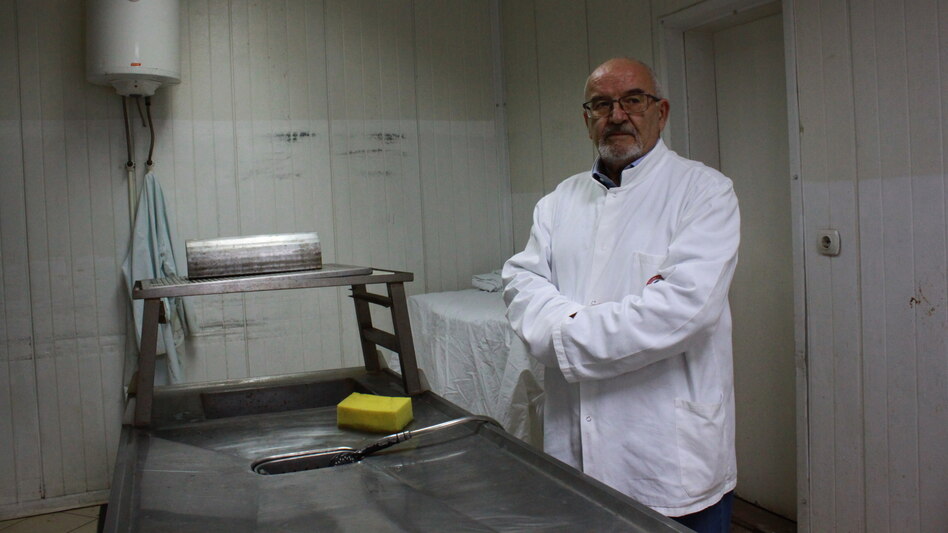
In Bijeljina Hospital the elevator stops on the first floor. Neon lights, gray linoleum floors, a sign: No smoking. Behind a half-open door, Vidak Simić sits at a desk, an ashtray next to the microscope. He lights a cigarette. He has been examining tissue samples from patients for 35 years, and he says he usually doesn't have good news for them. And he also autopsies corpses.
When the police find a dead person in the Drina, Vidak Simić first examines the body from the outside, recording everything he sees and taking photos from all angles. He then opens the body. “In drowned people, the lungs are as if they were inflated, there is sand in the airways and water in the stomach.” The dead in the Drina are difficult to identify based on external features. “Identification is often impossible without a bone sample.”
The autopsy room is in an adjacent building, wooden coffins stand in the hallway, the air smells of strawberries - room spray to combat the smell of corpses. In a room without windows, Simić opens a groaning, yellowed freezer. He shakes frozen drawers and grabs an envelope. Two fingers disappear inside and pull out a piece of bone. It is a part of a thigh bone from a migrant who drowned in the Drina, neatly labeled with the year 2018. “According to the regulations, I have to keep it for three years,” says Vidak Simić. "But I'm keeping them longer so that the dead can be identified maybe in three, maybe in five, maybe in ten years."
Vidak Simić was at the front in the Bosnian War. As a military doctor, he treated wounded people on the side of the attacker, the Republika Srpska. He doesn't like to talk about the war, speaks quietly, almost whispers, with each word slowly becoming another. Before the war, he believed that people in Yugoslavia were one people and that religion should not play a role. “We went to the Drina, had a barbecue, Muslims together with Serbs and Croats.”
After the war, he stayed with the dead: as a pathologist who also autopsied war victims from mass graves. “If we found just one bone, we were happy,” he says today.
Since 2016, he has autopsied more than 40 drowned migrants, most of them young men. Before meeting Suljić, he could not identify a single person. With the help of Suljić, he managed to score nine. “I only see my work as finished when the soul finds its way home.” And for this the person must be buried with dignity. He is a believer, an Orthodox Christian. He lights a candle in the church for every person he autopsies.
Nihad Suljić, a Muslim Bosniak with self-printed QR codes, and Vidak Simić, a Christian Orthodox Serb with a yellowed freezer: after all, they stand together on the banks of the Drina for the Bosnian television documentary. Simić looks seriously at his smartphone and holds it up to the camera.
It shows a video. Men dig a grave into the bone-dry ground somewhere in Afghanistan. They sing a lament. It is said to be the family of one of the first dead migrants that Simić and Suljić jointly identified and returned to his homeland.
“When Nihad sent me the video, I was very happy,” says Simić. Why happy with pictures like this? “Because my work as a human being, as a doctor and as a believer was complete.” The dead man, he says, has gotten his identity back. And then Simić smiles as the Drina passes peacefully behind him.
Read the full story at the source
Source: taz