
Housing taz
Rent protests in Spain: Sánchez under rent pressure
Thousands of people are camping in Madrid for affordable housing. Before the new elections, they hope to change more than the housing market. more...
Deutsch (original) ·Auto-translated to English
So this is what someone looks like that helped put the whole of Spain into disarray and even caused the government to resign. Sandra Mora is rather petite and yet somehow seems strong and resolute. The 30-year-old is one of the speakers for the Sindicato de Inquilinas, the tenants' union. She coordinates their actions in one of the 21 districts of Madrid. Mora speaks calmly but firmly. “We never thought it would come to this,” she says.
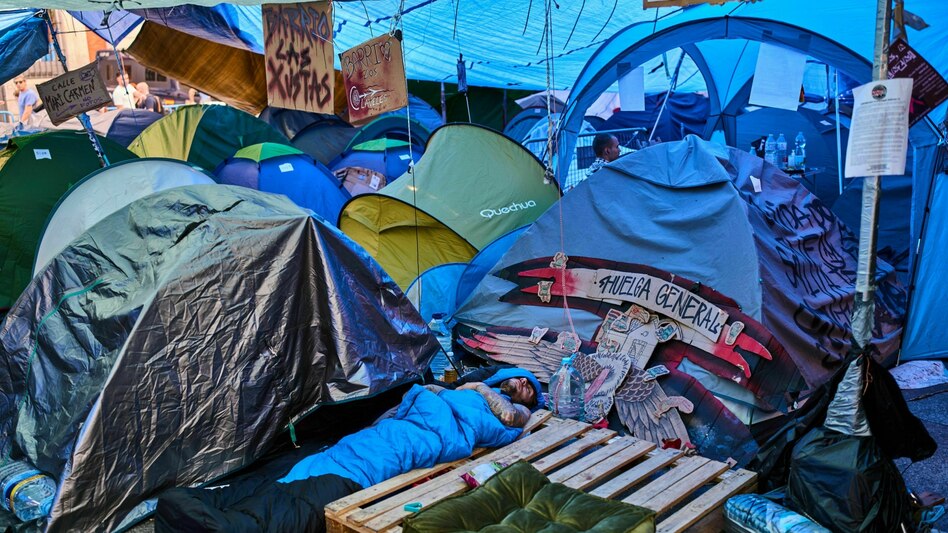
So far? Since the end of September, Spain has been experiencing the largest mass protests in years. Hundreds of thousands are taking to the streets for the right to affordable housing, a huge protest camp has been set up in the center of Madrid, and other camps are in many other Spanish cities. Under pressure from the street, the left-wing government under Pedro Sánchez hastily drafted two laws that, among other things, were intended to cap rents and prevent evictions. The laws failed in parliament due to resistance from the right. Sánchez then dissolved parliament and brought forward elections next summer to November 29th. Since then there has been an election campaign in Spain and the issue of apartments and rents is at the top of the list.
It took just 10 days to see the Sánchez government fall over the rent issue. And events have hardly lost any momentum: the tenants' union has already announced a general strike for affordable housing. It is scheduled to take place on November 11th, before the elections. The country's major unions have already publicly expressed their support - and it now looks as if the whole thing could turn into an "Iberian general strike" because unions in Portugal could also join in. In any case, that is the demand of the demonstrators, the unions have not yet made an official statement.
The trigger for all the unrest was the forced eviction of Maricarmen, an 87-year-old pensioner with walking difficulties in Madrid. “It was the perfect case to highlight what was going on in the housing market,” says Mora. That's why the tenants' union went public with this particularly vehemently. The police fought their way through hundreds of demonstrators in front of rolling television cameras. Mora was one of the protesters who was dragged away by police. Maricarmen was eventually taken on a stretcher from the apartment where she had lived for 70 years. The images outraged hundreds of thousands.
There were demonstrations all over Spain on the evening of Maricarmen's eviction. The following weekend, 300,000 took to the streets in Madrid. Some simply stayed and camped in tents in the Puerta del Sol square, where “the outraged” of the 15-M movement had also protested against inflation and high youth unemployment in 2011. At the weekend, half a million took to the streets in Madrid. There were protests in another 50 cities.
The protest camp in Madrid has now grown to well over 1,200 tents. It's a city within a city. There is a security service, food distribution and a cleaning service that keeps the surrounding streets clean every day. All kinds of workshops and information events are held. Dozens of organizations have gathered here, from environmental groups to Antifa, from neighborhood committees to international solidarity. When Maricarmen died in hospital two weeks after her eviction, it only strengthened the will to continue fighting.
“We obviously pulled the right strings,” says Mora happily. She wears a shirt with the inscription ACAB, underneath which it says not - as expected - "All Cops Are Bastards", but "All Caseros Are Bastards". Casero is the Spanish word for landlord. Mora doesn't want to talk much about the early elections. “As a union, we don’t get involved in party politics,” she says. But of course she hopes for a strong left. "Because we don't have to expect anything from the right. Here in Madrid, the right rules. The city administration and regional government don't even talk to us."
The housing problem is at the heart of the primary election campaign. It has been the number one issue in surveys for months that people in Spain are most worried about. Two thirds of the total population are in favor of a rent cap and measures against speculative real estate funds. Even among those who vote right and extreme right, it is more than half.
The left-wing minority coalition, Sánchez's socialist PSOE and the left-wing Sumar alliance, republished the two failed housing laws in the official gazette after the dissolution of parliament. Now they have to go through the Permanent Representation of Parliament. At least one of the two laws has a majority there: forced evictions of socially disadvantaged people such as Maricarmen are prohibited as long as those affected have no alternative housing.
Rents will initially be capped, rental contracts will be automatically extended by two years, and real estate funds will no longer be able to buy up houses until 2030. “A relief for many,” Mora sees it. But that is still far from enough. The tenants' union wants permanent rental contracts as the norm. The electoral alliance Frente Amplio – Broad Front – which replaces the previous smaller coalition partner Sumar, joins these demands.
This is exactly what the right is attacking. The Partido Popular (PP) sees the solution in housing construction. “I will have a million apartments built in my first legislature,” promises PP leader Alberto Nuñez Feijóo. “Why aren’t the conservatives building now?” asks Mora. Ultimately, the responsibility for housing policy lies with the regions, and in 11 of the 17 the PP governs - without doing anything. “In recent years, the PP in Madrid has sold thousands of public apartments to real estate funds,” criticizes Mora.
The right-wing extremist Vox, which governs four regions in coalition with the PP, blames immigration for the housing shortage. They only have one suggestion: Anyone who buys their first condominium should be exempt from VAT. Vox is not interested in tenant politics.
Tenancy law in Spain is weaker than almost anywhere in Europe. Rental contracts are generally limited to a maximum of seven years. “You have no security whatsoever,” says Mora. When the contract expires, the landlord can increase the rent as he wants.
The young woman earns her living in a cafeteria in the rich part of the city, “where the people who are evicting us live,” as Mora says. At the same time she is writing her doctoral thesis, the subject of which is the Irish writer Samuel Beckett, she says. Mora has been a member of the tenants' union for three years. At the time, she herself had problems with a rental agreement “that was not legal.” She was helped, then she began to help herself.
Mora's tenant biography is an example of developments in the housing market. Three years ago she lived in downtown Madrid with friends in an apartment for 300 euros per room. Now she has moved to one of the southern, much poorer parts of the city, where she shares a 90 square meter three-room apartment with two friends for 470 euros per room, cold. And this in a country where the minimum wage is 1,221 euros gross per month. Mora only earns 800 euros a month because she only has a part-time contract.
“For a long time, renting was viewed socially as something that only young people did temporarily, or who failed,” says Mora. The mentality in Spain was shaped by the last years of the Franco dictatorship: “Make owners out of proletarians” was the motto back then. There were loans and construction took place. While in countries like Germany over half of the population lives in rented accommodation, in Spain it is just 26 percent.
The purchase prices for apartments have risen to such an extent that with a normal wage the only option left is to rent. And this in a rental market that is hardly regulated. Conflicts are therefore inevitable. It is thanks to the tenants' union, which was formed in 2017, that this has now penetrated into public awareness. They repeatedly defend people who cannot pay excessive rent increases and are therefore facing eviction. In the Maricarmen case, a real estate fund increased the rent from 500 euros to over 2,600 euros.
The camp in Madrid has now developed a life of its own, independent of the union. It's about preparing for the general strike. “That will finally put the topic at the center of the debate,” Mora is certain.
“When the housing protests started, it was immediately clear to us that we had to be there,” say Carla and Martina Montero at the protest camp in Madrid. The 23-year-old student teacher Carla is the older of the two sisters. She always spends the night in the camp, but when not, she leaves her tent to friends. Martina is only there today. The high school student is not yet of age. “Our mother only let me come here with Carla as an exception,” she says a little crestfallen.
The two agree that the housing problem is the most important problem facing young people in Spain. Carla and Martina still live with their mother in a village 45 minutes by bus north of the capital. “But my boyfriend lives in a rented apartment,” says Carla. The 25-year-old gardener only earns the minimum wage. “He can’t afford an apartment with that,” reports Carla. That's why he only has one room in a four-person shared apartment.
Living together is not always easy, reports the student, who visits her boyfriend there regularly. It's cramped, the bathroom is small, and so is the kitchen. There is no living room. This was also rented out as a room. “The whole thing costs 575 euros a month,” reports Carla. That's more than half of her boyfriend's net salary. A maximum of 30 percent for the rent is considered socially acceptable.
The two hope that the left, despite polls saying otherwise, can still prevent the right-wing Partido Popular and the right-wing extremist Vox from winning the election. "We have not yet achieved any rent reform with the current government. This would be completely impossible with a right-wing government," she says. And just the idea that the neo-Francoist Vox could be in the government scares them both.
The two agree that the Sánchez government has done little in eight years. And what the left-wing coalition has actually done only works to a limited extent. A law passed by the left-wing coalition in 2023 provides for districts and communities in which residents spend an average of more than 30 percent of their family income on rent to be declared areas with a “stressed housing situation”. The idea is to cap rents. But the regions have to implement it. And where the right is in power, such as in the capital region of Madrid, it refuses. In addition, Madrid hardly builds any social housing, and much of what there was went to real estate funds at a ridiculous price in the early 2010s.
Manolo Jodar and his wife Ana Vilches, like thousands of others, are coming to Puerta del Sol these days to show their solidarity. It's more than just the housing issue that drives the two retired high school teachers. “Finally there is a mobilization that brings us back onto the streets,” says Jodar. In the early elections in times of mass social protests, the two see Sánchez's “attempt at liberation” and hope that it will succeed. Most surveys see the right-wing PP ahead together with the neo-Francoist Vox. The left-wing coalition has been in crisis for months, including because of corruption cases at the top of Prime Minister Sánchez's party. Many voters on the left have given up, says Jodar. Can the mobilization of the left now prevent the victory of the right? Jodar is optimistic, Vilches is not.
The two live in a condominium not far from the Puerta del Sol in the old town, in Lavapiés, which they bought more than 30 years ago. The real estate market wasn't going crazy back then. “Tourism ruined everything there,” says Jodar. What was once something like a village in the city is now full of holiday apartments and tourist bars. There are over 16,000 apartments in Madrid that are rented to tourists. Over 90 percent of them are unlicensed. Nevertheless, the conservative city administration does not intervene.
"District life no longer exists. Many of our neighbors have left, especially those who were renting," adds Vilches. Lavapiés, once a district of modest people, has become unaffordable. Her two sons couldn't stay either. “The ‘big one’ bought an apartment with his partner far outside the city center,” says Jodar. Both are civil servants. And yet it is not easy for them to pay the mortgage. The “little one” is a chef in Alicante on the Mediterranean. He lives in an apartment that belongs to the family. “Otherwise it would be difficult for him to make ends meet with his wages,” says Vilches.
"Without this movement, the election defeat would have been certain; with it there is at least a tiny chance," says Jorge Lago. “But the force with which general consciousness has changed worldwide is also difficult to stop in Spain,” fears Carlos III, a 50-year-old sociology professor at the University of Madrid. also a shift to the right in Spain.
“We have reached a turning point,” says Lago. For years, the housing problem was ignored by the majority. It was accepted for a long time that apartments were becoming more and more expensive, as this often increased the family's wealth. But at some point it came to a point where that was no longer the case. “The result: the social consensus that approved of speculation because one's own apartment was worth more and more has been broken,” analyzes Lago.
The sociologist, who was once one of the founders of the left-wing alternative Podemos, the party that emerged from the 15-M movement, lives in Malasaña, north of the old town. Like Jodar and Vilches, he observes a similar development in Lavapiés. In the building where he owns a condominium, a quarter of all apartments are tourist apartments. In neighboring buildings it is even half that. There are almost no rental apartments for locals anymore. Because holiday apartments bring in at least four times as much income.
Lago attributes the development on the housing market to neoliberal policies. “The PP pushed this forward, but the PSOE, once in power, did not reverse it,” he complains.
Politically, the situation is not like in Berlin, where a referendum on the socialization of housing companies is possible and even won - or where a left-wing candidate wins elections with it. But: “In Spain too, the issue of expensive housing is increasingly affecting the middle class itself,” says Lago. And the fact that this issue is suddenly the focus and that the left-wing government - even though it has initially failed in parliament - wants legal reforms gives him cautious hope in view of the upcoming elections. “Before the movement, a victory for the left was impossible, now not so much,” Lago repeats once again. As if it were about giving yourself courage.