
World taz
Mexican suppliers under pressure: The paint is gone
US protectionism is causing problems for Mexico's automotive industry; tens of thousands of jobs have already been lost. And Europe is far away. more...
Deutsch (original) ·Auto-translated to English
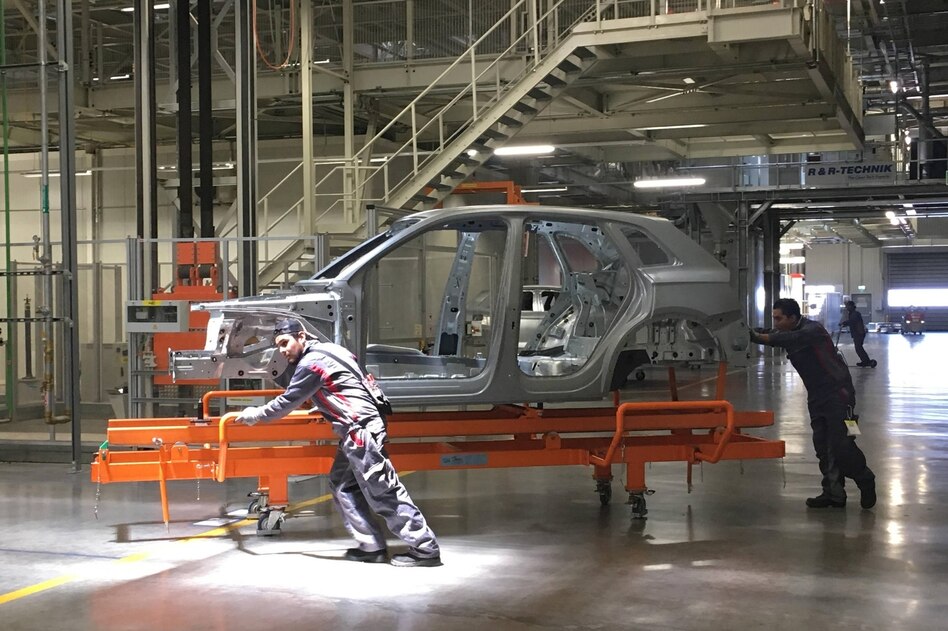
Machines were abruptly shut down and workers were laid off en masse: Since Donald Trump's return to the White House and his unpredictable tariff policy, the Mexican automotive supply industry has already lost 90,000 jobs and Mexico's trade with the USA - the most important export market - has collapsed.
The dynamics of the US automobile sector had made Mexico the region's major workshop for decades. Although Mexican suppliers used to be able to draw up long-term business plans, it is now difficult to plan projects over several months because business conditions are constantly changing.
15 journalists from 12 Latin American countries are taking part in the “Euromérica” workshop organized by the taz panter foundation. It's about the opportunities and challenges of the EU-Mercosur agreement and Latin American-European relations. A supplement will appear in the taz on December 5th, and there will be a public talk in the taz canteen on December 9th. All texts can be found here.
Francisco González, President of the National Automotive Suppliers Association (INA), believes that the jobs lost have been irrevocably lost. “We have to prepare for the fact that the number of jobs will no longer increase,” says González. “But we hope to see an increase in wages and an increase in specialization, because automation is driving us in that direction.” And if requirements and the quality of work improve, at least wages also increase.
A few figures illustrate the current imbalance: Of the total exports of Mexican auto parts in the first half of 2026, worth around $55 billion, 86 percent went to the USA, followed by Canada with 3 percent. The dependence on the northern neighboring country is also evident in the production of vehicles: of the 1.9 million cars exported from Mexico in the first half of the year, around three quarters went to the USA.
Suppliers and manufacturers alike suffer from Trump's protectionist measures. Production lines like that of the Toyota Tacoma have been discontinued - the model is now produced in Texas after years of being assembled primarily in Baja California, Mexico.
Given this situation, the idea of diversifying exports is obvious. But the data that shows the Mexican manufacturing industry's dependence on the United States also highlights the trade policy distance from Europe. No EU country appears in the list of the most important target markets for Mexican car parts. When it comes to imports of vehicles manufactured in Mexico, Germany takes third place with 2.7 percent. But no other European country records significant figures in this area.
Although Mexico produces around 4 million vehicles a year, sales opportunities across the Atlantic still appear to be rather slim. For example, only so-called “Unique Platform Models” are delivered to Germany, certain models such as the Audi Q5 and the BMW 2 Series Coupé that are assembled exclusively in Mexico but are intended for the global market.
According to Eric Ramírez, director for Latin America and the Caribbean at the consulting firm Urban Science, the expansion of such specialized production lines could be a way forward. However, this requires significant investment and several years to be implemented. “Developing new markets or projects for the export of vehicles cannot be done overnight,” he emphasizes. "It takes time to convert the export base. Exporting to other countries is time-consuming and quite complicated."
Support the taz panter foundation and its international projects with a donation. Learn more
When it comes to auto parts, large European companies are represented in Mexico - especially German ones such as Bosch, Continental and ZF - but the factories in the country are part of the value chain of the US industry. “We in Mexico are focused on the U.S. Europe is focused on Europe, Asia is focused on Asia,” says Eduardo Watty, vice president of sales for Bosch Mexico. “Each region is strongly focused on its respective market.”
Against this background, the opportunity for the Mexican supplier industry lies less in exporting large quantities of car accessories than in promoting local talent and skilled workers. These have a demographic advantage - the Mexican population is still young - and they come up against companies like Bosch, which have already been active in the country for a long time and have set up engineering and development centers.
Gerardo Gómez from the consulting firm JD Power Mexico also sees the country's advantage "in the experience of the automotive industry, the youth of the Mexican workforce and the quality of its production." According to Goméz, it is now important to further develop “technology and specialization”.
In Mexico's automotive industry, many machines have come to a standstill - a result of decades of dependence on the United States. Mexico faces a real-time changing environment, with thousands of jobs at stake - and their families' livelihoods. In the economy, in addition to business transactions and balance sheets, their well-being should play a crucial role.
Tzuara De Luna is a reporter at the Mexican business magazine Expansión.
Translated from Spanish by Ole Schulz