
Germany taz
Metro expansion in Lisbon: On the wrong side of the river
The subway network in Lisbon is being expanded - but who benefits from the metro offensive? There are very few people on the outskirts of the city. more...
Deutsch (original) ·Auto-translated to English
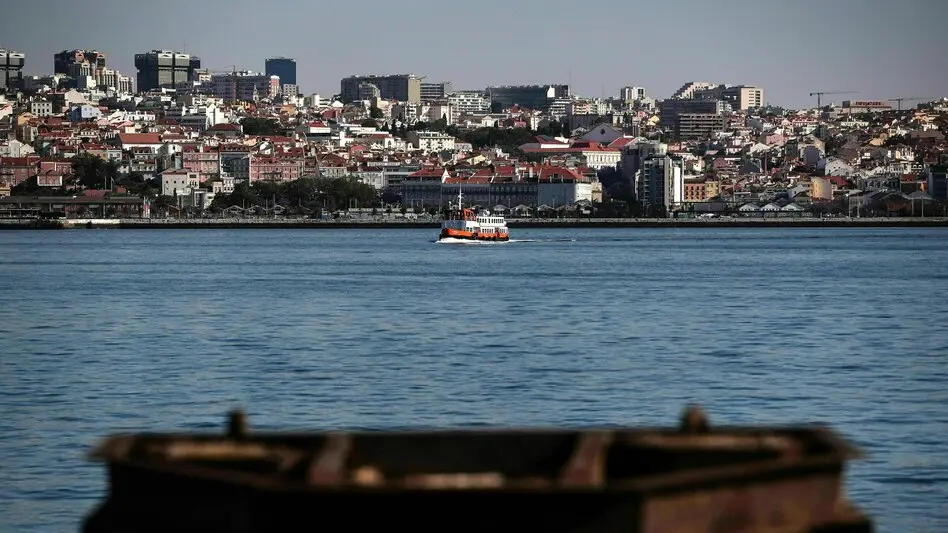
The smell of salt water and fish is in the air, waves foam against the stones on the shore. The first ferry to Lisbon leaves. The tram that has just taken a dozen commuters to the port of Cacilhas squeaks back south.
Cacilhas is located just under two kilometers as the crow flies from the center of Lisbon. Located on the other side of the Tagus, the town belongs to the municipality of Almada and is also one of the most important transport hubs in the region. Ferries, buses, trams and trains meet here. On the network map it looks like a good connection. But how well these connections work in everyday life also depends on how frequently the means of transport run and how well their timetables are coordinated with one another.
At half past nine in the morning, Camillo is sitting on the balcony of his apartment with his laptop and looking at the river.
It is the silence that makes Cacilhas so special to him. The silence, and above all the affordability. 15 square meters, a balcony with a view of the Tagus, the harbor and the tram station within walking distance, and all for 400 euros a month. In the center of Lisbon, on the other side of the river, he would pay 700 or 800 euros for something similar, Camillo estimates.
After the Colombian moved to Lisbon in September 2024 to study for his master's degree, he initially lived in the center. He got to know the city, worked in various bars and restaurants and at some point decided he didn't want to stay there.
“The center is not for ‘real living here’. Everything there is made for tourists, and ONLY for tourists,” he complains.
Honking city tour buses, dancing people filming themselves in the middle of the crowded streets, party tourists late into the night, even in the middle of the week - all of this drew Camillo to the other side of the river.
Camillo has been living in Cacilhas since March. His neighborhood consists mainly of people with an immigrant background: many Brazilians, people from Angola and Cape Verde and older generation Portuguese.
“For someone like me, who grew up in Bogotá, this rather suburban life is something completely different – but I think that’s exactly why I like it here.”
So cheaper and quieter. But further away from what Camillo has to do in Lisbon. He has to commute a lot, for work appointments and to meet friends. As soon as he has an appointment in Lisbon or wants to meet friends, he has to plan the trip across the Tagus. The mere two kilometers as the crow flies says little about how quickly and easily he actually reaches his destination.
For Sara, his roommate, the route across the Tejo also determines everyday life. She has two jobs in Lisbon and her days are long - which is partly due to the poor timing across the Tagus. Your first job starts at 11am. In order to start her shift at the sushi restaurant on time, she leaves the house around 9 a.m. At 4 p.m. she starts working in a facility for addicts. She often doesn't return until around midnight.
"I usually take the ferry at midnight to get back home. Buses only run very irregularly and a train connection to Cacilhas only works with several changes. It's hardly worth it," explains the Brazilian.
In contrast to Camillo, she would prefer to live in the center; it would make her everyday life easier, she says. “But finding something affordable there in my situation is almost impossible,” she says.
In fact, rents in Portugal have risen dramatically in recent years - by 124 percent in the last 10 years, according to official figures. That's about twice as much as the EU average. In mid-October, following the rental protests in neighboring Spain, there were also protest camps in Lisbon and Porto. The Portuguese government took tough action against the activists and most recently had a camp in a central square in Lisbon cleared out on November 1st. The conservative government of Prime Minister Luís Montenegro wants to stick to its plans to make evictions easier and to abolish rent caps for new contracts.
So Sara is forced to live where it is cheaper and work where she would actually prefer to live.
“When you hear about the big new plans for Metro Lisboa, you feel a little neglected here.”
They all meet at the Cais do Sodré. The train station is on the southwestern edge of the center. The green metro line ends here, the ferries to Cacilhas dock here and from here trains run westwards, to the beaches and to the town of Cascais, which is popular with holidaymakers. Just a few minutes away are Baixa and Praça do Comércio, the historic center and one of the city's central squares.
The Cais do Sodré has been open again since August 27th after major renovations. A few weeks later, there is hardly anything left of the construction site externally. No barriers, no large construction vehicles. But the Cais do Sodré is soon to become the starting point of one of the most important changes in the Lisbon subway network.
The planned Linha Circular will connect the Rato district directly to the Cais do Sodré via the new Estrela and Santos stations. 1.9 kilometers of new route, two new stations. According to the current schedule, the connection is scheduled to go into operation in the first quarter of 2027. The metro currently estimates the cost of the construction work at 379 million euros.
The Lisboa Metro is a public transport company. The expansion promises shorter routes, better connections and more people using public transport. According to calculations by Metro Lisboa, around 3,380 journeys on individual means of transport could be avoided every day and around 4,150 tonnes of CO₂ could be saved in the first year of operation.
The expansion is also intended to improve the connection between the metro, ferries and trains. Cais do Sodré is an important arrival point for commuters from Almada, Seixal or Montijo south of the Tejo. You arrive here by ferry or train and can change to the metro. The new ring line is intended to enable additional direct connections within the center from there. However, whether this shortens the entire journey depends on where people are going and how well the individual parts of their journey fit together.
On the network map, Cacilhas is therefore part of this new transport promise: with the ferry to Cais do Sodré and there directly into the metro. But whether Camillo would benefit from the new connection doesn't just depend on how quickly he gets to the center.
“Just expanding the infrastructure alone is usually not enough,” says Benjamin Büttner, mobility researcher at the Technical University of Munich. The decisive factor is not the number of new kilometers, but the question of whether a trip actually works better.
For Büttner, good traffic policy begins with a fairly simple question: How quickly does someone actually get from their apartment door to their destination?
There is more to this than the metro itself. How far away is the stop? How often does the train run? Does the connection fit? How long do you wait? How often do you have to change trains? And what happens on the last stretch? Büttner calls this the entire chain of routes, which should function as smoothly as possible – “preferably from door to door”.
A new route can look big on the network map and still make little difference to a person's everyday life.
A new metro can definitely get people out of their cars. At the same time, a city must consider how attractive the car remains, says Büttner. Parking space management or higher parking fees could be part of such a push-and-pull system: public transport becomes more attractive, driving less in certain places.
But the planned ring line in Lisbon also raises the question of which parts of the city will actually be easier to reach. In other words, whose needs are prioritized in such investments?
Santos is characterized by art galleries, design studios and countless regularly viral restaurant discoveries. It is primarily home to international residents and tourists. In the evenings the district turns into a nightlife area and a station on the new ring line is also to be built here. There isn't much to see yet. Only an almost 50-meter-long construction fence has been blocking the sidewalk for months, forcing passers-by to walk on the main street.
Büttner would ask the question why this district in particular needs a new station differently anyway. "We have to stop seeing the subway stations as just transport hubs. They should be seen as places." When it comes to a station, it shouldn't just be about getting away as quickly as possible.
"Is there a bakery, a supermarket? What are the work opportunities here, are there places to stay and services? Can someone do something on the way home without having to make an additional journey?"
The so-called Extended Node-Place Model looks at exactly these two sides. A station is both a node in the transport network and a place in the city. Good connections alone do not say what is actually happening around a station.
Simone Tulumello, urban researcher at the Instituto de Ciências Sociais at the University of Lisbon, sees this as one of the crucial points of the planned metro expansion.
The new ring line is intended to connect central stations with one another and thus primarily densifies the network in the center of Lisbon. For Tulumello this is also a political decision. Investments are made in central, attractive districts that are already in high demand, while people who live further out and have to go to work in the city every day do not automatically get to their destination any faster.
This is particularly evident on the yellow metro line running north, where many people live who commute to the center for work. While the new ring line better connects central districts, these commuters do not automatically benefit from shorter journey times.
Emanuele Sciuva, researcher at the Politecnico di Torino, examines the growing market for medium-term rental offers in Lisbon in a recent study. Students, young professionals and digital nomads are among the groups that use such apartments. A new metro station can make a neighborhood more attractive and thus fundamentally have an impact on property and rental prices. However, he does not see a direct effect of the ring line on current developments in Lisbon. The housing market is already under pressure from many other factors, including international investors with purchasing power and tourism, which is fueling the holiday apartment market.
His real point is that a city can always make its center more accessible without making it more livable for more people. So who actually gets more from the city in which he or she lives through new infrastructure?
For Sara, this is exactly everyday life. She pays less rent and gets up earlier in the morning and comes home later at night. For his cheap, quiet apartment with a balcony and a view of the Tagus, Camillo accepts that his life will depend more on the timetable.
The evening is getting later and the mood at the harbor at Cais do Sodré is becoming quieter. People carry shopping bags and work bags and wait for the ferry to Cacilhas. On the other side of the river, at the end of the street, there is a tram, buses are waiting for their passengers, and while the cafés here turn their “open” signs to “closed”, the lights come on in the central districts of Lisbon.
There are two kilometers between Camillo's apartment and the center, actually not a long distance. However, distance in public transport is not always a question of kilometers.