
Germany taz
Merz at the CSU board: The common streamline
The Union sisters are practicing solidarity with the CSU board. There is no question for Merz and Söder that the electricity tax will be reduced for everyone. more...
Deutsch (original) ·Auto-translated to English
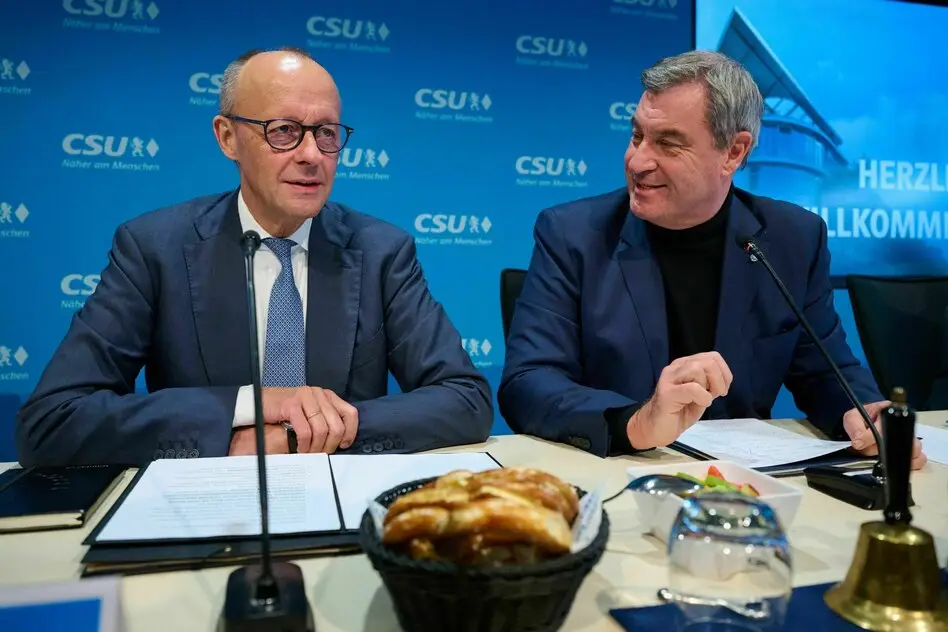
Friedrich Merz will have been happy about that. In Munich today he received a snack board as a gift from CSU boss Markus Söder. On it the inscription: “CDU/CSU – good cooperation”. Even if one may have heard a slight irony in Söder's two-time remark that Merz was "thrilled" about the gift, it is of course exactly what the CDU leader and his CSU colleague want to show off - once again - this Monday afternoon in the canteen of the CSU party headquarters: unity, unity, good cooperation.
Things haven't been going as well between the Union sisters for a long time, that's the message. And to underline this, the Chancellor likes to come to Bavaria regularly. This morning he was a guest at the CSU board meeting.
“A very special visit,” emphasized Söder in the subsequent press conference in the canteen, not a given and a great honor. In fact, according to the CSU, the committee last had a Chancellor, Angela Merkel, visiting many years ago - a CDU leader with whom the Christian Democrats did not always have a harmonious relationship.
Söder is now talking about “backing for Berlin”, a “common line” and that the next few days will be about demonstrating credibility. And for both party leaders, credibility includes reducing the electricity tax to the minimum prescribed by the EU for everyone. This project, which was set out in the coalition agreement, had recently become a point of contention with the coalition partner SPD. So far, the tax has only been reduced for industry, manufacturing, agriculture and forestry. Private households and other companies are not yet being relieved - which SPD leader and Finance Minister Lars Klingbeil simply justifies with a lack of money.
With 200 billion euros in debt, no one can tell him that there is no potential in the budget process, Söder now complains. After all, a fuel discount and electric mobility were implemented twice this year “out of nowhere”. “So there are options if you want.” And Merz announced that they would briefly discuss the issue at the coalition committee tomorrow. There is no question that an agreement will be reached with Klingbeil on a reduction next year.
The numbers were compared again over the weekend. Klingbeil knows that this decision is necessary. However, Merz does not want to commit to how the tax cut will be financed. He doesn't want to anticipate the coalition committee.
Merz and Söder do not want to comment on the personnel decisions pending at the SPD. Actually. However, Merz then expresses his expectation that nothing will change in the coalition's agreed course, even under a new SPD leadership. The coalition agreement applies and there is no reason to renegotiate.
What apparently caused irritation was that former Federal Labor Minister Hubertus Heil announced his candidacy for the SPD chairmanship. Söder then becomes clearer: one of the candidates stood for citizens' money, he mentions with a frown, i.e. one of the traffic light projects, the reversal of which was the highest priority for the Union after the election. There is no question that Söder means salvation by this. There will be no stopping the reforms, he says, and he sounds almost threatening when he adds: “We will be watching this very closely.”
The coalition committee on Tuesday will also focus on the pension reform, especially the timetable for its implementation, Merz announced. And about the right to vote. Here too, the coalition plans to reverse the traffic light reform. At least to the extent that all directly elected candidates will come back to the Bundestag in the future. Income tax is also an important issue for Söder. Dismantling the cold progression is of “urgent importance,” said the CSU leader.