
Germany taz
Merz at the CSU: P for party conference, P for president
At its party conference in Munich, the CSU is primarily concerned with the P question. Can anyone else stop Ilse Aigner on her way to the office of Federal President? more...
Deutsch (original) ·Auto-translated to English
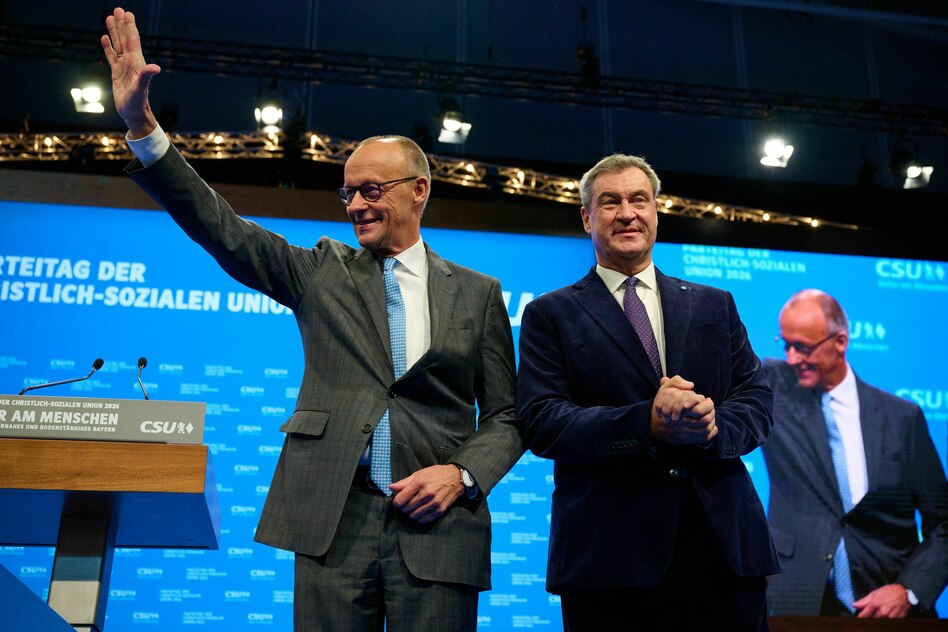
Of course, it's primarily about content and not about people, and of course the CSU would also use this for its party conference, which took place on Friday and Saturday in Hall C6 of the Munich trade fair. And yet at this party conference one person was particularly in the focus of the public - but also of the delegates. It was not CSU leader Markus Söder who spoke on Friday, nor was it CDU leader Friedrich Merz who spoke on Saturday. In fact, it wasn't one of the many who were on stage on these two days.
It was Ilse Aigner, President of the Bavarian State Parliament and, if the delegates had their way, Germany's next Federal President. The moment when this becomes most clear can be observed on Saturday afternoon. Chancellor Merz has just moved into the hall - accompanied by Söder and the melody of the Rocky anthem “Eyes of the Tiger”, played by a brass band.
Now he is on stage and begins his speech: “Dear Markus Söder,” he says, “dear Ilse Aigner.” He continues the list and also greets “dear Manfred Weber” when the crowd senses their chance a second late: the delegates jump up and cheer frenetically. The message to Merz is unmistakable. He endures the applause, which is not directed at him but at those mentioned, and grins. There will be no more than these three words “Dear Ilse Aigner” on the topic of the P question on this day.
The name Aigner has been mentioned regularly for more than a year when it comes to the successor to Frank-Walter Steinmeier. However, unlike what is often the case in such cases, it is far from being considered burned. On the contrary: the enormous support of her party, but also the popularity beyond it, make Aigner's candidacy seem almost a sure-fire success.
Of course it isn't. The big unknown is CDU leader Friedrich Merz. He has already made favorable comments about a possible candidate Aigner, but a little later he even fundamentally questioned whether a woman should actually take over the office. A question on which there already seemed to be a broad consensus among politicians from the democratic parties.
One can also speculate about whether Markus Söder's wish really came “from the heart,” as he put it in his speech on Friday. A large number of political observers are convinced that Söder's ambitions for the chancellorship would finally be sealed if this wish became reality. The fact is that Söder said it to great applause from the delegates at the CSU party conference, and not for the first time: Bavaria's state parliament president Ilse Aigner, Söder hopes, should become federal president.
Söder is now at least fine insofar as the ball is now clearly in Merz's court. The next step must come from him if the planned procedure for the presidential election at the end of January is to be adhered to: the Union and the SPD want a common candidate - or are they candidates? – imagine, ideally someone who would also be supported by the Greens. Nobody questions the fact that this time the right to make proposals lies with the Union and that the CDU leader has the first say.
Of course, Merz is under pressure after her sister party has positioned itself so clearly. Merz and his wife are also good friends with Aigner. He is unlikely to have any doubts about her suitability for the office. On the other hand, the Christian Democrat should take possible reservations from his own party into account in his considerations.
This is not about reservations about Aigner as a person, but rather about his party affiliation. Unlike the CSU, the CDU is in a crisis that has already reached life-threatening proportions in some regions, as the election in Mecklenburg-Western Pomerania showed. In this situation, giving the CSU priority over such an important personnel could be interpreted as a further sign of weakness. The German Press Agency reports from CDU circles that the party leadership there still sees the candidate question as completely open. “The CDU has not given up its claim to nominate a candidate from its ranks,” the dpa quoted its source as saying at the weekend.
In any case, many now expect Merz to make a decision soon. In the summer, the CDU leader announced that Steinmeier's successor would be clarified after the state elections in the east. The elections are long over, and impatience is growing. At the CSU party conference, EPP parliamentary group leader Manfred Weber and his counterpart in the Bavarian state parliament, Klaus Holetschek, made this clear. “Please don’t waste any time now,” says Weber. “It would also show Berlin’s ability to act if decisions were made quickly now.” And Holetschek says: “The time window has come to make a decision.”
And so to the content: Both Söder and Merz invoke the solidarity of the Union sisters in their speeches. Merz says that we are stronger together than alone. “We stand together and stick together.” Clichés, of course, but the sign of unity is actually particularly important to both of them. There is already enough arguing in the coalition, and given the Union's modest poll numbers, there shouldn't even be the slightest suspicion that all is not well between the two sisters.
Both speakers particularly address the fight against extremism “from the far left and from the far right”, i.e. the search for a government in Berlin and Saxony-Anhalt. They don't want to hand over the country to these forces, they say, and issue warnings: to the SPD and the Greens if they bring the Left Party into the Red City Hall in Berlin, to members of the CDU who vote for AfD politicians in Saxony-Anhalt. According to Merz, they have no place in his party.
Germany must remain an industrial country, Merz demands, and the electricity tax must be reduced next year. Söder wants to add an extremism clause to the state financial equalization and under no circumstances increase inheritance tax. Merz praises Germany as an industrial location, as does Söder Bavaria. And of course: they are for openness to technology and against the end of combustion engines. Justice? Sure, that has always been the DNA of the Union, says Merz, but redistribution and expropriation are not the Union's idea of justice.
The reform process should now be completed quickly, if possible before Christmas. “That will bring some calm to the coalition,” hopes Merz, “but also to our country.” But Germany not only needs reforms, but also “courage for the future”. When he recently met with Nvidia boss Jensen Huang, he said to him that he believed in Germany. “Let’s make this phrase our own.”
With a little courage for the future, Merz could soon make a decision on the P question. In any case, Ilse Aigner is patient. “I was really happy about the reaction of the party conference,” she said in passing. But: The party conference will not decide that. “That is the task of the party leaders.”