
Germany taz
Merz on a trip to Asia: walking a tightrope in Seoul
The German Chancellor wants to promote free trade in East Asia. But people there are worried about growing EU protectionism. more...
Deutsch (original) ·Auto-translated to English
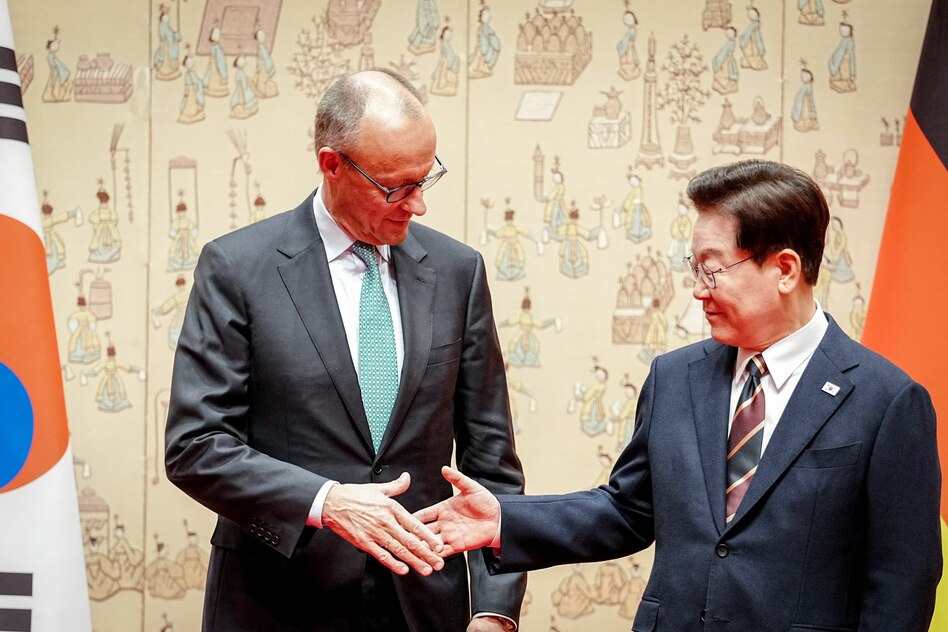
When Friedrich Merz opened the Asia-Pacific Conference in Seoul, he was assured of the favor of the packed ballroom. The Chancellor brings a message that is particularly popular in export-oriented South Korea: “We are uniting resolutely against unilateralism, autocratic power politics and violations of international law,” he said – and once again called for strengthening free trade with like-minded partners.
For Germany, the Chancellor's trip to Asia is a tightrope walk. The Federal Republic urgently needs to diversify its economy; after all, two important pillars of German prosperity have collapsed in recent years: cheap energy supplies from Russia and the Chinese sales market. On top of that, US President Donald Trump's tariff policy is destroying any long-term planning in the USA.
The Asia-Pacific region offers the crisis-plagued German economy at least some reason for optimism. Some of the most dynamic economies and most powerful industrial locations in the world are located here, said Siemens boss Roland Busch: “The question is: How can we convert these opportunities into growth for both regions?”
The answer to that is difficult. A look at the statistics reveals this: Germany's foreign trade with the region is heading for growth of 2.7 percent for the current year. But at the same time, Germany is suffering from a whopping trade deficit. And there is one main reason for this: China. The People's Republic's export surplus compared to Germany is likely to be a record sum of over 110 billion euros.
The reasons for this are a mixture of our own failures. But at the same time, the Chinese state is playing with instruments that vehemently contradict the rules of the World Trade Organization (WTO): from excessive subsidies to an artificially low currency. "Europe must effectively protect itself against distortions of competition from China. At the same time, long-standing and reliable trading partners such as South Korea must not be put in a worse position as a result," says Tanja Gönner, managing director of the BDI industry association. Trade protection is not an end in itself, but must specifically create competitive equality.
In doing so, she gets to the heart of Europe's crucial dilemma. Only recently, EU Trade Commissioner Maroš Šefčovič agreed with Beijing to curb Chinese exports of hybrid cars. Deliveries to the EU are expected to fall by more than half. But what sounds like a success from Brussels' perspective is viewed like a hawk in Seoul and other Asian capitals. Although the EU measures are essentially directed against China, they are also likely to affect other states as “collateral damage”. Ultimately, the EU would like to focus more on local value creation “made in Europe” when awarding contracts – classic protectionism. South Korea's car and defense companies will soon be left behind when it comes to allocating public money.
The CEOs at the Asia-Pacific conference therefore received the signals from Brussels with mixed feelings. There is widespread consensus that we have to react to Chinese overcapacity. But the measures should be carried out with surgical precision, attract as little attention as possible - and not distract from the fact that people in Europe should, above all, do their own homework. A tightrope act that is almost impossible to accomplish.