
Germany · taz · · 47m
Maxim Biller on contemporary literature: What makes me angry
Deutsch (original) · Auto-translated to English
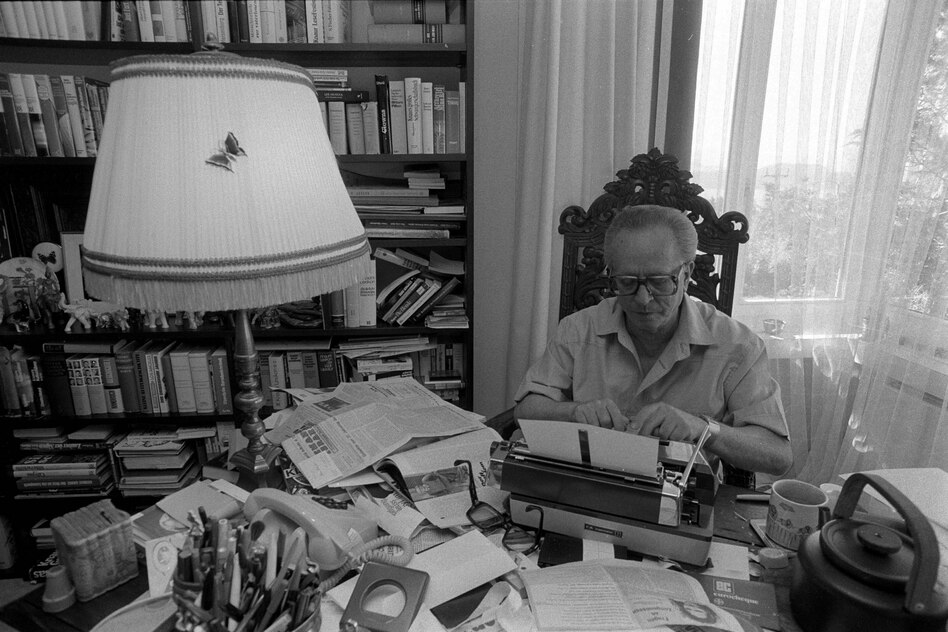
Do you know Simmel? Johannes Mario Simmel from Vienna, whose German mother saved his life in 1938 because she told the Nazis that he was not the son of a hook-nosed Jewish father, but an Aryan sex cuckoo? The man who escaped wrote scripts after Hitler's death and was a moderately well-known tabloid journalist. And he hacked away at his portable typewriter until a mega-seller was finished in 1960, an agent and rumor novel, sweet, exciting, politically committed, literary of no value.
After that, Simmel's typewriter spewed out one moralistic dime novel after another, which earned him a fortune worth millions and the scorn of highbrow literary criticism. Until October 1987, FAZ bully Frank Schirrmacher surprisingly included him in the big canon in a book fair lead-in. Simmel, he wrote, was “faster, nastier and sharper than the public consciousness,” the gifted explorer of “the national soul.” You can imagine the trouble both of them got into with the concrete feature section.
Why do I want to talk about Simmel during these festive book fair days? Because I'm the anti-schirrmacher! Because today the gate to the ivory tower is being opened more wide than ever before by blasé literary criticism to writers who are not writers, at best automatons greedy for money, kitsch and reality - that is, by the very type of reviewer who was once so angry with the FAZ prodigy. And because Schirrmacher's Simmel disruption is now just as forgotten as Simmel's books, name and success.
The 66-year-old is a writer and literary critic. Biller has published numerous essays, reports and stories and has been, among other things, awarded the Theodor Wolff Prize and the European Features Prize. His book “Black Saturdays” has just been published, in which he addresses the aftereffects of October 7th on Jews.
Biller was born in Prague to Russian-Jewish parents. In 1970 he emigrated to West Germany with his family. He studied literature, attended the German School of Journalism and wrote, among other things. For the Spiegel and the New Yorker, his column “Moral Stories” appears in the FAS. Since 2015 he has been criticizing books for the “Literary Quartet” on ZDF. He lives in Berlin.
How are the two connected? Garbage remains garbage and will rot sooner or later anyway. And critics who are bored with their own gravitas and want to get some of the glamor of famous entertainment writers are just wasting their time.
A novel by the infamous Ms. Wahl has been sitting on my desk for weeks. Is she our Sagan? A female Simmel? I tried to read this book, once, twice, for free. The daydream-like, sticky conflict of girl versus man, Insta-careerist versus asshole boomer is a kind of Kafka parable for idiots that Max Brod would definitely have burned. There is nothing hidden between the lines, as there should be in real literature, no secret, no poetry.
The fact that Wahl's “novels” regularly receive a full-scale reception in our feature section is ridiculous. And the climax of a trivial revolution that has even reached the seminaries. Or why was the University of Siegen recently given such a dime-sized book a two-day conference as a Germanistic gesture of subjugation? Also out of fear of losing meaning in our modern, anti-intellectual meta-world, I suspect.
Is choice alone the problem? Of course not. See Heinz “Bling, bling” Strunk, who yesterday was celebrated for his humorlessness as a non-comedian in humorless Hamburg. His provincial proll prose wins one serious literary prize after another and sells almost as well as Melville and Proust did decades after their deaths. And where does the respect come from for the charming Mr. Kehlmann and his cloak-and-dagger prose disguised as historical novels, often with a dash of Nazi porn? How seriously can you take Nelio Biedermann's Kakanien reveries, so pompous and banal in a way that the novels of his role model Joseph Roth never were?
And have you ever tried to read Juli Zeh, who, as a voluntary resident of the East German hinterland, also feeds her readers with cliched anti-clichés and the shabby language of a success-obsessed best-selling author? Not to mention the guest worker kitsch of Fatma Aydemir and all the other literary crybabies from her opportunistic migrant cohort. In his legendary “Subject Dictionary of Literature,” Gero Wilpert calls the tasks and attributes of real prose “poetic illumination of being.” You won't find it in all of these authors.
What makes me so angry: Entertainment and trivial literature has always existed, not just since Schirrmacher tried to ennoble Simmel and luckily failed. Today, as I said, expressions of respect for the literary arts are taking up more and more space, in feature articles, podcasts and master's theses. In other words, wherever only the real artists, magicians and great storytellers should be honored and regurgitated, day and night, issue after issue, especially those whose rank is not so easy to recognize from today.
But where are the hymns to Robert Walser, the debates about the great Peter Weiss and his apolitical political epics? Who remembers themselves and others of the great modernist and cosmopolitan Wolfgang Koeppen, who writes their fingers sore with hymns to Soma Morgenstern, Joseph Roth's friend and forgotten Galician Chekhov? But once the memory of the great poets has died out, the miserable writers will determine the big picture for years and decades.
And that's why today - in the festive days of the big book fair in Frankfurt am Main - I suggest that we rearrange our bestseller lists. The idea is very simple and extremely effective and enlightening: There is then a ladder for trash. And one for literature. So that even the stupidest literary critic doesn't get confused anymore.
Read the full story at the source
Source: taz