
Germany taz
Max Slevogt as an illustrator in Berlin: Not least a test of strength
Max Slevogt is introduced as an illustrator in the Liebermann Villa in Berlin. Bruno Cassirer was his publisher, who challenged and supported him. more...
Deutsch (original) ·Auto-translated to English
Ouch. That hurts. The man in tailcoat and top hat has placed the scissors on the long tail of the horned faun, which is stubbornly pulling forward. Max Slevogt designed this scene as an advertisement for the first issue of the magazine “Kunst und Künstler”, which was founded by the publisher Bruno Cassirer in 1902. Curator Viktoria Bernadette Krieger explains that the tug of war on the long tail was related to a conflict between publisher and artist: the artist always wanted a little more space on the page than the publisher and portfolio designer considered appropriate.
A special exhibition in the Liebermann Villa on Wannsee is dedicated to the productive, but not always tension-free, relationship between Max Slevogt as an illustrator and Bruno Cassirer as a publisher. They have worked together on more than 51 illustrations and portfolios since Slevogt came to Berlin in 1901. Max Liebermann had won the painter friend from Munich over to the Secession in Berlin; The gallery owner Paul Cassirer had offered him a good contract, and his cousin Bruno Cassirer was interested in him as a publisher.
A research project on the estate of Max Slevogt (1872–1932), including those from the Mainz State Museum and the Saarland Museum, examined the correspondence between Slevogt and his publisher. This is what the exhibition in the Villa Liebermann is based on: it depicts Slevogt as a completely headstrong and capricious person who the publisher had to repeatedly warn and motivate.
"Off to new works! Max Slevogt, Bruno Cassirer and Max Liebermann": Liebermann Villa on Wannsee, until January 18, 2027
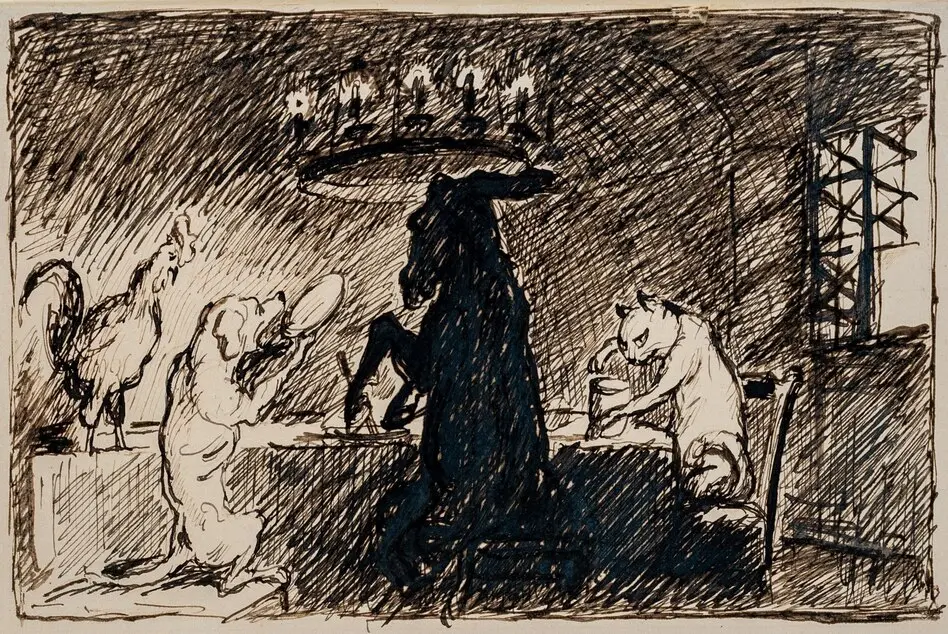
Slevogt loved drama, humor and the bizarre. In Ali Baba, the head of a decapitated man on a platter, over which a figure dances elatedly with a knife and tambourine, became the title vignette. In an ink drawing, the Bremen Town Musicians are sitting very busy at the table, the dog is licking the plate, the donkey is fiddling with cutlery, the cat is standing on its hind legs to thoroughly get to the rest of the pot.
A photographic portrait of Bruno Cassirer can be seen that shows him on the harness racing track. He was also successful as an importer of American horses and had his own breeding. Slevogt's sketchbooks demonstrate his great interest in animal studies, horses, monkeys, cats. The spontaneity and fleeting nature with which the Impressionists broke up the painting surface found an ideal motif here.
The graphics on display, for which you should have reading glasses with you, the lines are often so fine and the formats are so small, are complemented by a few paintings, such as a portrait that Liebermann painted of Slevogt in warm red tones.
Liebermann also worked with Bruno Cassirer, for example he illustrated Goethe's novella “The Man of Fifty Years”. In love with his son's girlfriend, he is seized by new vanity and works hard on his rejuvenation. A thoroughly ironic story that Liebermann intimately depicted with interiors from his house and models of the family in finely lined drawings.
The exhibition “Off to New Works” provides an, albeit not comprehensive, look at the graphic works of Slevogt and Liebermann. With the collaboration between publisher and artist, she also opens a further chapter in the social history of art and the production conditions of classical modernism, which contributed significantly to its success.