
Germany taz
Lyon Biennale and its concept of art: Museum of the Vomiting Girl
The delimitation of art has come to an end. She returns from the railway hall to the museum. Observations from the 18th Lyon Art Biennale. more...
Deutsch (original) ·Auto-translated to English
Wasn't it Marshall McLuhan who watched disappearing media return as art? In this respect, art had a historical mission or a transformative character. What had been pushed and celebrated as a dissolution of boundaries since the 1960s soon turned out to be an endless expansion: into urban space, into natural space, into industrial ruins.
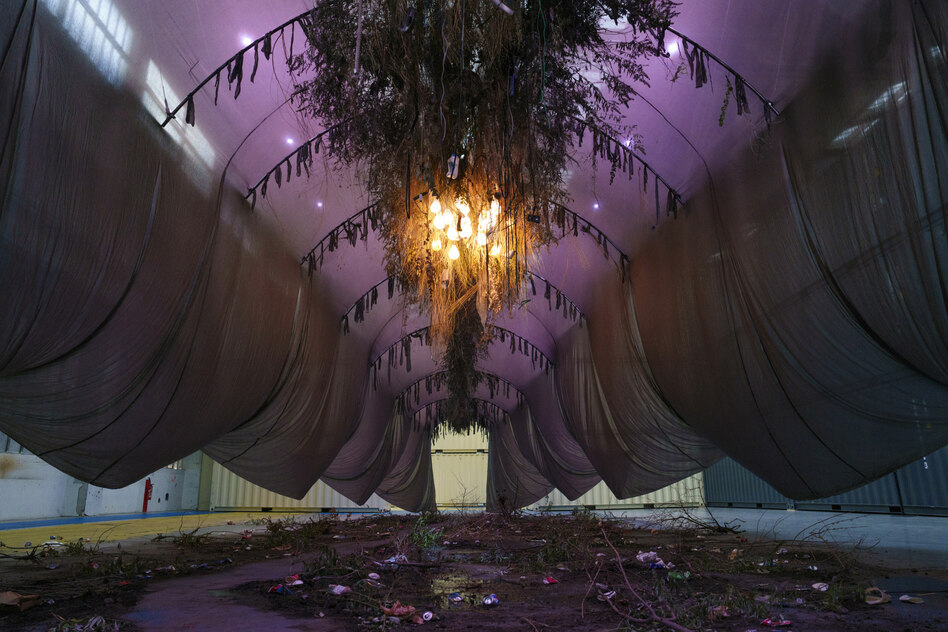
Just twenty steps into a railway hall south of Lyon you can now witness a shifter. The internationally active artist Laure Prouvost had a low tent structure installed there, which sinks and rises again across the entire area using almost invisible threads, so that the huge installation looks like a breathing body. When it lifts, a loose ensemble of debris and dust becomes visible on the surface below, but only for a few seconds before it is hidden again. And as soon as you pass it, the hall called Grandes Locos catches your eye; there is only dirt and scrap everywhere. The expansion of art seems to have taken an art break. Maybe it's your last breath.
Thirty years ago, at the Lyon Biennale, the meta-curator Harald Szeemann tried out a new niche of delimitation in an imposing Art Deco hall, a Foucauldian trickster's game, half anti-art and half discourse. Szeemann was a daring, enthusiastic Swiss man who could not be shaken by anything. He had installed “Zeitlos” in the large hall of the Hamburger Bahnhof in Berlin; and the “illumination” of the large Deichtorhalle in Hamburg, which happened in 1989/90. Both exhibitions were walk-in stage sets of indescribable dynamism. By the time he landed in Lyon in 1997, he had joined the Outsiders.
“To Pass From One Dream to Another”. 18th Biennale de Lyon Art Contemporain, Lyon (FR), until December 13th
The Art Deco hall in Lyon was called Halle Tony Garnier. The place was definitely comparable to Berlin and Hamburg. All three halls were relics of the great age of mechanical industries. Too big for other purposes, too beautiful to be demolished. Vacancy, large-scale renovation – new places for art.
Over the past thirty years, these new places for art have emerged everywhere and often ad hoc. Abandoned office buildings, empty craft businesses, discarded prisons, production and warehouses. These places have been the actual media that have become art beyond their original purpose. Because unlike museums, which always offer new meanings against the same backdrop, in the post-industrial exhibition world the concept of art has mutated incessantly. The difference between art location and art became smaller and smaller. The idea that everything is social practice has prevailed. Grandes Locos seems to be the end point, a chaotic patchwork of surrogates that can only be escaped through absolute indifference.
Lyon is an exemplary case of industrial history reflected in art. From the Tony Garnier Hall, the art biennale moved to a former sugar factory on the southern tip of the central island, behind which the Rhône and Saône flow together. It was a somewhat remote dead-end situation, and there were campers along the road there with red lit hearts in the windows. Now that a futuristic museum building by the Viennese architects Coop Himmelb(l)au symbolizes the “confluence” of the rivers nearby, the campers are gone. The arrival of art where it previously played no role almost always anticipates gentrification. The Eisenbahnerhalle is just another stop on the same boring route of the business.
This makes the installation of the invited artists in the headquarters of contemporary art, the mac-Lyon, all the more astonishing. There you can see a green jungle there, but only as an example, through a hole cut into a partition wall at calf height. Such a violent disruption still seems outrageous in a well-functioning, security-based art museum. The other forty or so rooms on three floors are an elegant, inward-looking course with tinted walls and dramatic lighting. As has been well practiced since Roger Buergel's Documenta 2007 - "modernity is our antiquity" - the curatorial eye is focused on various overlooked ethnicities, such as the Maori on the Pacific half of the world, and colonial faults, a touch of Indian Hinduism.
A huge group of ceramic figures stands silently and rebelliously on a pedestal in front of an illuminated white wall, i.e. in the shadows. All the figures are variations of one motif, namely the vomiting girl. According to the wall caption, “Vomit Girl” is the autobiographical work of a now-Australian artist, Mai Nguyễn-Long, who was, to put it harmlessly, homeless as a child in Vietnam. Anyone who thinks the group of figures is “ethnic craft” and moves on will miss the painful point.
By the way, the curator for Lyon, Catherine Nichols, has her base at Hamburger Bahnhof in Berlin. There, the east wing and the west wing have been practicing museums for some time now, with tours and labyrinths that are filled with dedicated installations or hangings down to the centimeter. The figure of building and superstructure tilts. The artists are still moderated with standard post-colonial phrases, but in fact they are further developments of a freely conceived art in a space artificially trimmed for freedom, which a clever artist once described as a “white cube”. Art is back to itself; a bit holy; Pathos replaces agitprop.
And is that the future? If the Lyon Biennale were paradigmatic: yes. In the wild east of the city, Villeurbanne, the Frac Rhône-Alpes has set up a small contemporary “barn” where the Biennale has now invited people into ten rooms, by first name: Charles-Arthur, Can & Lalin, Haonan, Yehwan, Maja, Valentin, Katariin, Floraine, Sirag, Joyce. They are between 25 and 28 years old. They all play the white cube like old masters. That's why they weren't combined, but rather given each one their own space. These are young cosmopolitan artists whose art is no longer derived from victim biographies. They don't want that at all.
Let's take Katariin Mudist from Estonia. She had about 150 wooden shelves installed on four walls of a white room. On each one sits an object: a switch made of old iron; a fire extinguisher; a sledgehammer; a shoe; the steel end of a pitchfork. They all served at least temporarily as “door holders” and were borrowed from cultural sites from Tallinn to Brisbane. But there is also a paint factory in Stockholm and, not to forget, the Lyon Biennale. The young woman Mudist loosely touches on art genres such as: observation, inventory, and the readymade. In Doorstop she finds the small, the overlooked, the misused, the ephemeral: Siegfried Giedion's “The Reign of Mechanization” as an everyday comic.
In comparison, you can forget all the pop crap from the Eisenbahnerhalle. The delimitation of art has taken place, it cannot be repeated. The real trick will be to start over without forgetting history.