
Politics · taz · · 2h
State financial equalization: Union threatens to withdraw money from Berlin
Deutsch (original) · Auto-translated to English
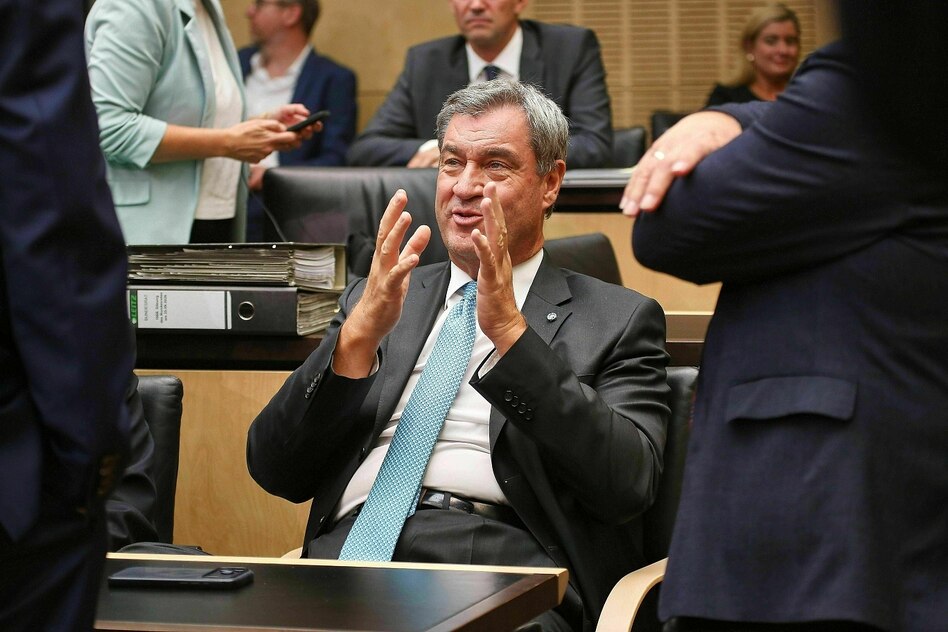
CDU and CSU politicians are threatening financial sanctions “if Berlin gets a state government that has anti-Semitism and hatred of Jews in its program.” This concerns payments from the state financial equalization and from the capital financing agreement.
At the weekend, the parliamentary group leaders of the CDU/CSU-governed states met with Bavaria's Prime Minister and CSU leader Markus Söder in Munich to exchange ideas and also discussed a possible left-wing government in Berlin. A few days earlier, Minister of State for Culture Wolfram Weimer (independent) had threatened cuts in federal cultural funding in Berlin. It must be ensured “that the federal government is not made into the financier of a cultural policy that threatens to systematically exclude Jewish artists.”
But threats of financial cuts are not only aimed at the left. Before the AfD's election victory in Saxony-Anhalt, Danyal Bayaz (Greens), Finance Minister in Baden-Württemberg, explained that there must be financial consequences if a state government questions the principles of the rule of law or takes “special paths that are questionable in terms of the rule of law”.
The state financial equalization is intended to help create uniform living conditions in Germany and is guaranteed in the Basic Law (Article 107, Paragraph 2). The details of the complicated calculation operation are regulated in the law on state financial equalization.
The financial equalization was reorganized in 2017 and has been in effect in a new form since 2020. Unlike before, strong federal states no longer have to pay money to financially weak states. Rather, the compensation takes place when the sales tax is distributed. Financially strong countries receive less, while financially weak countries receive more. In addition, there are federal payments to the weak states.
In 2025, around 20 billion euros were redistributed between countries. The largest donor country was Bavaria with 11.7 billion euros, followed by Baden-Württemberg and Hesse with 4 billion euros each. Berlin benefited the most from the compensation with around 4 billion euros. Saxony-Anhalt received around 2 billion euros additionally.
Bavaria filed a lawsuit against the new state financial equalization in 2023, even though the state had approved it in the Federal Council in 2017. The Free State wants to ensure that it no longer has to shoulder the majority of the compensation in the future. The Federal Constitutional Court had promised that the proceedings could be decided this year, but there has been no word of this yet in Karlsruhe.
There are no rules in the entire financial equalization system to punish federal states that - in the opinion of the other states - have gone astray. Even if a federal state acts unconstitutionally, this has no impact on the state financial equalization.
Rather, the countries can spend the money they receive as they wish - even on projects that other countries consider pointless or dangerous. However, the states do not receive more money from the financial equalization if they spend additional money, because the equalization is based on income, not on expenditure.
In order to be able to use financial equalization to discipline individual federal states, the Basic Law would probably have to be changed. This would require a two-thirds majority in the Bundestag and Bundesrat.
As far as Berlin is threatened with sanctions, it also concerns the capital financing agreement. Here, the state of Berlin receives additional funds from the federal government for tasks that have to do with its role as federal capital. This refers in particular to costs for the police security of the Bundestag and Bundesrat, but also money for “general state representation in the cultural sector”, for example for the Berlin Philharmonic, the Berlin Operas and the Academy of Arts. From 2028 and until 2037, the federal government has promised an extra 2.9 billion in this contract. The contract follows a similar contract from 2017.
The capital financing contract also does not provide for any constitutional loyalty or good conduct clause. The contract was only re-signed last week. The only contractual partners are the federal government and Berlin, not the other federal states, which therefore cannot have any direct influence here. Minister of State for Culture Weimer is more in control here. However, he could also have influenced the content of the contract.
If a red-green-red coalition comes into being in Berlin, it will not be determined by the particularly radical Neukölln Left anyway, so the current discussions will probably have more of a symbolic meaning.
Read the full story at the source
Source: taz