
Germany taz
Countries have to pay more for routes: ECJ is damaging rail traffic
After an EU ruling, tolls for passenger rail transport will become much more expensive. Schleswig-Holstein warns of the collapse of local transport. more...
Deutsch (original) ·Auto-translated to English
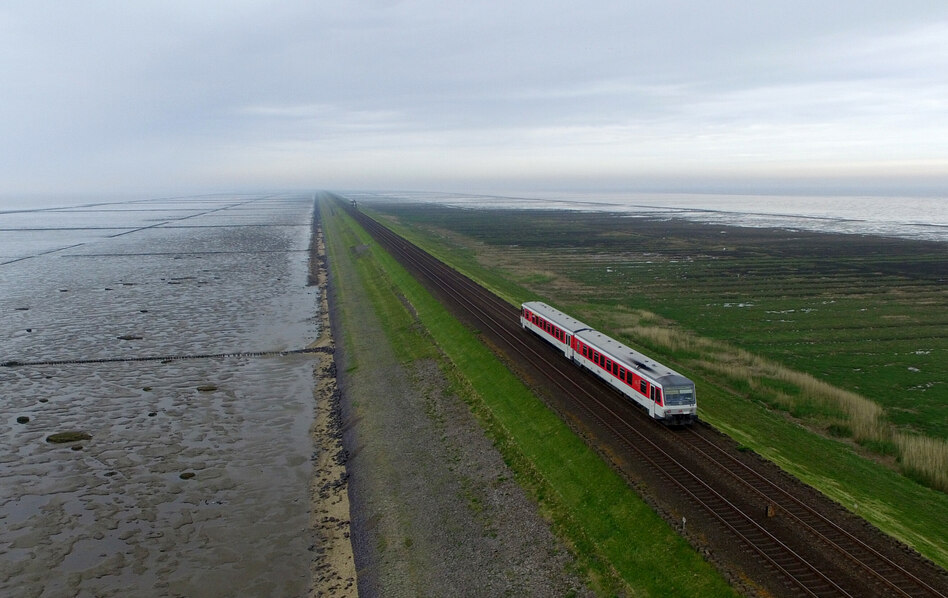
At the meeting of the state transport ministers, which is taking place this week in Hohenschwangau in Bavaria, there is also a request from Schleswig-Holstein: Claus Ruhe Madsen (CDU), minister in the black-green state government, is demanding more money from the federal government for regional railways. Because an EU ruling will make their operation significantly more expensive. Without compensation, the government and the opposition alike fear that fewer trains could run than before.
The background is that the railway subsidiary DB InfraGO charges a toll for the use of the tracks, known as the route price. Until now, this was staggered: regional passenger trains paid less than freight or long-distance trains. But in the spring the European Court of Justice stopped this track price brake: it distorted competition.
There was praise from the industry association Die Güterbahnen, which includes railway companies and companies. In order to cap the costs of passenger trains, freight and long-distance trains had to pay more to cover the financial needs of the network operators. “This led to more traffic being shifted to the road,” says a statement from the freight railways. The downside, however, is that in the future the states will have to pay more for passenger trains - even retroactively. According to a report by the Schleswig-Holstein newspaper publisher, it will cost Schleswig-Holstein alone over seven million for 2025 and around 15 million for 2026. The costs for 2027 are still open.
This is bitter for the financially weak country. The black-green government has actually planned to strengthen buses and trains and make them an alternative to cars for more people. In July, Claus Ruhe Madsen's ministry presented a local transport plan that describes the current status positively: locals and holidaymakers will travel almost 2.4 billion kilometers by rail in 2025, “an all-time high”. Around 500,000 of the almost three million Schleswig-Holstein residents have a Germany ticket.
But that should only be the beginning: by 2031, according to the plan, public transport should become more attractive through tighter timetables, longer operating times and new routes. The Ministry of Transport identified “the tense financial situation” as an obstacle on the way to the land of milk and honey.
Public transport is only partially paid for by passengers. The federal, state and local governments pay the sums for maintaining old or building new routes. The State Ministry of Transport cites the “regionalization funds” that the federal government pays for local passenger transport by rail as an important component. For Schleswig-Holstein it's about 400 million euros per year. The states should not only use this money to maintain operations, but also to further expand them. But the “rail toll” is already a considerable cost factor. If it becomes significantly more expensive, fewer passenger trains could end up running instead of more.
There is a threat of “a catastrophe for local transport in Schleswig-Holstein,” said Christopher Vogt, chairman of the FDP state parliamentary group in Kiel in the run-up to the transport ministers’ conference. He fears “less supply, higher prices and years of chaos for commuters”. In fact, trips have already been canceled on almost all lines and the offer has been reduced nationwide.
Minister Madsen also sees the problem. He is therefore calling on the new Federal Transport Minister Steffen Bilger (CDU) to put the route costs on a new basis. According to a key issues paper, which was first reported by the German Press Agency, Madsen's proposal would see the federal government pay for investments and certain infrastructure costs in the future instead of passing these sums on to the route prices. The federal government should also cover the additional costs resulting from the court ruling.
The Alliance for Rail interest group also criticizes the fact that rail is worse off than cars and planes due to route prices. Their demand: “We believe that halving the route prices is unavoidable.”
Note d. Red: The previous version of the text said that there was a short railway line in Rendsburg that trains could use free of charge. This information was incorrect and has been removed from the text. We apologize for the error.